


News & Exhibitions
Latest Factory Updates, Industry Trends & Global Exhibition Information
Scie CNC Selection: Matching Saw Capacity to Daily Panel Cutting Volume
Scie CNC Selection: Matching Saw Capacity to Daily Panel Cutting Volume
Selecting a scie CNC is not simply a matter of choosing the largest machine a budget allows. In panel processing, a saw that looks productive on a quotation can still become a constraint once real order patterns, material handling, nesting complexity, shift changes, and downstream assembly needs are considered. Conversely, an oversized automated saw may tie up capital while operating far below its practical capacity.
The useful starting point is daily cutting demand, but that figure needs to be defined carefully. “Panels per day” is often too vague for a sourcing decision. A shop processing standard cabinet sides from melamine-faced board has a very different workload from one cutting mixed MDF, plywood, compact laminate, and oversized decorative panels. The number of sheets matters; the number of cutting programs, trim cuts, part sizes, stack heights, and material changes matters just as much.
For procurement teams comparing a scie CNC, the goal is to identify a machine whose usable output—not only its published cycle speed—fits current production while leaving realistic room for growth. That requires looking at the complete cutting cell, from panel loading to labeled parts leaving the machine.
Start with the production day, not the machine brochure
Before comparing beam saws, document what actually reaches the cutting department during a normal week. Include board dimensions, thickness range, board weight, finish sensitivity, average batch size, and the percentage of jobs requiring frequent pattern changes. A facility with a predictable run of identical cabinet components can take advantage of high-throughput cutting. A producer handling many small custom orders may gain more from fast program changes, reliable labeling, and low setup friction than from headline feed speed.
A practical capacity estimate begins with the number of full sheets to be processed in each shift. Then adjust that estimate for the losses that quotations commonly overlook: loading and unloading time, operator breaks, program verification, offcut handling, blade changes, cleaning, quality checks, and occasional material defects. A saw cannot cut continuously for an entire scheduled shift, so nominal output should never be treated as guaranteed daily output.
It is also worth separating average demand from peak demand. If production is driven by project deadlines, seasonal furniture orders, or a small number of large contracts, the saw must handle busy periods without creating a queue that delays edge banding, drilling, packing, or assembly. Buying solely around the yearly average can leave the operation dependent on overtime, subcontract cutting, or rushed job sequencing whenever volume rises.
Translate orders into a cutting-load profile
The most useful pre-purchase document is usually a cutting-load profile built from recent production data. It does not need to be complicated. List representative jobs and identify the sheet format, material, thickness, number of cutting patterns, number of parts per sheet, required trim, and expected daily frequency. Include difficult jobs rather than only the easiest, highest-volume work.
This profile reveals whether capacity is limited by saw travel, programming, material movement, or operator attention. For example, a high number of small components can raise handling time even if the cutting cycle itself is short. Wide panels may require different loading arrangements. Thick or dense materials may affect practical stack cutting and blade selection. These factors cannot be understood from a single “cuts per minute” figure.
When suppliers use different definitions for throughput, ask each one to assess the same cutting-load profile. This creates a more meaningful comparison than asking for a general output claim. The supplier should state the assumptions used: panel dimensions, material type, stack height, optimization method, loading arrangement, operator involvement, and working hours per shift.
Capacity is a system question
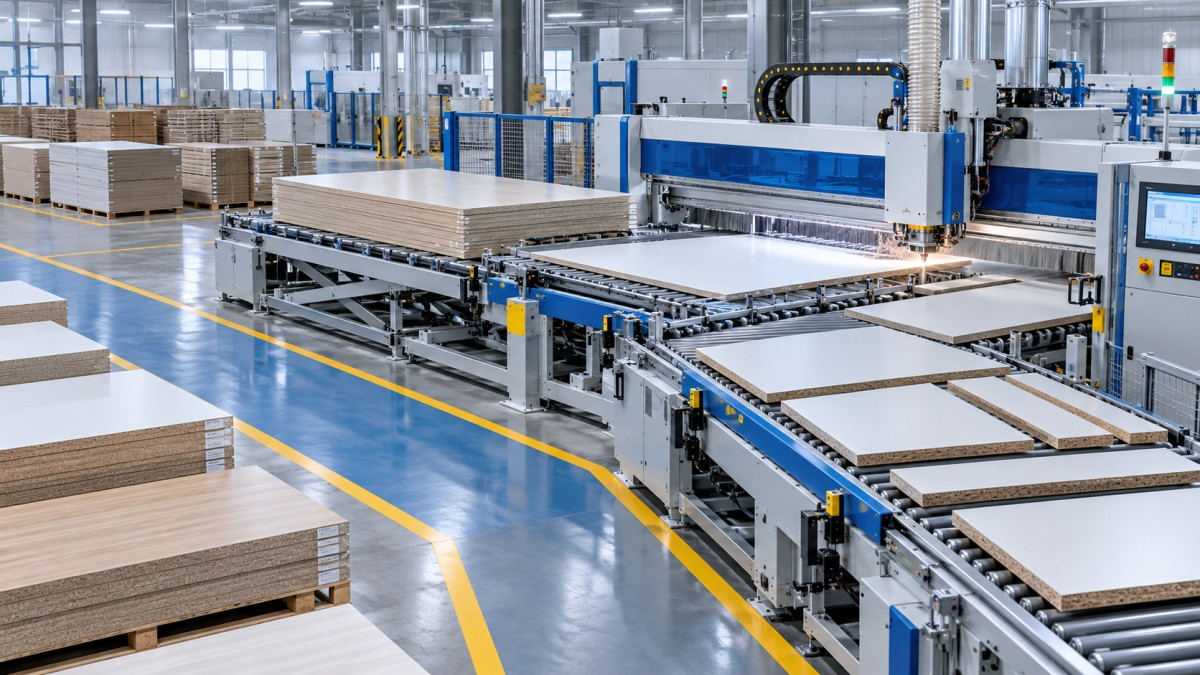
A scie CNC is often evaluated as an individual machine, yet its output is shaped by the equipment and people around it. A rear-loading beam saw may be appropriate where panel storage, loading equipment, and floor layout support continuous material supply. In a compact workshop, a manual or semi-automatic loading arrangement may be more realistic, even if the theoretical cutting rate is lower. The correct choice depends on how much waiting time the surrounding process introduces.
Downstream flow deserves the same attention. If edge banders, CNC drilling centers, or assembly stations cannot absorb the output of a faster saw, the extra capacity may only move work-in-progress from one area to another. In contrast, a saw with precise labeling integration and dependable data transfer can reduce identification errors that otherwise appear later in assembly. For custom furniture operations, that benefit can be more valuable than a modest reduction in the cutting cycle.
Check the parameters that determine real fit
The basic cutting envelope must suit both current boards and expected future panel formats. Confirm maximum cutting length, cutting width, maximum panel height or stack height, and the supported thickness range. Do not assume that a machine designed for a common sheet size will comfortably handle all oversized material purchased by the business. Allowance may be needed for trim, warped-board management, or different loading orientations.
Cut quality deserves a separate discussion. Precision depends on machine construction, calibration, clamping, pressure-beam behavior, saw carriage performance, blade condition, scoring setup where applicable, and the material itself. Procurement documents should distinguish positioning accuracy from finished edge quality. A panel can be dimensionally correct while still showing chip-out or a poor edge on a sensitive melamine finish. Ask how the proposed configuration addresses the actual materials in the cutting-load profile.
The same principle applies to software. Cutting optimization is not merely a convenience feature. It affects yield, cutting sequence, labeling, offcut recovery, and the operator’s ability to manage changing orders. Confirm which file formats or production-management interfaces are required, what is included in the control system, and whether future integration needs can be supported. If existing design or ERP software is involved, compatibility should be verified through technical documentation and a defined test process rather than assumed during commercial discussions.
Automation should remove the right constraint
Automatic loading, unloading, lift tables, labeling, and offcut systems can improve consistency and reduce manual handling, but only when they address the real constraint. A low-volume workshop with varied work may not recover the cost of a complex loading system as quickly as a two- or three-shift operation. On the other hand, a business facing labor shortages, heavy panels, or repetitive high-volume cutting may view automation as a requirement for safe and stable production rather than a luxury.
Floor space and maintenance access are frequently underestimated. A complete saw cell needs room for panel staging, material flow, offcut storage, operator movement, electrical connections, dust extraction, and service access. Request a layout drawing early and compare it against the actual site, including door openings, column locations, and the route used to bring machine components into the building. A technically suitable machine can become expensive to install if site conditions are discovered too late.
Avoid the two common capacity mistakes
The first mistake is underbuying based on today’s quietest period. A saw with little buffer can force production planning around machine limitations. As order mix expands, the operation may lose flexibility precisely when it needs to respond quickly. It is sensible to consider credible growth plans, but not vague aspirations. New product lines, confirmed contracts, additional shifts, or a planned move from manual cutting are stronger planning inputs than a general hope of higher sales.
The second mistake is buying excessive capacity without defining how it will be used. More automation adds controls, installation work, maintenance requirements, and dependency on reliable parts support. If the machine spends much of its time waiting for panels, programs, or downstream stations, the return on that additional complexity can be disappointing. A well-matched mid-capacity configuration often performs better operationally than an advanced system placed in an unprepared workflow.
There is another subtle risk: comparing only purchase price. The cost of a scie CNC includes tooling, installation preparation, extraction connection, training, commissioning, routine service, wear parts, software support, and the consequences of unplanned downtime. These costs vary by site and machine specification, so they should be itemized rather than estimated casually.
Make service part of the technical evaluation
For a production saw, after-sales support is part of capacity. A machine that cannot be restored quickly after a fault has less practical value than its performance specification suggests. During supplier evaluation, clarify the commissioning scope, operator training content, documentation language, remote diagnostic process, recommended critical spare parts, and the route for obtaining replacement components. Requirements for electrical supply, compressed air, extraction, and safety arrangements should also be confirmed against the intended installation location and applicable local requirements.
Qingdao Zhongding Machinery Co., Ltd. has worked in woodworking machinery for more than 20 years, growing from a small workshop into a manufacturer and exporter serving furniture producers, woodworking workshops, and industrial production lines. That history matters less as a marketing statement than as a reminder of what a sourcing conversation should cover: not only machine configuration, but also precision engineering, installation realities, spare-parts planning, technical support, and the long service life expected from production equipment.
A supplier should be prepared to discuss trade-offs openly. For example, a proposed higher-capacity saw may require a different loading plan, stronger production scheduling discipline, or additional downstream equipment. A lower-automation configuration may be a more sensible first step if labor, space, or job variability makes full automation premature. Useful technical support turns those choices into explicit decisions instead of hidden assumptions.
A more reliable way to finalize the selection
Before issuing a purchase order, provide shortlisted suppliers with representative cutting files or a detailed cutting-load profile. Ask for a proposed machine configuration, expected workflow, stated assumptions, layout requirements, and a clear list of included and excluded items. Review whether the proposal accounts for peak-day volume rather than only average volume. Where possible, arrange a demonstration using comparable boards and patterns, with particular attention to edge quality, small-part handling, programming, and cycle interruptions.
The right scie CNC is the one that processes the actual mix of panels at a dependable pace, fits the site, supports the intended production flow, and can be maintained over time. Daily sheet volume is the anchor for the decision, but it should never be the only number in it. When material complexity, handling, automation, service, and future demand are evaluated together, saw capacity becomes a practical production choice rather than a hopeful estimate.
Send Your Inquiry
We welcome your cooperation and we will develop with you.