


News & Exhibitions
Latest Factory Updates, Industry Trends & Global Exhibition Information
What Should a Woodworking Production Line Quote Include for a Factory Expansion?
A factory-expansion quote should allow the total investment, production result, and project boundaries to be assessed before an order is placed. A single line item such as “panel production line” or “automatic furniture line” is too vague to compare. The document needs to show what material enters the line, which operations are included, what leaves the line, and which equipment, labor, utilities, and site conditions are assumed.
For a woodworking production line quote, the most useful starting point is a defined production scenario: panel type, dimensions, thickness range, daily product mix, edge-banding requirements, drilling patterns, surface condition, and expected shift arrangement. Without this basis, two quotes can appear similar while representing very different levels of capability. A line configured for regularly sized melamine-faced particleboard is not automatically suitable for mixed MDF doors, plywood cabinet parts, or frequent small-batch changes.
Define the production scope before comparing prices
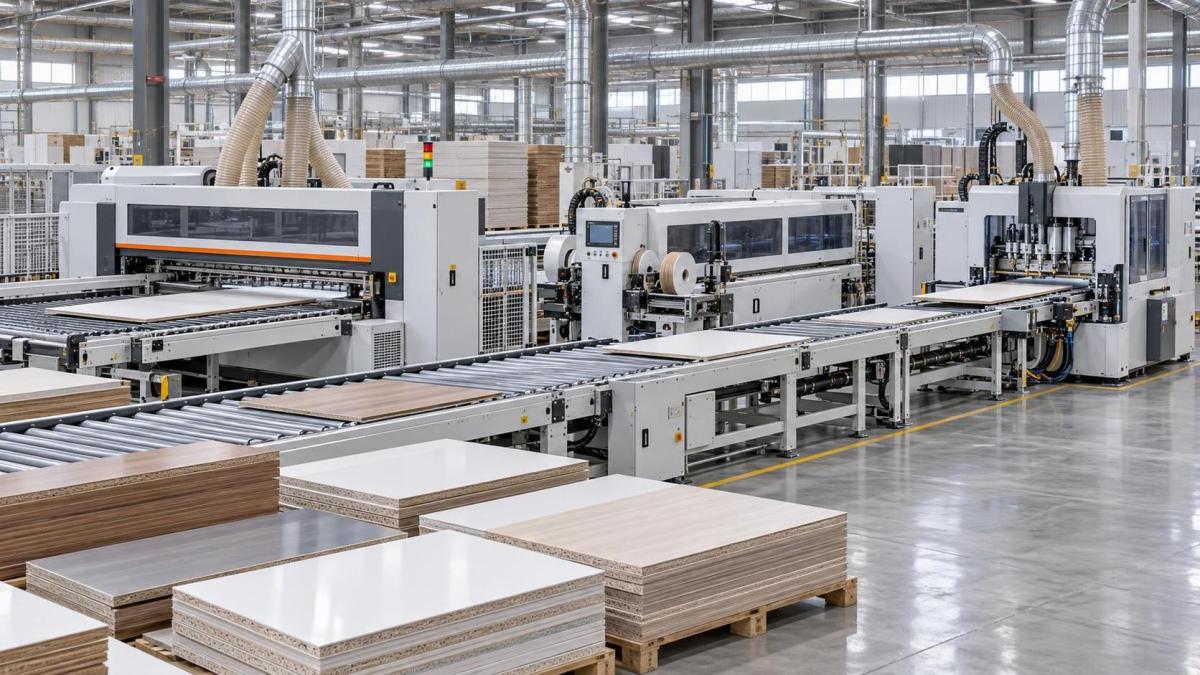
The quote should state the process route in sequence. For panel furniture production, that route may begin with board storage or manual loading, continue through cutting, labeling, edge banding, drilling, sorting, and unloading, then end at a designated buffer or assembly handover point. Each transfer point matters. If loading, return conveyors, part sorting, or outfeed handling are omitted, the quoted machines may still run, but the intended line flow will be incomplete.
A useful scope description identifies both included operations and exclusions. For example, a cutting cell may include an automatic panel saw, rear feed lift, labeling unit, discharge conveyor, and dust connection ports, while excluding raw-board warehouse racking, scrap extraction piping, packaging equipment, and finished-part storage. This distinction prevents a low initial figure from masking equipment that will still be required to operate the line continuously.
Where the expansion connects to existing machinery, the quotation should describe the interface rather than simply state “compatible with current equipment.” Relevant details include conveyor height, direction of travel, part orientation, communication signals, barcode format, workpiece buffer capacity, and whether the existing dust collection system has enough available airflow. A mismatch at one interface can force manual handling between otherwise automated machines.
Machine configurations need measurable detail
Every major machine should be identified by model or configuration code and accompanied by a specification table. General descriptions such as “high-speed CNC nesting machine” or “premium edge bander” do not establish what has actually been priced. The technical description should connect machine capability with the intended workpieces.
Capacity statements deserve the same level of attention. Quoted output should indicate the assumed panel dimensions, part geometry, machining program, edge count, material type, and working time basis. A theoretical cycle time measured on one repeated rectangular part does not describe output for a mixed cabinet order with narrow strips, shelf holes, grooves, and frequent program changes. Capacity should also be separated by process stage, because an edge-banding section or drilling cell may become the limiting point even when the saw has spare capacity.
Tooling should not be hidden inside a generic “standard accessories” line. Cutting tools, drill bits, collets, saw blades, diamond cutters, glue pots, glue rollers, and spare pressure wheels have different replacement cycles and may be essential for commissioning. The quotation should state which are included for initial operation, their quantities, and whether they are intended for chipboard, MDF, plywood, solid wood, or mixed materials.
Automation claims need a clear operating boundary
Automation is often quoted as a broad feature, although its value depends on what it removes from the actual process. A label printer attached to a panel saw, for example, supports identification but does not itself create automatic sorting. A return conveyor on an edge bander reduces carrying distance, yet it may still require an attendant to turn or re-feed parts. The quote should state the equipment sequence and the manual actions remaining at each stage.
For every automated cell, the document should clarify:
- how work orders enter the control system and whether software is included, supplied by another party, or expected to connect with an existing design or production system;
- which material sizes and weights can be loaded automatically, including limits for warped boards, narrow parts, and coated surfaces that require careful handling;
- whether barcode scanning, part tracking, automatic program selection, and error alerts are included as functioning features or only as available interfaces;
- where parts accumulate when a downstream machine stops, and whether buffer capacity is sufficient to avoid stopping the upstream section immediately;
- which changeovers still require manual adjustment, such as glue color changes, edge-tape replacement, tool changes, suction-cup placement, or fixture setup.
This level of detail is especially important when a factory is expanding output while retaining a varied order mix. High automation can be efficient for repeated cabinet components, but a complex flow may add setup time when products change frequently. The right configuration is tied to the stable portion of production, the smallest practical batch, and the level of part traceability needed between cutting and assembly.
Separate equipment price from project cost
The commercial section should make the pricing structure visible. The amount for machines, conveyors, control components, software, accessories, installation work, and optional modules should be distinguishable. A lump-sum quote is harder to evaluate because it does not show whether a lower price results from fewer functions, less site work, a reduced spare-parts package, or a different delivery condition.
Optional items should be priced individually and described precisely. Common examples include automatic loading, unloading stacks, return conveyors, dust extraction connection components, additional tool packages, barcode equipment, remote support hardware, voltage conversion, and extended commissioning time. Options should be tied to a stated effect on the process rather than presented as an unexplained catalogue add-on.
Consumables and operating costs should be addressed where they materially affect the project. For edge banding, this includes the specified glue type and whether the equipment is set up for EVA, PUR, or another adhesive system. A PUR arrangement has different cleaning and handling requirements from a standard EVA setup. Dust extraction demand, compressed-air consumption, connected electrical load, and cooling requirements should also be shown as machine-by-machine data or as a documented line total. These figures allow site infrastructure to be sized before equipment arrives.
Installation scope should describe the site reality
Installation is often where a quotation becomes ambiguous. The document should distinguish between delivery, unloading, positioning, mechanical assembly, electrical connection, pneumatic connection, dust-duct connection, leveling, commissioning, and trial production. “Installation included” has little value unless those activities are defined.
Layout drawings should show the footprint of each machine, service clearances, operator access, maintenance access, control cabinets, material flow direction, and required loading or unloading space. The physical machine dimensions alone are insufficient. A panel saw may fit within a building bay while the feed lift, board staging area, and discharge zone do not. Similarly, an edge-banding return path can conflict with columns, door openings, or forklift travel lanes.
The site requirement section should identify floor condition, foundation needs where applicable, available voltage and frequency, compressed-air quality, dust extraction connection diameter, ducting responsibility, lighting or access requirements for installation, and lifting arrangements for heavy equipment. A line that is designed around one electrical supply or a particular dust-collection layout can require additional engineering if the factory infrastructure differs.
Training and acceptance terms should be stated separately from installation. Training should identify the covered subjects, such as machine operation, program setup, daily cleaning, routine lubrication, tool replacement, fault recognition, and safety-device checks. Acceptance should define the material and sample parts used for testing, the agreed machine functions, and the conditions under which a demonstration is considered complete. A polished sample made from ideal material is not an adequate acceptance basis when the intended production includes multiple board grades or frequent size changes.
Delivery terms change the effective comparison
A quote should specify the commercial delivery term, shipment origin, packaging method, estimated production lead time, partial-shipment treatment, and the party responsible for freight, insurance, import procedures, unloading, and inland transport. Equipment can be competitively priced at the factory gate while transport, insurance, destination handling, and site movement remain unbudgeted.
Packaging details matter for long-distance shipment and sensitive control equipment. The quotation should identify whether machines are packed as complete units, partially dismantled for container loading, or shipped in multiple packages. When a machine is dismantled, the supplier’s assembly scope and the required local lifting equipment should match that shipping arrangement. Electrical cabinets, touch screens, precision guides, and exposed working units require appropriate protection during transit and storage.
Payment milestones should be associated with identifiable project events rather than vague wording. Common milestones may relate to order confirmation, readiness for shipment, shipping documents, installation completion, or acceptance. The useful question is whether the events can be verified and whether the equipment configuration is locked before fabrication begins. Changes after production starts can affect lead time, wiring, tooling selection, and control programming.
After-sales content should be operational, not promotional
The service section should identify the warranty period, what parts or failures are covered, exclusions related to normal wear, the method for reporting faults, and the expected route for technical support. It should also state whether remote diagnosis requires an internet connection at the machine and who is responsible for providing that connection.
A spare-parts proposal is valuable when it separates critical start-up items from routine wear parts. Critical items may include sensors, relays, contactors, pneumatic valves, belts, switches, controllers, and components with longer replacement lead times. Routine items can include blades, cutters, drill bits, pressure wheels, trimming inserts, filters, and glue-related maintenance parts. The final selection should follow the installed configuration; a generic spare list is less useful when the actual machine has different drives, drilling heads, or control components.
Maintenance obligations should be visible because they influence sustained output after expansion. The quote or attached technical documents should indicate daily cleaning points, lubrication intervals, filter maintenance, glue-system cleaning, calibration needs, and requirements for air quality and dust removal. Poor extraction around cutting and edge-banding equipment affects both surface finish and machine cleanliness, while contaminated compressed air can reduce the reliability of pneumatic components.
Use a common comparison basis
When reviewing several woodworking production line quotes, place each offer against the same production scenario and mark every assumption that differs. Compare the included process steps, throughput basis, material range, automation boundary, software scope, tooling, utilities, installation tasks, delivery condition, and service terms. A lower-priced offer may be appropriate when existing equipment already covers omitted tasks. It becomes misleading when the omissions are required to achieve the planned flow.
Before approval, request a final configuration list, layout, utility schedule, exclusion list, and commercial terms that all refer to the same revision. This creates a practical record of the agreed line rather than a collection of brochures, emails, and provisional numbers. For a factory expansion, that clarity is often worth more than a headline equipment price because it exposes the work, cost, and interfaces that determine whether the new line can begin production as intended.
Send Your Inquiry
We welcome your cooperation and we will develop with you.