


News & Exhibitions
Latest Factory Updates, Industry Trends & Global Exhibition Information
Assessing Global Woodworking Machinery After-Sales Support Across Export Markets
After-sales capability should be assessed as part of the machine itself when woodworking equipment will cross borders. A panel saw, edge bander, CNC nesting machine, wide-belt sander, or four-sided planer can meet the quoted specification and still create an expensive production interruption if installation guidance is unclear, a control fault cannot be diagnosed remotely, or a common wear part is unavailable at the required time.
The practical question is whether support remains usable after shipment, customs clearance, site installation, and the first months of production. A credible assessment examines the supplier's response process, technical documentation, spare-parts structure, remote diagnostic method, and ability to deal with the actual electrical, material, and operating conditions at the destination. Global woodworking machinery after sales support is strongest when these elements are connected rather than offered as separate promises.
Start with the probable failure path
Support quality becomes visible when a fault is described from the machine outward. A useful service system should distinguish between a mechanical adjustment issue, an electrical supply problem, a pneumatic fault, a parameter error, a damaged component, and a process condition caused by the workpiece. These categories require different actions. Sending a replacement part for a machine that only needs a feed-speed adjustment wastes time; giving generic operating advice when a drive or encoder has failed leaves production stopped.
During evaluation, ask how a service request is received and routed. The answer should identify the information needed before diagnosis begins: machine model, serial number, controller screen image, alarm code, short video of the fault, material being processed, tool condition, current operating settings, and recent changes to the machine or production line. This is not administrative formality. A spindle overload on a CNC router may result from an unsuitable cutting program, a blunt tool, incorrect tool clamping, insufficient dust extraction, a weak vacuum hold-down condition, or an electrical drive issue. The alarm alone does not establish the cause.
Response time should also be defined carefully. An acknowledgement that a message was received is different from a technically useful response. The relevant measure is the time until a qualified person can narrow the fault, request the right evidence, and state the next action. For complex equipment, a remote session with the controller or a structured troubleshooting sequence is usually more valuable than a fast but vague reply.
Evaluate support against the installed environment
Export machines operate under conditions that may differ significantly from the factory test environment. Voltage, frequency, phase configuration, grounding quality, compressed-air stability, ambient dust, humidity, and available extraction capacity all influence commissioning and reliability. A machine designed around a particular electrical configuration needs a clear conversion or confirmation process before shipment. An unresolved mismatch can appear later as nuisance inverter alarms, unstable servo behavior, overheating, or premature electrical-component failure.
Installation support should therefore cover more than assembly drawings. For a CNC machining center, the installation package needs to address foundation or floor requirements, machine leveling, electrical connection, air preparation, vacuum piping, extraction interfaces, lubrication checks, tool calibration, axis reference procedures, and safety device verification. For an edge bander, the support scope should make clear how to set glue temperature, pressure rollers, trimming units, scraping tools, and workpiece-feed conditions for the selected edge material.
Material differences matter as much as utility conditions. Melamine-faced board, particleboard, MDF, plywood, solid wood, veneered panels, acrylic-edged parts, and moisture-variable lumber do not behave alike. Edge chipping, glue-line defects, burn marks, sanding scratches, and dimensional variation can arise from the material, the cutting tool, the machining parameters, or the equipment adjustment. Support documentation that treats every quality issue as a machine defect is not sufficient for a production setting.
A capable support process ties fault investigation to the application. For example, poor edge adhesion requires attention to board edge preparation, adhesive type, glue-pot condition, temperature, application amount, pressure, panel temperature, and edge tape compatibility. Replacing a roller without checking these relationships may temporarily change the result without correcting the source of the problem.
Documentation is a service tool, not a shipment accessory
Manuals often receive little attention during commercial comparison, yet their quality affects both startup time and future service dependence. The documentation set should correspond to the delivered configuration rather than a generic product family. A manual for a standard machine is less useful when the delivered unit includes a different controller, additional drilling group, automatic loading interface, nonstandard motor, special safety arrangement, or region-specific electrical components.
Assess whether the documentation includes clear electrical and pneumatic schematics, parts identification, lubrication points, maintenance intervals, controller operating instructions, alarm interpretation, adjustment procedures, and consumable specifications. Exploded parts views are especially useful when they connect reference numbers to ordering information. A label such as “bearing assembly” is not enough when multiple assemblies differ by shaft diameter, orientation, sensor position, or revision level.
Translation quality deserves attention because ambiguous instructions create avoidable service calls. Technical language should identify the exact component, action, direction, and safety condition. “Adjust properly” provides no reliable basis for restoring a cutterhead, pressure beam, chain track, or sensor bracket. A good instruction states what is being adjusted, which reference surface is used, what condition confirms correct adjustment, and whether power isolation is required first.
Spare-parts readiness must match machine criticality
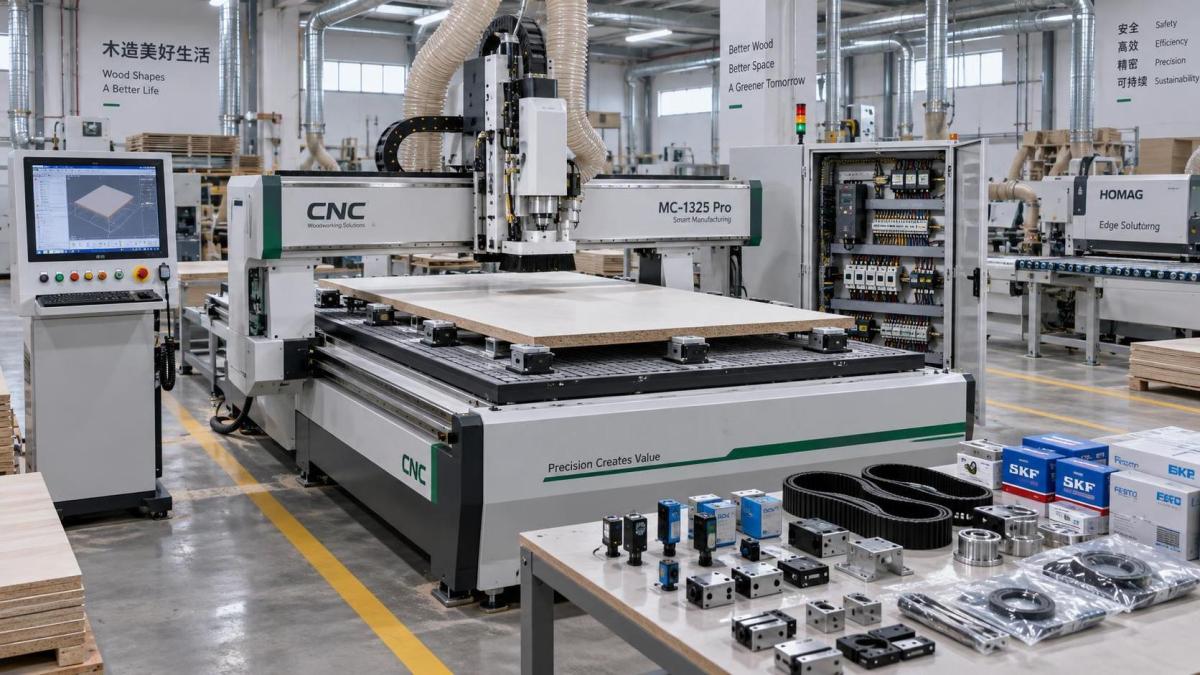
A spare-parts promise has little meaning without a parts strategy. The useful distinction is between consumables, predictable wear items, failure-critical components, and long-lead assemblies. Saw blades, router bits, sanding belts, scraper knives, lubricants, filters, and some pressure rollers are normally planned operating items. Sensors, contactors, solenoid valves, fuses, pneumatic fittings, belts, chains, bearings, limit switches, and certain drive accessories may be relatively small parts with a large effect on downtime. Major spindles, servo drives, gearboxes, vacuum pumps, control modules, and specialized electronic boards require a different planning approach.
The appropriate initial spare package depends on machine type, production intensity, technical complexity, and delivery lead time to the installation site. A simple manual or semi-automatic machine may need only a focused set of wear parts and basic electrical items. An automated line with servo axes, barcode scanning, material handling, and linked control systems creates more potential interruption points. Keeping every possible component on site is rarely sensible, but keeping no critical items can turn a minor fault into a prolonged stoppage.
Part identification needs particular scrutiny where machines have been upgraded over time. A photo of a failed component can be misleading if similar components have different voltage ratings, communication protocols, mounting patterns, or firmware requirements. The serial number, electrical drawing, component label, and machine configuration record should be used together before a replacement is released.
Remote support has limits that should be recognized early
Video calls, messaging, controller screenshots, and remote access can resolve many problems quickly. They are effective for parameter review, alarm interpretation, sensor status checks, axis homing procedures, software settings, lubrication verification, and guided adjustments. Remote diagnostics also work well when the machine has a stable network connection and the local site can safely provide requested observations.
However, remote support cannot physically measure spindle runout, rebuild a damaged glue unit, align a long conveyor, replace a failed gearbox, or determine whether a machine frame shifted during transport without adequate site evidence. An assessment should ask how field intervention is handled when remote diagnosis reaches its limit. Relevant points include the availability of local technical resources, the escalation route for complex faults, the preparation required before a visit, and responsibility for travel, tools, lifting equipment, and replacement parts.
Remote access should be governed by a clear procedure. The machine controller may contain production programs, workpiece dimensions, and operating settings that should not be changed casually. There should be agreement on who authorizes access, how changes are recorded, whether the machine must be stopped during intervention, and how original parameters are retained. A support action that restores operation but leaves no trace of altered settings can create a difficult quality problem later.
Commissioning reveals the real service standard
Pre-shipment testing demonstrates that the machine operated before packing. It does not prove that it will perform correctly after installation in a different facility. Commissioning should confirm the delivered configuration, electrical and pneumatic readiness, safety functions, lubrication, motion direction, calibration, tooling setup, and product output. The acceptance process should use representative workpieces where possible, especially when surface finish, drilling accuracy, edge quality, or repeated positioning are important.
Acceptance criteria should be practical and tied to the intended process. On a panel saw, that may include cut quality, squareness, repeatability of fence positioning, and stability of the panel-handling system. On a CNC nesting machine, it may include reference-point consistency, tool-change reliability, vacuum holding performance, machining accuracy on representative board material, and clean extraction around the cutting zone. On a sanding machine, the relevant observation may be surface uniformity across panel width rather than simply whether the sanding belt rotates.
Problems discovered at commissioning should be documented with evidence and separated into shipping damage, installation deficiency, configuration error, manufacturing defect, and process adjustment. Combining these categories into one complaint delays resolution because each has a different corrective path. A dented enclosure, an incorrectly connected motor, a missing software parameter, and tear-out caused by an unsuitable cutter are not equivalent service events.
Compare service commitments in operational terms
Commercial wording such as “lifetime support” or “fast response” should be converted into operational questions. Is support available through a defined channel? Are machine records retained by serial number? Can technical personnel communicate clearly in the working language used for installation and troubleshooting? Are service requests handled during the relevant working hours, and is there an escalation path when production is halted? Does the supplier provide revised drawings or parameter records after configuration changes?
- A support contact that can identify the delivered machine configuration is more useful than a general sales contact forwarding messages.
- Written guidance for routine maintenance reduces dependence on emergency communication and makes recurring symptoms easier to recognize.
- For automated equipment, clarify whether the service scope covers interfaces with loaders, unloaders, extraction equipment, barcode systems, and upstream production controls, or only the core machine.
- Shipping arrangements for parts should be discussed in terms of packaging, customs documents, and traceable identification, because an urgently dispatched component still cannot restore production if it is delayed by incomplete paperwork.
The strongest comparison is built around realistic interruption scenarios rather than broad service statements. Consider a failed proximity sensor during a production shift, unstable vacuum on a nesting table, a controller alarm after a power event, poor glue adhesion on a newly introduced board, or a damaged spindle discovered after extended use. For each scenario, the credible support path should show what evidence is needed, who diagnoses the issue, which parts may be involved, what can be done at the site, and what happens if the first remedy does not work.
Long-term value is easier to judge when after-sales support is treated as an operating system with records, technical logic, parts discipline, and escalation routes. That approach exposes whether support is prepared for the conditions under which woodworking machinery actually earns its return: repeated production, changing materials, limited downtime tolerance, and equipment that must continue performing long after the shipment has arrived.
Send Your Inquiry
We welcome your cooperation and we will develop with you.