


News & Exhibitions
Latest Factory Updates, Industry Trends & Global Exhibition Information
What Overseas Woodworking Machine Support Should a Factory Confirm Before Purchase?
Imported woodworking equipment can offer a factory useful capabilities, but the purchase decision should not end with spindle power, feed speed, or unit price. A machine that arrives without a workable installation path, accessible technical support, and timely parts can become expensive long before its expected service life is reached. For procurement teams, the practical question is whether overseas woodworking machine support will keep the equipment productive when local conditions differ from the supplier's showroom or factory test setup.
Support deserves the same level of scrutiny as machine configuration because it affects commissioning time, operator confidence, maintenance cost, and exposure to unplanned downtime. A low purchase price can lose its advantage quickly when an electrical issue stops a panel line, a damaged sensor cannot be identified remotely, or a common wear part requires a long international shipment.
Before issuing a purchase order, factories should confirm four things in concrete terms: how the machine will be commissioned, who can diagnose faults, which parts can be obtained quickly, and what support remains available after the warranty period. General statements such as "online service available" or "spare parts supplied" are not enough. The factory needs to understand the actual process, responsibilities, response path, and cost boundaries.
Start with the production risk, not the support brochure
The required support level depends heavily on where the machine sits in production. A standalone edge bander used for lower-volume custom furniture has a different risk profile from a CNC nesting cell feeding a continuous cabinet line. If the machine is a bottleneck, supports several downstream workstations, or runs multiple shifts, a short interruption may create a larger cost than the difference between two supplier quotations.
Procurement should map the equipment's role before comparing suppliers. Questions worth asking internally include:
- Will the machine replace existing capacity or add backup capacity?
- Can work be redirected to another machine if it stops?
- Which components are most likely to halt production: controls, drives, pneumatic valves, bearings, cutters, sensors, or software?
- Does the factory have technicians who can safely carry out mechanical, electrical, and control-system troubleshooting?
- What is the operational cost of one day of lost output, including delayed deliveries, overtime, and rework?
This exercise prevents a common purchasing mistake: applying the same service expectation to every machine. A basic drill press may be manageable with good documentation and a local electrician. A high-output CNC machining center, automatic sanding line, or panel-processing system often requires a more formal support arrangement because problems can involve multiple linked systems.
The supplier should also understand the factory's operating environment. Electrical supply, compressed air quality, dust extraction, material characteristics, humidity, operator skill, and available lifting equipment all affect installation and reliability. When a supplier asks detailed questions about these conditions, it is usually a positive sign. Those questions show that support is being considered as part of machine deployment rather than as an after-sales promise added after the sale.
Confirm how commissioning will work from delivery to stable output
Remote commissioning has become a practical option for many woodworking machines, especially where equipment is modular and the buyer has capable maintenance staff. It can reduce travel cost and avoid waiting for an overseas engineer. But remote assistance works only when responsibilities are clear and the site is properly prepared. A video call cannot compensate for missing utilities, incorrect foundations, untrained operators, or an unclear electrical interface.
A factory should request a written commissioning sequence before purchase. It does not need to be a lengthy legal document, but it should identify the stages, required site conditions, and the party responsible for each task. The sequence normally includes unpacking inspection, mechanical placement, utility connection, machine leveling, safety checks, parameter verification, trial production, and operator handover.
For each stage, procurement should establish what evidence will be required. For example, will the buyer provide photos of cable routing and pneumatic connections before power-up? Will the supplier review the installation through live video? Who verifies that dust extraction is adequate for the specified application? How will successful commissioning be defined: basic machine movement, acceptable sample quality, or a specified production cycle?
These details matter because many disputes arise from different assumptions about what "installation support" includes. A supplier may consider the machine commissioned once axes move and safety circuits are functional. The buyer may expect production-ready quality on its own board material, edge tape, glue, tools, and work programs. Both expectations can be reasonable, but they should be aligned before shipment.
Language should be considered at this stage as well. Technical support is more effective when alarm messages, electrical drawings, manuals, and training materials are understandable to the people actually operating and maintaining the equipment. Translation does not have to be elaborate, but critical safety instructions, fault codes, wiring identifiers, lubrication points, and adjustment procedures should be usable on the factory floor.
Ask what happens when the machine stops
The quality of overseas woodworking machine support becomes most visible during a fault, not during a sales discussion. Procurement teams should ask suppliers to describe their normal diagnostic workflow rather than merely asking whether they provide after-sales service.
A credible workflow usually begins with structured information gathering: alarm code, machine serial number, photos or video, control-screen captures, and a description of the operating condition when the fault occurred. The supplier should then be able to guide the site's technician through safe checks in a logical order. For machines with connected controls, remote access may speed diagnosis, but the buyer should understand what remote connection is required, who authorizes access, and whether the factory's IT rules allow it.
Response time should be discussed in operational language. A promise to "reply quickly" leaves too much room for interpretation. Procurement can ask which communication channels are monitored, during which time windows, whether emergency faults are handled differently from general adjustment questions, and how issues are escalated if first-line support does not resolve them. Time-zone differences are manageable when the support model accounts for them; they are disruptive when the only available contact responds after a full production shift has been lost.
It is also useful to separate machine faults from process issues. A poor machining finish may be caused by a dull tool, unsuitable feed setting, unstable workholding, board defects, or an actual spindle problem. Edge-banding defects may involve adhesive temperature, roller pressure, panel condition, trimming setup, or electrical control. Suppliers that can help the factory distinguish these categories reduce unnecessary part replacement and avoid long exchanges based on incomplete diagnosis.
On-site service should not be treated as an automatic entitlement unless it is explicitly included. International travel, visa timing, local access conditions, and technician availability can all affect attendance. The purchase contract or service agreement should state whether on-site support is included during commissioning, available at additional cost, or handled through a local partner. It should also state who pays travel, accommodation, labor, and any required local safety induction.
Spare parts planning is a cost-control decision
Parts availability is often discussed too late, after the machine has already stopped. For imported equipment, the important question is not simply whether the supplier has parts in stock. It is whether the factory can obtain the right part within a timeframe that matches its production risk.
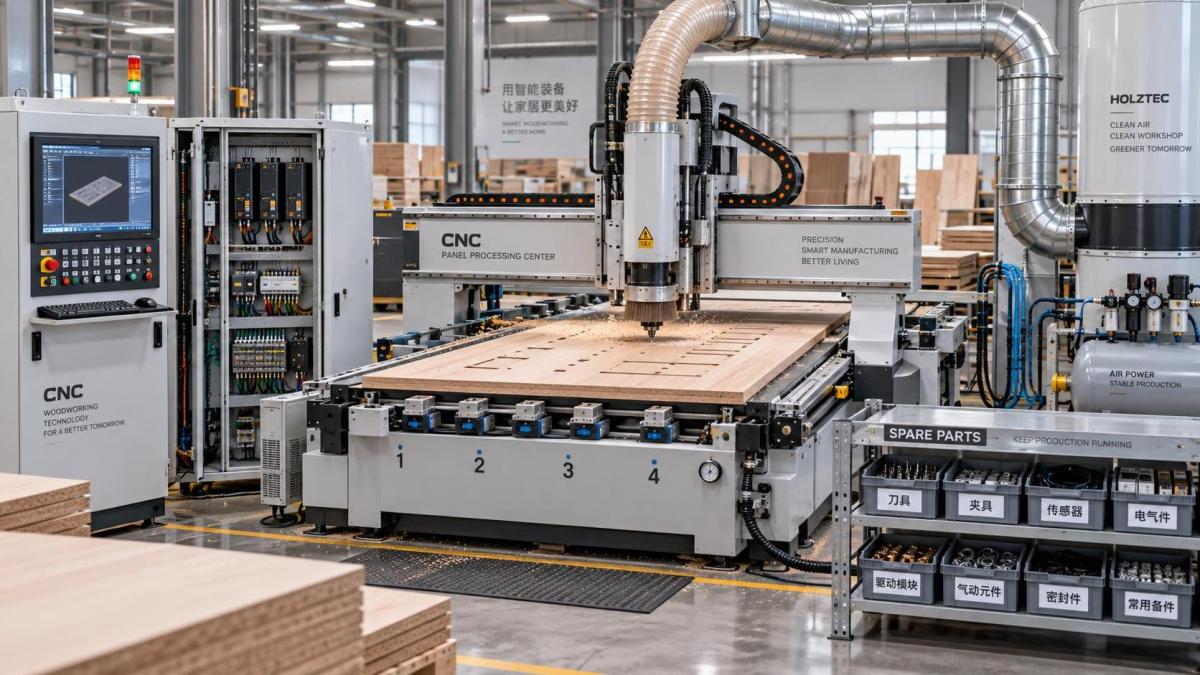
Ask for a recommended start-up spare-parts list that is specific to the purchased configuration. This should distinguish between consumables, normal wear items, critical electrical components, and parts that are unlikely to fail but would cause long downtime if they did. A generic parts catalog is less useful than a machine-specific list with part numbers, descriptions, quantities, and replacement guidance.
The right stock level varies. Keeping every possible component on site ties up cash and can create inventory problems, especially for electronics that may be updated over time. Keeping nothing on site creates dependence on international logistics. A balanced approach is to hold relatively low-cost, high-impact items locally while agreeing on supply arrangements for expensive or specialized assemblies.
For many woodworking machines, the factory may consider stocking items such as sensors, switches, relays, pneumatic fittings, belts, fuses, selected valves, contactors, and common bearings when they are configuration-specific or difficult to source locally. Tooling, saw blades, cutters, abrasive belts, and adhesive-related consumables should be reviewed separately because their consumption depends on material mix, shift pattern, and quality requirements.
Control components deserve special attention. If the machine uses proprietary software, a specific motion controller, servo drive, touch screen, or inverter, procurement should establish the exact model references and whether equivalents can be sourced locally. It is risky to assume that an electrical component with a similar rating is a drop-in replacement. Compatibility may depend on firmware, parameter settings, connectors, communication protocols, and safety circuits.
The buyer should also ask how parts are identified. Clear labels, exploded drawings, electrical schematics, and a parts manual reduce the time spent describing a failed component across languages and time zones. Serial-number control matters when a product family has multiple revisions. The machine delivered to the factory may not match an image used in an older manual or quotation.
Training should match the people who will use the machine
Operator training and maintenance training are often combined into one vague commitment, yet they serve different purposes. Operators need to run the machine safely, select appropriate settings, recognize abnormal conditions, complete routine checks, and know when to stop. Maintenance personnel need a deeper understanding of lubrication, alignment, calibration, electrical safety, fault isolation, and part replacement.
A brief handover may be sufficient for a simple machine, but automated equipment benefits from role-based training. The factory should identify in advance who will attend: shift operators, line leaders, maintenance technicians, process engineers, and supervisors. Training should cover the actual product range where possible. A CNC program demonstration on sample panels is useful, but it does not fully prepare an operator to manage changes in panel size, material density, tool condition, or workholding requirements.
Procurement should request a training scope that covers at least the following areas:
- Safe start-up, shutdown, guarding, and emergency-stop procedures.
- Daily cleaning, lubrication, inspection, and basic adjustment tasks.
- Correct use of alarms and the information needed when requesting support.
- Normal quality checks for the machine's process, such as drilling accuracy, machining finish, sanding consistency, or edge quality.
- Routine recovery steps after tool changes, material changes, power interruptions, or planned maintenance.
Documentation is part of training, not a separate administrative item. A factory that receives only a high-level manual may remain dependent on the supplier for routine matters. Practical documents should help technicians locate components, interpret alarms, maintain lubrication intervals, back up relevant settings, and restore standard operating parameters after authorized service work.
Read warranty terms as an operating document
Warranty language can look comprehensive while leaving important gaps. Procurement should examine what is covered, when coverage begins, how claims are evaluated, and who bears the cost of labor and transport. A parts warranty does not necessarily cover diagnosis time, field labor, air freight, customs charges, or damage caused by incorrect installation.
It is particularly important to clarify the boundary between manufacturing defects and operating conditions. Woodworking machinery is sensitive to issues such as unstable voltage, insufficient compressed air, poor dust extraction, inappropriate tooling, contaminated glue systems, inadequate cleaning, and untrained operation. The supplier may reasonably exclude failures linked to these conditions, but the factory needs to know those requirements before installation, not after a claim is rejected.
Ask whether replacement parts are shipped before or after the returned component is inspected, whether photographs or test records are required, and whether software support is included. For CNC and automated machines, parameter files, program backups, license management, and software updates can become as important as physical parts. The factory should maintain its own controlled backups after commissioning rather than relying on a supplier to reconstruct settings later.
Build support requirements into supplier comparison
Support should be scored alongside technical specification, delivery terms, and price. A useful comparison does not reward the supplier with the longest service statement. It measures whether the proposed arrangement fits the factory's internal capability and production exposure.
For example, a supplier offering remote commissioning may be a strong option when the buyer has experienced electrical and mechanical technicians, reliable connectivity, and time to prepare the site carefully. A factory without that capability may place greater value on local installation resources, more detailed training, or a nearby service partner. Neither approach is inherently better. The relevant question is whether the support model closes the gaps at the buyer's site.
Before final approval, procurement can ask the selected supplier to provide a consolidated support package: commissioning responsibilities, utility requirements, training scope, contact methods, recommended initial spares, manuals, warranty conditions, and paid-service terms after warranty. Reviewing these documents together exposes contradictions that separate sales, engineering, and service conversations may miss.
The machine price is paid once. The consequences of weak support appear repeatedly through delayed start-up, avoidable downtime, emergency freight, and maintenance work that takes longer than it should. A factory that confirms the support path before purchase is in a stronger position to protect output, budget operating costs realistically, and keep imported woodworking equipment productive over the long term.
Send Your Inquiry
We welcome your cooperation and we will develop with you.