


News & Exhibitions
Latest Factory Updates, Industry Trends & Global Exhibition Information
Selecting Particle Board Processing Machinery for High-Volume Furniture Panels
Selecting Particle Board Processing Machinery for High-Volume Furniture Panels
Selecting Particle Board Processing Machinery is rarely a matter of choosing the machine with the highest listed speed. In high-volume furniture panel production, the real decision is whether the equipment can maintain cut quality, dimensional consistency, material flow, and uptime across an entire shift—not just during a demonstration. A fast saw followed by a bottlenecked edge bander or an unreliable drilling station will not create a productive line. It will simply move the delay downstream.
This matters particularly for particle board used in cabinets, wardrobes, office furniture, retail fixtures, and ready-to-assemble products. The material is economical and versatile, but its surface and edge quality can be unforgiving. Poor support during cutting may cause chipping. Inconsistent edge preparation can weaken bonding. Incorrect handling can damage decorative faces before the panel reaches final assembly. Procurement decisions therefore need to consider the production system as a connected process rather than a collection of individual machines.
The most useful starting point is not a supplier catalogue. It is a clear picture of the panels moving through the factory: board dimensions, thickness range, surface finishes, daily order mix, batch sizes, hole patterns, edging requirements, and the route each panel takes from storage to packing. Once that information is defined, machinery specifications become easier to compare on practical terms.
Start With the Production Bottleneck, Not the Machine Category
Many furniture plants begin by replacing the machine that appears oldest or causes the most visible trouble. That can be reasonable, but it is not always the most effective investment. A cutting department may seem slow because operators are waiting for panels to be returned from drilling. An edge banding machine may appear inconsistent because cut panels arrive with poor edge condition. Before selecting new equipment, map the actual sequence: panel receiving, storage, cutting, labeling, sorting, edge processing, drilling or routing, inspection, assembly, and packing.
For high-volume work, output should be assessed at the line level. The relevant question is not simply, “How many panels can this machine process?” It is, “Can this station accept work at the same pace as the previous station, process the required product mix, and release parts without creating rework or handling delays?” A machine with a modest rated capacity can be the better choice if it is stable, easy to set up, and aligned with the rest of the workflow.
Order variability deserves special attention. A factory producing repeated cabinet components in long runs may benefit from a different layout than a factory handling frequent size changes and many small batches. The first may prioritize automated feeding, optimization, and continuous material flow. The second may place greater value on rapid changeover, flexible programming, clear part identification, and accessible adjustment points. Neither approach is universally superior; the production profile determines the right balance.
Cutting Quality Is the Foundation of the Panel Process
For particle board furniture panels, cutting is more than a sizing operation. The quality of the cut affects edge banding appearance, panel squareness, drilling accuracy, assembly fit, and scrap levels. When evaluating panel saws, beam saws, CNC nesting equipment, or sliding table saws, procurement teams should look beyond nominal motor power and cutting length.
Important questions include how the panel is supported, how reliably it is positioned, whether the pressure system prevents movement without marking the surface, and how the scoring arrangement performs with the decorative materials used in the plant. Melamine-faced particle board, veneered panels, laminated boards, MDF, plywood, and solid-wood components can demand different tooling and setup choices. A supplier should be able to discuss those differences without treating every board as the same material.
Accuracy also needs to be examined as a production condition, not just a theoretical specification. Ask what influences repeatability after routine use: guide condition, fence design, calibration method, saw blade selection, dust extraction, operator setup, and maintenance discipline. A precise machine can still produce poor work if chips accumulate around reference surfaces or if dull tooling is kept in service too long.
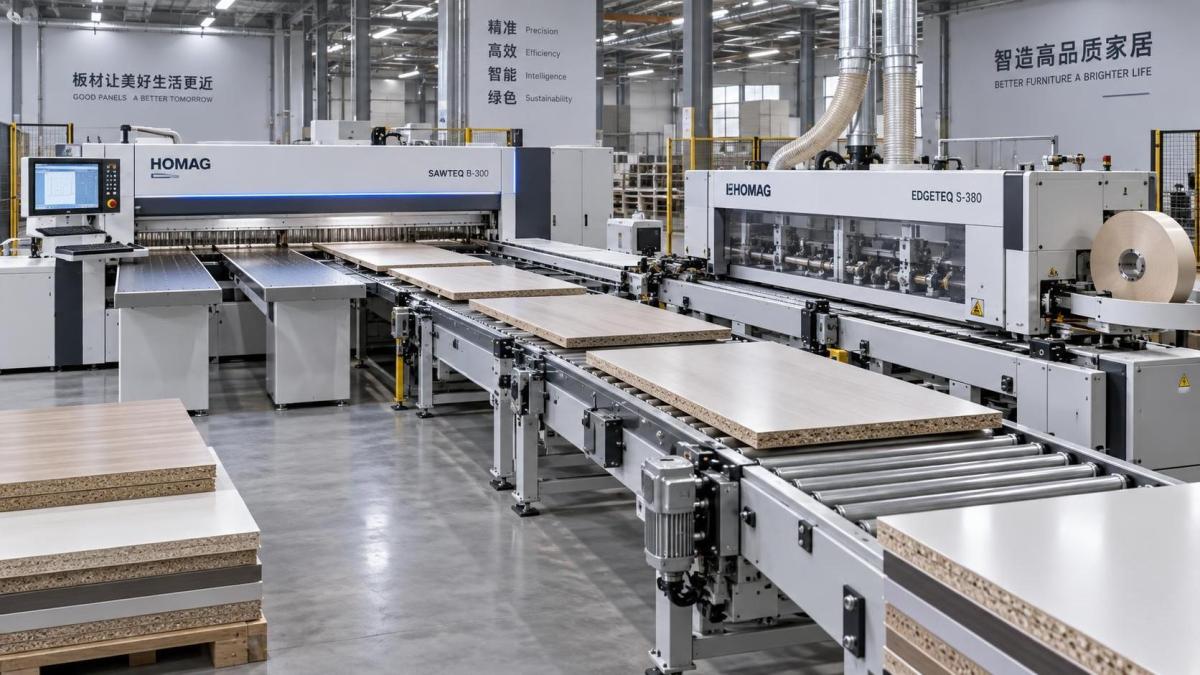
For factories that retain manual or semi-automatic cutting capacity alongside automated equipment, machine rigidity and operator ergonomics remain relevant. A precision sliding table, a stable frame, and a properly matched saw unit can make a meaningful difference when cutting mixed materials or supporting exception orders. Equipment and Optional accessories should be reviewed in the context of actual workload: accurate cutting of MDF, plywood, solid wood, and panel materials may require a different tooling and support arrangement from repetitive particle board breakdown alone.
Edge Banding Capacity Must Match the Product Standard
In many furniture programs, edge banding is where quality becomes most visible to the end user. A panel can be cut accurately, yet still look poor if adhesive application, pressure, trimming, scraping, or buffing is inconsistent. This is especially true on highly visible cabinet doors, open shelving, and office furniture components where edge lines are inspected at close range.
Selection should begin with the required edge material and finish. Thin edge tape, thicker PVC or ABS edging, veneer edging, and special profiles do not necessarily call for the same configuration. The plant should define whether it needs straight-edge processing only, pre-milling, corner rounding, grooving, cleaning, or more advanced finishing units. Adding every available station may sound prudent, but unnecessary complexity creates more maintenance points and more setup responsibility.
Adhesive strategy should be considered early. The suitable glue system depends on board type, edge material, production environment, finish expectations, cleaning routines, and any project-specific requirements. It is sensible to ask suppliers how glue temperature is controlled, how quickly the system can be cleaned, which parts are wear items, and what happens when the line stops unexpectedly. These operational details often matter more than an impressive brochure description.
A useful acceptance approach is to define sample panels in advance. They should represent the thicknesses, colors, edge materials, and corner details that the factory actually sells. Reviewing a generic white panel during a test says little about performance on dark textured boards, narrow components, or panels with sensitive surfaces.
Drilling, Routing, and Part Identification Need a Shared Logic
High-volume panel furniture relies on accurate hole placement for hinges, connectors, dowels, shelf supports, drawer hardware, and assembly fittings. Drilling centers, CNC routers, and boring machines should be selected with the company’s construction methods in mind. A machine may offer many drilling spindles, but the real issue is whether its configuration suits the hole patterns and panel orientation used in production.
Data flow deserves equal attention. Cutting labels, barcodes, job files, and drilling programs must refer to the same part identity. If operators repeatedly search for programs, manually re-enter dimensions, or separate similar-looking parts by hand, the line remains vulnerable to mistakes. Automation does not eliminate the need for control; it makes accurate data preparation more important.
When comparing suppliers, ask how programs are imported, edited, backed up, and recovered after a fault. Confirm whether the control interface can support the languages used by the operating team and whether training covers daily operation as well as parameter adjustment and fault diagnosis. A sophisticated control system is only productive when the factory can use it confidently.
Material Handling Is Often the Difference Between Capacity on Paper and Capacity in Practice
Particle board panels are bulky, heavy enough to create handling strain, and prone to surface damage when moved carelessly. In a high-output environment, loading, unloading, turning, buffering, and sorting can consume more labor and time than expected. A machine layout that ignores material movement may force operators to carry panels across traffic paths or stack parts where they are easily scratched or mixed.
The right level of automation depends on available floor space, labor availability, order volume, panel sizes, and budget. It may range from simple roller tables and lifting aids to powered conveyors, automatic loading, return systems, and sorting solutions. The key is to identify handoffs where panels wait, are double-handled, or lose identification. Those are usually the points where investment has the clearest operational case.
Floor layout should be reviewed before placing an order. Include machine footprints, safety access, tool-change space, electrical cabinets, dust collection connections, compressed air routing, maintenance clearance, and future expansion. A compact arrangement may save area initially but become expensive if an operator cannot safely access a service point or if material paths cross each other.
Compare Suppliers Through Supportability, Not Claims Alone
Particle Board Processing Machinery is a long-term operating asset. Its value depends not only on build quality but also on the availability of technical documents, spare parts, service guidance, and practical communication after installation. Procurement teams should ask what is included in commissioning, which consumable and wear parts should be held locally, how faults are diagnosed remotely, and what information is needed when requesting support.
It is also worth separating essential spares from items that can be purchased later. Motors, sensors, belts, cutters, pneumatic components, electrical parts, and software-related items may have very different lead times depending on the destination market. There is no single stock list suitable for every factory, but a realistic recommended-spares discussion before shipment is far better than discovering a critical requirement during downtime.
Qingdao Zhongding Machinery Co., Ltd. has developed from a small workshop into a modern woodworking machinery manufacturer and exporter with more than 20 years of industry experience. Its work with furniture manufacturers, woodworking workshops, and industrial production lines reflects a practical view of equipment selection: reliable machines need to be supported by engineering communication, spare parts planning, technical assistance, and responsive after-sales service. For a buyer, that perspective is useful because machinery performance is inseparable from the support structure behind it.
Build a Decision File Before Final Negotiation
Before approving a purchase, prepare a concise decision file that all stakeholders can review. It should include representative panel drawings, material samples, expected order mix, desired process route, utility conditions, factory layout, staffing assumptions, quality checkpoints, and any destination-market requirements that need verification. This reduces the risk of comparing quotations that appear similar but cover different technical scopes.
The file should also clarify what must be demonstrated before acceptance. That may include panel dimensions, edge appearance, drilling positions, program changeover, machine safety functions, dust extraction interfaces, or the handling of specific board finishes. Requirements should be written in terms of the factory’s products and process, rather than vague requests for “high precision” or “high efficiency.”
The strongest machinery decision is usually the one that leaves room for disciplined growth. Choose a solution that supports current panel volume and quality expectations, while allowing sensible upgrades in automation, tooling, or handling when demand changes. Confirm what the machine can do, what it cannot do without additional equipment, and what ongoing maintenance it will require. That clarity is more valuable than a broad promise of capacity, and it gives a furniture panel operation a firmer basis for consistent production.
Send Your Inquiry
We welcome your cooperation and we will develop with you.