


News & Exhibitions
Latest Factory Updates, Industry Trends & Global Exhibition Information
Jointer Planer vs. Separate Machines: When Does a Combo Unit Make Sense?
A jointer planer combination machine makes sense when the constraint is not simply budget, but the relationship between available floor space, board flow, batch size, and changeover tolerance. It is often the more rational capital purchase for a compact workshop producing varied work in limited quantities. Separate jointer and thickness planer machines are usually the stronger choice when surfacing is a continuous production operation, when several operators need access to the process, or when stopping to convert a machine creates a measurable bottleneck.
The mistake is to treat the decision as a comparison between “one machine versus two machines.” A combination unit combines two operations that may occur in sequence on the same board, but it does not allow those operations to happen simultaneously. That distinction determines its real production value.
The operational difference behind the same two functions
Both configurations prepare rough lumber for accurate machining. Jointing establishes one flat reference face and a straight, square edge. Thickness planing then brings the opposite face to a controlled thickness while preserving the reference surface created at the jointer. The order matters: a thickness planer cannot reliably correct a bowed or twisted board because it can follow the existing shape rather than remove it.
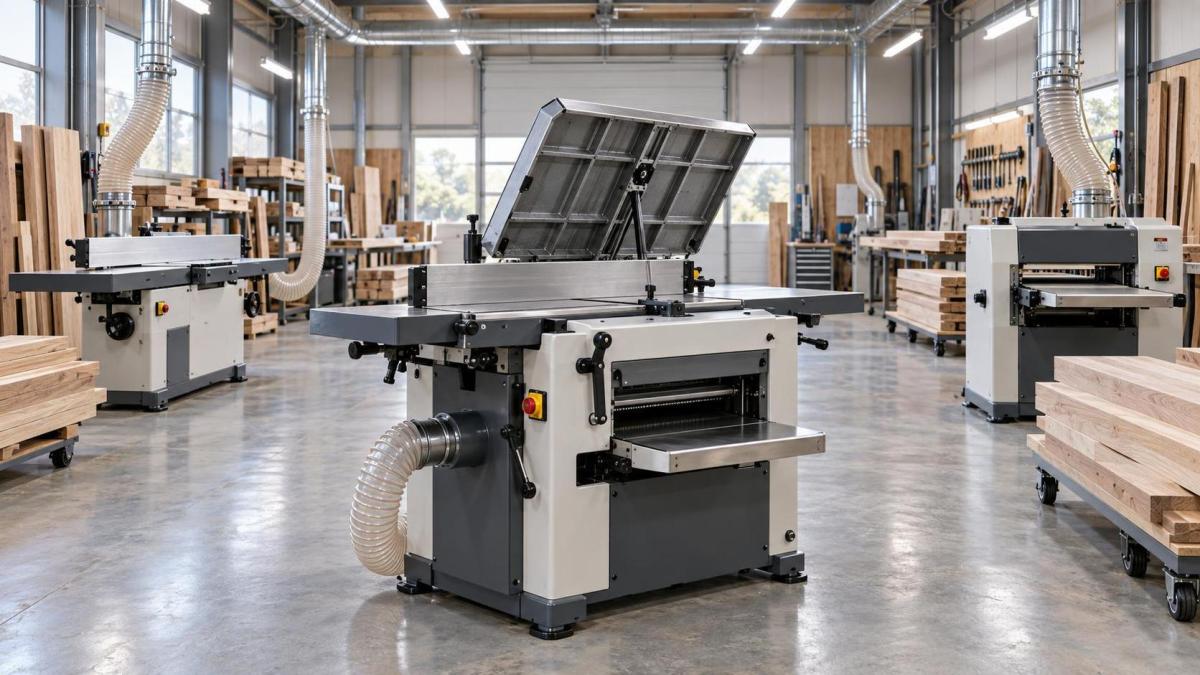
With separate machines, an operator can joint stock on one machine while another operator thickness-planes previously prepared stock on the other. Material moves forward through the cell with little interruption. A jointer planer combo unit performs the same work, but its tables, fence, dust hood, or feed configuration generally need to be repositioned before thickness planing begins. The exact conversion method varies by design. Some machines use lift-up jointer tables; others require sections to be folded or moved. The practical issue is whether conversion interrupts the work flow at an inconvenient point.
This does not make a combo machine inherently slow. If an operator processes a batch of boards through jointing before converting the machine and thickness-planing the entire batch, the lost time can be modest. If work alternates constantly between jointing and planing—such as when making parts to changing dimensions, correcting material during fitting, or handling many small mixed jobs—conversion becomes more disruptive.
Floor space is more than the machine footprint
Space is the most visible reason to select a jointer planer combo, but purchase evaluations often underestimate how much clearance each configuration needs. Long boards require unrestricted infeed and outfeed room. A combination machine may have a compact cabinet footprint yet still need substantial space when jointing tables are opened. The planer feed direction also needs a safe material path. Storage racks, carts, dust ducting, and operator standing space can create restrictions that are not obvious on a supplier’s general layout drawing.
Separate machines demand more permanent floor area, but they can sometimes be placed to create a smoother one-way material flow: rough stock storage, jointer, planer, then cutting or machining. This arrangement reduces handling and limits the chance that surfaced lumber is mixed with unsurfaced stock. In a larger facility, that flow advantage can be worth more than the area saved by a combo unit.
For a constrained workshop, however, a combination unit may make an otherwise impractical surfacing capability possible. The relevant question is not whether two standalone machines fit when measured tightly against walls. It is whether the shop can run either arrangement safely without moving stock, dismantling temporary setups, or blocking another essential process whenever long material is surfaced.
Capacity depends on scheduling, not only feed speed
Catalog comparisons can overemphasize cutterhead speed, feed speed, and maximum width. These specifications matter, but the production difference between configurations is frequently governed by setup behavior. A dedicated jointer and a dedicated thickness planer preserve their settings. Once fences, tables, and planing thickness are established, operators can return to either process without changing machine configuration.
A combo unit rewards batch discipline. For example, rough lumber can be divided by species, thickness, or final part family; all pieces requiring face and edge jointing are processed first; the machine is converted; then the group is thickness-planed. This method works particularly well where material preparation is planned ahead of final machining.
It works less well where material arrives irregularly, where boards must be surfaced as needed for frequent custom adjustments, or where one person must keep multiple downstream machines supplied. In those conditions, the conversion itself is only part of the cost. The larger cost is the interruption to sequencing: a board needing quick correction can delay a current thickness-planing batch, or wait until the next conversion.
Separate machines become easier to justify when surfacing capacity must support more than one operator or more than one downstream process. A jointer can prepare the next batch while the thickness planer processes the previous one. The gain is not merely speed at either station; it is reduced waiting between stations. This is especially relevant for production involving wide panels, solid wood components, door parts, stair components, or other work where consistent prepared stock must be available throughout a shift.
Machine size and cutterhead design should be assessed separately from configuration
“Combo versus separate” should not obscure the fact that machines within either category vary significantly in capability. A buyer comparing configurations should first set the required working envelope: maximum board width, expected board length, minimum finished thickness, and the real condition of incoming timber. A machine sized only for nominal material dimensions may prove restrictive when handling cupped, rough-sawn, or wide stock that requires multiple passes.
Cutterhead selection also affects operating cost, finish quality, and maintenance planning. Straight-knife cutterheads remain common and can be economical, but knife setting and replacement require careful adjustment. Spiral or helical insert cutterheads may offer practical advantages in certain operations, including localized insert replacement and potentially improved results on difficult grain, depending on material and setup. They also change the cost structure: the initial machine price may be higher, while maintenance tasks differ from long-knife systems.
These choices do not automatically favor one configuration. A high-specification combo machine may be more suitable than low-capacity separate machines if its width, table rigidity, cutterhead, and feed system match the work. Conversely, two dedicated machines with inadequate tables or weak dust collection do not create a reliable surfacing cell merely because they are separate.
Conversion quality is a procurement issue, not a minor convenience feature
When considering a jointer planer combination machine, the conversion procedure deserves direct examination. It should be evaluated with the same seriousness as motor power or cutting width. The key questions are practical:
- Can one trained operator change between modes without lifting awkward components or using special tools?
- Does the design preserve fence alignment and table settings after repeated conversion?
- Can the dust hood be moved and secured clearly for each operating mode?
- Are interlocks provided so the machine cannot be operated with tables or guards in an unsafe position?
- How accessible are the cutterhead, feed rollers, drive components, and lubrication points for routine service?
A short demonstration is useful, but the concern is repeatability over normal use. A conversion system that is technically quick but awkward, poorly balanced, or difficult to lock will discourage proper workflow. Operators may then postpone necessary changes, create workarounds, or leave material queued in ways that reduce the expected advantage of owning the machine.
For imported equipment, the request for quotation should specify the intended electrical supply, plug or connection expectations, dust-port dimensions, cutterhead type, and documentation language. A quote that identifies only “jointer planer” and working width leaves too many operational details unresolved. Drawings showing machine dimensions in both configurations, table travel, feed direction, and required clearance are more useful than a single overall machine photograph.
Investment should be measured across the cell, not at purchase order level
A combo unit often reduces the immediate equipment count. That can lower spending on foundations, electrical drops, switches, dust connections, and installation labor. It may also simplify spare-parts management because there is one machine platform rather than two. These are legitimate economic advantages, particularly where space expansion would be costly or unavailable.
Yet lower initial capital is not the same as lower total cost of ownership. If the machine becomes a shared production bottleneck, the cost appears as waiting time, work-in-progress accumulation, additional handling, and difficulty maintaining delivery schedules. A two-machine setup also provides a degree of operational resilience. If one machine needs a bearing replacement, cutterhead service, or electrical repair, the other operation may remain available. With a combination unit, either issue can remove both jointing and thickness planing capacity at once.
Spare parts and service support should therefore be examined in functional terms. Common wear items may include knives or inserts, bearings, belts, feed rollers, switches, contactors, and safety components. Availability matters more than a broad promise of support. Purchase documentation should clarify parts identification, recommended stock items, service intervals, wiring diagrams, and the process for obtaining technical assistance across time zones.
It is also worth separating required capacity from occasional peak demand. Buying separate machines solely to handle rare peaks can be inefficient if overflow can be managed through better production planning or outsourced material preparation. But relying on a compact combo unit for sustained output beyond its practical throughput can create a permanent constraint. The decision should reflect normal operating demand and the consequences of delay, not a single unusually busy order.
Safety, dust extraction, and acceptance criteria need equal attention
Both formats involve exposed rotating cutterheads, high-speed material movement, and significant chip generation. Guarding, emergency stop arrangements, electrical protection, instruction manuals, and safe dust extraction are not optional details. The applicable conformity and workplace requirements depend on the destination market and installation context. For machinery supplied into the European Economic Area, buyers commonly need to assess the relevant machinery conformity obligations, technical documentation, declarations, and marking requirements applicable at the time of placing equipment on the market. Requirements in other destinations should be checked against local rules rather than assumed from a supplier’s general export specification.
Dust collection should be sized around the machine’s stated extraction requirements and the actual duct layout. An undersized extraction system affects visibility, cleanup, cutterhead performance, and operator exposure to wood dust. A combo machine may simplify duct routing, but its extraction arrangement must work correctly in both jointer and planer modes. This is another reason to request details of port locations and hood positions before approving a layout.
Factory acceptance criteria should focus on verifiable items: table flatness and alignment, fence squareness and repeatability, thickness-setting accuracy, feed consistency, cutterhead configuration, vibration, safety functions, and completeness of manuals and electrical documentation. For combination machines, the acceptance process should include several mode conversions, not just a successful test in one configuration.
Where each configuration is the stronger fit
A jointer planer combo unit is a sound choice when available floor area is genuinely limited, surfacing work is intermittent or batch-based, one operator normally controls the operation, and production scheduling can group jointing and thickness planing tasks. It is also appropriate where the alternative is not two well-integrated dedicated machines, but compromising on machine size or omitting in-house surfacing capability altogether.
Separate machines are the better fit where throughput is critical, surfaced stock must be continuously available, work regularly changes between the two operations, multiple operators share the area, or downtime in either process would materially affect production. Their strongest advantage is not that they make better boards by definition; it is that they preserve flow and capacity.
The most defensible purchase decision begins with a material-flow review. Map the board sizes, expected batch pattern, number of operators, required clearance, current bottlenecks, electrical and extraction capacity, and the cost of an interruption in surfacing. Once those conditions are visible, the choice between a jointer planer combination machine and separate machines becomes less a matter of preference and more a question of whether the workshop needs compact flexibility or uninterrupted parallel processing.
Send Your Inquiry
We welcome your cooperation and we will develop with you.