


Melamine Lamination Press Costs: What Drives Energy Use and Payback?
For manufacturers evaluating a Melamine Lamination Press, purchase price is only part of the investment equation. Energy consumption, heating efficiency, automation, output, and maintenance determine long-term cost.
The strongest investment case usually comes from matching press capacity and heating technology to actual production demand, rather than selecting the lowest initial quotation or largest machine.
Business decision-makers should assess total cost of ownership across electricity, labor, material waste, uptime, spare parts, installation, and expected panel throughput over the equipment service life.
A well-specified press can reduce cycle variation, improve surface quality, stabilize delivery schedules, and create a measurable payback path through higher productive capacity and lower operating losses.
Start With Total Cost of Ownership, Not Machine Price
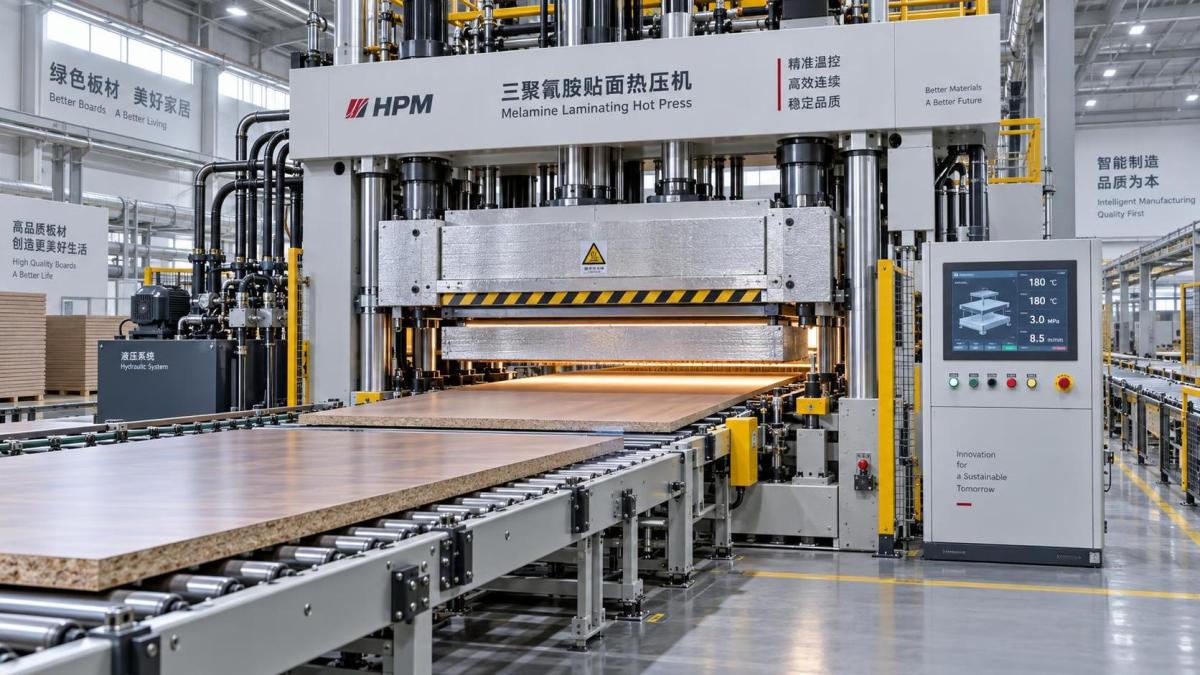
The advertised cost of a Melamine Lamination Press is visible immediately, but its operating profile determines whether the investment supports margins for the next several years.
Capital cost includes the press frame, hydraulic system, heating plates, electrical controls, loading equipment, installation, commissioning, operator training, and required plant infrastructure modifications.
Operating cost includes energy for heating and hydraulics, labor for loading and handling, consumable components, scheduled maintenance, unplanned repairs, rejected boards, and production downtime.
These costs should be compared against expected annual output, contribution margin per finished panel, customer quality requirements, and the commercial value of shorter lead times.
A low-cost machine may appear attractive when volumes are uncertain. However, poor thermal consistency, longer cycles, or frequent manual interventions can erode that advantage quickly.
Conversely, a more capable press can be justified when production is stable, board specifications are demanding, and the manufacturer can keep the machine loaded consistently.
The right question is not simply, “What does the press cost?” It is, “What will each acceptable laminated board cost over its expected useful life?”
That calculation forces buyers to consider output quality and availability alongside energy consumption, making comparisons between equipment proposals more commercially meaningful.
What Actually Drives Energy Use in a Melamine Lamination Press?
Heating is normally the largest energy consumer because press plates must reach and maintain temperatures needed to cure melamine-impregnated decorative paper consistently.
Energy demand depends on plate size, operating temperature, insulation quality, heat source, shift pattern, press opening frequency, and the temperature difference between production runs.
Large platens consume more energy during warm-up because they contain more steel mass. Their value depends on whether available board volumes keep that capacity productive.
Frequent starts and stops are expensive because the press repeatedly replaces heat lost during idle periods. Continuous production generally improves energy efficiency per board.
Electric heating offers precise control and straightforward installation, but local electricity tariffs can materially affect annual cost in energy-intensive production environments.
Thermal oil systems can be advantageous in factories with existing boiler capacity, particularly where several heating processes share a centralized energy source.
Steam heating may suit some industrial sites, but decision-makers should verify temperature stability, condensate management, response time, and the true cost of generated steam.
Hydraulic power consumption also matters, especially in older designs where pumps run continuously. Variable-speed systems can reduce unnecessary electrical draw during non-pressing stages.
Heat losses through poorly insulated plates, piping, manifolds, and press structures create an ongoing burden. Insulation quality deserves inspection during supplier technical evaluations.
Accurate temperature sensors and responsive control loops prevent overheating. Excessive temperature does not guarantee better bonding; it can increase energy use and damage decorative surfaces.
How Heating Efficiency Affects Cycle Time and Panel Quality
Heating efficiency matters because it influences both utility bills and production rhythm. Faster, more uniform heat transfer can shorten cycles without compromising laminate adhesion.
A press must apply sufficient temperature, pressure, and dwell time for the melamine resin to cure correctly across the complete board surface.
If platen temperature varies across the pressing area, operators may compensate by extending cycles. This protects quality but reduces output and raises energy used per panel.
Uniform heating is especially important for wide panels, textured surfaces, high-gloss finishes, and premium furniture components where visual defects create costly rework or rejection.
Decision-makers should ask suppliers for platen temperature uniformity data, measurement methods, calibration practices, and recommended operating conditions for intended board sizes and paper types.
Fast heating alone is not enough. Reliable temperature stability during the pressing cycle is more valuable than a high nominal heating rate that fluctuates under load.
Thermal control should also support recipe-based operation. Different paper grammages, substrate densities, textures, and finishes may need distinct temperature and dwell-time settings.
Repeatable recipes reduce dependence on individual operator judgment. They also make it easier to document process settings when customers require consistent surface and bonding performance.
Improved thermal efficiency can therefore create two forms of return: lower kilowatt-hours per board and more saleable boards produced within each available shift.
Capacity Decisions: Bigger Is Not Always More Profitable
Press capacity should reflect the factory’s realistic order mix, not only peak demand forecasts. Underutilized capacity can become an expensive source of fixed energy and depreciation.
Evaluate platen dimensions against common board formats, trimming allowances, loading arrangements, and planned product expansion. Oversized platens may waste heat when processing smaller panels.
Cycle time must be assessed as a complete sequence, including loading, positioning, press closing, heating, holding, opening, unloading, inspection, and stack handling.
A technically fast pressing cycle delivers limited value if manual loading or downstream handling creates bottlenecks. Production line balance is essential to realizing rated output.
For single-day operations with fluctuating demand, a compact press with quick warm-up may provide stronger economics than a large system designed for continuous industrial output.
For multi-shift panel production, higher capacity and automated material handling can lower labor cost per board while keeping heating systems closer to efficient steady-state operation.
Buyers should calculate annual available machine hours after allowing for maintenance, product changes, warm-up, cleaning, quality checks, and realistic operator breaks.
Then divide expected annual volume by productive hours to determine required boards per hour. This reveals whether a supplier’s nominal capacity actually fits the business case.
A useful comparison measures cost per acceptable square meter, rather than boards per hour alone. This accounts for different panel dimensions, yield, and quality rejection rates.
When Automation Produces a Faster Payback
Automation increases initial investment, but it can improve payback where labor availability is limited, quality variation is costly, or production volume justifies consistent material flow.
Common automation options include automatic loading, board alignment, unloading, conveyor transfer, stacking, recipe selection, pressure control, safety interlocks, and production data collection.
Automatic loading reduces the time between cycles and helps operators position boards consistently. This can raise throughput while reducing damage caused by manual handling.
Alignment systems are valuable when decorative paper placement must be precise. Misalignment may create immediate visual defects and consume expensive substrates, labor, and production time.
Automated controls also improve traceability. Managers can compare cycle times, temperatures, pressure profiles, fault history, and output by shift, product, or operator team.
However, automation should solve a defined constraint. A fully automated line may not pay back in a workshop producing short runs, varied formats, or irregular order volumes.
Decision-makers should identify the current bottleneck before approving automation. It may be loading labor, paper preparation, substrate supply, cooling, trimming, inspection, or packing.
The payback model should include labor redeployment, not only headcount reduction. Automation often creates value by allowing skilled employees to focus on quality control and higher-value tasks.
Reliable safety systems are also commercially important. Reduced injury risk, controlled access, and predictable operating procedures support continuity and reduce exposure to operational disruption.
Maintenance, Uptime, and Spare Parts Can Change the Economics
A Melamine Lamination Press earns value only while it is producing acceptable panels. Maintenance quality therefore has direct influence on payback and customer delivery performance.
Hydraulic seals, hoses, valves, pumps, temperature sensors, electrical contactors, control components, and platen surfaces all require planned inspection and timely replacement.
Small leaks or inaccurate sensors can become expensive. They may increase energy consumption, cause uneven pressure, extend cycles, or create bonding defects before a major failure occurs.
Buyers should request a recommended preventive maintenance schedule, a list of critical spare parts, estimated replacement intervals, and clear instructions for daily operator inspections.
Supplier responsiveness matters when production schedules are tight. Remote technical support, available spare parts, service documentation, and accessible engineers reduce the cost of unexpected stoppages.
It is also important to evaluate component sourcing. Standard, serviceable components can make long-term maintenance more practical in regions far from the machine manufacturer.
Press construction quality affects uptime as well. A rigid frame, stable platens, reliable hydraulic design, and durable electrical cabinet reduce the likelihood of accuracy loss over time.
Ask for references from factories with similar panel sizes, production volumes, and operating conditions. Their experience often reveals maintenance realities beyond a technical specification sheet.
A maintenance budget should be included in the financial model from the beginning. Treating service cost as an exception produces an unrealistically favorable payback calculation.
How to Build a Practical Payback Calculation
A credible payback calculation should use conservative assumptions and compare the proposed press with the factory’s current process, alternative suppliers, or outsourced production arrangement.
Start with annual incremental output. Estimate how many additional acceptable square meters the machine can produce after accounting for actual utilization, downtime, and product changeovers.
Multiply incremental output by contribution margin, not selling price. Contribution margin reflects the revenue remaining after board, paper, resin, packaging, and variable production costs.
Next, calculate annual operating cost. Include electricity or thermal energy, labor, maintenance, consumables, planned spare parts, insurance, and any additional facility overhead.
Then estimate quality-related savings. Better pressure and temperature control may reduce rejected boards, rework, customer claims, and material waste, especially on premium surfaces.
Subtract the new annual operating cost from additional contribution margin and quality savings. The result is the annual net benefit attributable to the investment.
Divide total installed cost by annual net benefit to estimate simple payback. Total installed cost should include freight, duties, foundations, utilities, commissioning, and initial spare parts.
For larger projects, decision-makers should also use discounted cash flow, net present value, and sensitivity analysis. These methods account for financing cost and uncertain assumptions.
Test the model against lower-than-expected utilization, higher energy prices, delayed ramp-up, material cost changes, and a modest increase in maintenance requirements.
If the project remains acceptable under conservative scenarios, the investment is more robust. If returns disappear quickly, capacity or automation specifications may need adjustment.
Questions to Ask Before Selecting a Press Supplier
Supplier selection should combine technical capability, commercial transparency, service capacity, and willingness to validate performance against the buyer’s actual materials and production targets.
Ask what board dimensions, substrate types, decorative papers, temperatures, pressures, and cycle times were used to determine the quoted production capacity.
Request details about heating method, installed power, typical energy consumption, insulation design, platen temperature uniformity, hydraulic configuration, and available energy-saving controls.
Clarify which items are included in the quotation. Controls, loading systems, conveyors, safety equipment, installation assistance, operator training, and spare parts may be priced separately.
Review acceptance criteria before placing an order. These should cover panel quality, temperature performance, pressure stability, cycle repeatability, safety function, and commissioning responsibilities.
Qingdao Zhongding Machinery Co., Ltd. supports woodworking manufacturers with equipment selection, technical guidance, spare parts supply, and responsive after-sales service for long-term production needs.
A supplier should be able to discuss the complete operating context, rather than only machine specifications. The best recommendation reflects output goals, local energy conditions, labor, and workflow.
Conclusion: Pay for Productive Efficiency, Not Just Equipment Capacity
The financial value of a Melamine Lamination Press depends on how efficiently it converts energy, labor, materials, and machine time into saleable laminated panels.
Energy-efficient heating, stable process control, appropriate capacity, well-chosen automation, and dependable maintenance support can materially improve lifetime returns and reduce operational risk.
Business decision-makers should evaluate each proposal using cost per acceptable panel, realistic utilization, conservative payback assumptions, and evidence of reliable long-term service support.
When these factors are considered together, the chosen press becomes more than a capital purchase. It becomes a production asset designed to protect quality, capacity, and profitability.