


News & Exhibitions
Latest Factory Updates, Industry Trends & Global Exhibition Information
How much motor power does a single blade rip saw for hardwood need?
A single blade rip saw for hardwood needs enough continuous main motor power to cut the most demanding timber in your regular production at the required feed speed, with reserve for normal variations in the wood and blade condition. There is no dependable motor rating based on “hardwood” alone. A machine cutting thin furniture stock intermittently faces a different load from one ripping thick, dense boards throughout a shift.
The useful buying question is therefore: What cutting thickness, timber condition, blade specification, and sustained feed speed can this motor support together? A higher kilowatt rating can provide useful capacity, but it does not automatically produce straighter cuts, better surfaces, or higher output. The feed system, spindle, blade, and electrical supply must support the same operating conditions.
Compare the main saw motor, not the total installed power
Before comparing machines, establish what each quoted power figure represents. A specification may list the main saw motor, the feed motor, or total installed power. These figures describe different things. Feed motor power helps move the workpiece through the machine; it does not add directly to the power available at the saw blade.
For the main motor, distinguish rated mechanical output from electrical input. The motor draws more electrical power than it delivers mechanically because of losses. The drive introduces further losses between the motor and spindle. Comparing an input figure from one supplier with a motor output figure from another creates a misleading impression of cutting capacity.
Ask for the main motor’s rated output, speed, duty rating, and supply requirements alongside the machine’s blade speed and transmission arrangement. Where proposals use horsepower and kilowatts, convert them to the same unit and confirm that both describe the same rating basis.
Maximum cutting height is a separate specification. It describes a dimensional limit, but does not establish the feed speed the machine can maintain at that height in a particular hardwood.
Thickness, feed speed, and kerf determine how much wood the blade removes
Motor demand rises as the blade removes more material per unit of time. A useful starting relationship is:
Material removal rate = cutting thickness × blade kerf × feed speed.
This explains why a motor can perform comfortably on one job and struggle on another. Increasing board thickness increases the depth of material passing through the teeth. Increasing feed speed makes the blade remove that material faster. A wider kerf removes more wood along the same cut.
The relationship helps compare jobs, but it is not a complete motor sizing formula. Converting material removal into required cutting power also requires an appropriate cutting energy value for the timber, blade, and operating conditions. That value changes with wood properties, tooth geometry, sharpness, and friction. A generic calculator can suggest a comparison, but it cannot establish a reliable production rating without suitable supporting data.
Board width needs a different interpretation. On a single blade machine making one longitudinal cut, width does not directly increase the volume removed in the way cutting thickness does. Wider or heavier boards can still make feeding and support more demanding, especially when the stock is distorted or poorly supported.
Hardwood species matter, but the species name is not enough
Density and wood structure influence cutting resistance. However, two batches sold under the same species name can behave differently because of moisture condition, grain direction, knots, and internal stress. A selection based only on a species label leaves too much of the operating load undefined.
Describe the material as it reaches the saw. Include whether it is rough or surfaced, its moisture range, thickness variation, and the defects normally accepted into production. Stock containing frequent knots or irregular grain can create changing loads that a short demonstration on clear, straight timber will miss.
Internal stress deserves particular attention. As a board is ripped, the cut may close behind the blade and increase friction or cause binding. More motor power cannot make that condition acceptable. The machine needs suitable guarding, anti-kickback provisions, and a correctly configured splitter or riving arrangement appropriate to its design, together with proper stock handling.
Define both the normal job and the demanding job. If the thickest material appears only occasionally, reducing feed speed may be commercially acceptable. If it makes up most of the schedule, the saw should sustain the required output on that material without depending on frequent slowdowns.
Blade selection can change whether a motor is adequate
A motor assessment is incomplete without the proposed blade specification. Diameter, kerf, tooth count, tooth geometry, and chip space all affect how the blade cuts and clears material. A blade intended for another operation may produce excessive resistance or poor results even when the motor appears large enough.
In ripping, chips need room to leave the cut. Tooth count must suit the stock thickness and feed conditions. Excessively small chip spaces can restrict evacuation, while an unsuitable tooth arrangement can produce rough cutting or unstable engagement. Blade selection should follow the saw and blade manufacturers’ operating limits.
A thinner kerf can reduce material removal and therefore cutting demand under otherwise comparable conditions. That benefit has limits: the blade must retain adequate stability for the machine, cutting depth, and feed rate. Choosing the thinnest available blade solely to accommodate a smaller motor can introduce deflection or accuracy problems.
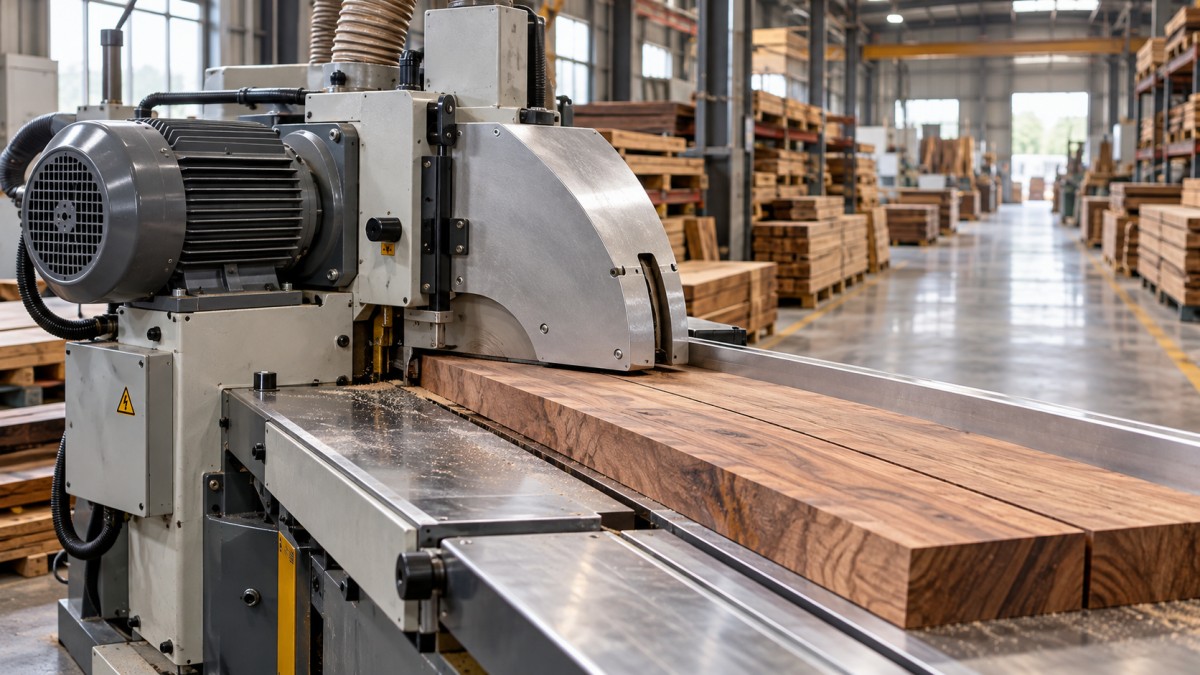
For a meaningful comparison, record the actual blade used in each demonstration. A machine tested with a sharp, narrow kerf blade should not be assumed to deliver the same feed performance with a wider production blade. Blade projection above the stock, alignment, and sharpening condition should also follow the specified setup.
Size for sustained production and normal load variation
The motor must handle both the average cutting load and the variations encountered during ordinary production. Selecting a motor that operates continuously at its limit leaves little tolerance for denser sections, normal edge wear, or changes in stock thickness.
However, applying an arbitrary oversizing percentage is not a substitute for understanding the process. The useful reserve depends on how variable the material is, how long the saw remains loaded, and how closely feed speed can be controlled. Motor overload capability or a service factor, where specified, should not be treated as routine production capacity.
Consider the actual cutting sequence. Widely spaced boards may leave recovery periods between cuts. Closely spaced boards or long workpieces may keep the motor under load almost continuously. A machine that completes an individual demanding cut can still be unsuitable for repeating that cut throughout a shift.
The site supply also matters. Available voltage, phase, frequency, starting method, and circuit capacity must match the proposed equipment. Voltage problems or unsuitable starting arrangements can interfere with operation even when the motor’s nominal output looks adequate.
If a larger motor is proposed, confirm that it is part of a machine configuration designed for that output. Increasing motor size alone does not increase the ratings of the spindle, belts, bearings, feed mechanism, or electrical controls.
Use a representative cutting trial to settle the power question
The strongest purchasing evidence is a trial that reproduces the intended job closely enough to reveal sustained performance. Prepare a cutting specification before requesting the demonstration, so each candidate is assessed against the same requirement.
- Material: species, moisture condition, thickness range, and normal defects.
- Production target: required feed speed, board spacing, and expected cutting duration.
- Blade: diameter, kerf, tooth configuration, and sharpening condition.
- Quality requirement: acceptable straightness, surface condition, and allowance for later machining.
- Recorded performance: motor load, blade speed stability, feed consistency, and overload events.
Run ordinary production material as well as the demanding stock included in the purchasing specification. Repeat cuts long enough to assess stable operation and thermal behavior under the intended duty. A brief pass through a selected board demonstrates only that particular cut.
Interpret motor current carefully. It is useful for observing load changes and comparing operation with the motor’s ratings, but current alone is not a direct measurement of cutting power. Voltage, power factor, motor efficiency, and measurement conditions affect the interpretation. Where actual power is needed, use suitable instrumentation and qualified personnel.
Agree on acceptance criteria before the trial. The machine should maintain the specified feed conditions, produce acceptable cuts, and operate within its continuous ratings. Record any feed reductions needed for the demanding material. That makes the tradeoff between purchase cost and throughput visible.
Recognize when more power will—and will not—help
If a correctly set up saw consistently loses blade speed or reaches its allowable load while cutting the specified stock at the required feed rate, greater main motor capacity may be justified. That conclusion is stronger when blade condition, chip clearance, alignment, and supply conditions have already been addressed.
Other symptoms point elsewhere. Burning can result from rubbing, a dull blade, misalignment, or unsuitable feeding. Wandering cuts may involve blade stability, stock guidance, or internal stress. Irregular movement can originate in the feed system. These problems may coexist with high motor load, but a larger motor does not resolve their cause.
Likewise, additional saw power provides little production benefit if operators cannot load boards fast enough, the feed mechanism cannot maintain traction, or downstream handling already limits output. Assess the complete cutting station before paying for capacity that the process cannot use.
When requesting a proposal from Qingdao Zhongding Machinery Co., Ltd., provide the material and production specification alongside the required cutting dimensions. Its woodworking machinery, technical support, and spare parts services are relevant to evaluating the complete machine and maintaining it after installation. The proposal should connect the selected main motor to defined cutting conditions and a practical acceptance trial.
Choose the motor rating that supports your regular demanding workload at an acceptable sustained feed speed, with allowance for normal process variation. If two machines both meet that requirement, compare their feed control, cut quality, maintainability, and operating cost. Those differences are more useful than additional nameplate power that your production does not require.
Send Your Inquiry
We welcome your cooperation and we will develop with you.