


News & Exhibitions
Latest Factory Updates, Industry Trends & Global Exhibition Information
How many tool slots does an automatic tool changer CNC router need?
An automatic tool changer CNC router needs enough usable tool positions for the jobs you intend to run between planned setup stops, plus a justified allowance for spare tools and confirmed future operations. An 8-position magazine can suit a stable, limited tool set; 12 positions provide more flexibility when several job families share the machine; larger magazines become relevant when varied profiles, specialty tools, or unattended production require more tools to remain loaded.
The practical problem appears when a production schedule moves from standard cabinet panels to routed doors or solid-wood components. A machine may have enough slots for each job separately but not for the combined schedule. Operators then stop to exchange holders, verify tool data, and check the next program. Buying the largest magazine is not automatically the answer: first establish which tools must be available together and whether the advertised capacity is usable with those tools.
Count the tools that must stay loaded, not the tools you own
A workshop’s complete cutter inventory is a poor starting point for magazine sizing. Some cutters are alternatives, some serve rarely ordered products, and others can be changed during an already planned setup. The relevant number is the set of tool assemblies needed across your intended production window.
Define that window before comparing quotations. It might be one batch, a shift containing several product types, or an unattended run. A shop that groups similar work can operate with fewer resident tools than a shop that accepts mixed jobs in arrival order, even when both manufacture similar products.
Build the tool list from actual machining programs or proposed process plans. Record the cutter, holder, operation, material, and whether it must remain loaded. Count complete assemblies rather than cutter names: the same cutter geometry may need separate holders when different projections or setup requirements prevent practical sharing.
- Core tools: assemblies used repeatedly across the planned schedule.
- Job-specific tools: cutters required for particular profiles, joints, materials, or finishing operations.
- Backup tools: duplicates that the control and production process can actually use when a primary tool reaches its defined limit.
- Confirmed additions: tooling for products or operations already included in the investment plan.
Do not assign a slot to every drilling operation automatically. Where a machine has a separate drilling unit, supported drilling operations may not consume magazine positions. Conversely, drilling performed by spindle-mounted tools must be included. Compare the complete machine configuration, not magazine capacity in isolation.
Translate the production plan into a capacity requirement
A useful planning relationship is:
Required usable positions = distinct assemblies needed during the production window + necessary backup assemblies + justified expansion allowance.
This is a sizing method, not a universal specification. The expansion allowance should reflect identifiable needs rather than an arbitrary percentage. A planned door range requiring two additional profiles is stronger justification than a general expectation that the business might expand.
The following hypothetical tool list illustrates the calculation for a mixed woodworking schedule. It is not a recommended tooling package; cutter selection depends on the material, part geometry, workholding, and machining strategy.
This example requires nine usable positions. An 8-position configuration would force a change in tooling, scheduling, or machine specification. A 12-position option would provide room for the listed tools, provided their dimensions do not make adjacent positions unavailable. There is no reason to move to a larger magazine unless further requirements justify it.
Where 8, 12, and larger magazines fit
These are evaluation categories, not production guarantees. A machine with eight positions can be adequate for a demanding but repetitive process. A 12-position machine can still be restrictive when frequently changing products require many distinct profiles.
Material variety matters only when it changes tooling requirements. Processing MDF, plywood, and solid wood does not automatically require three complete tool sets. However, edge-quality targets, abrasive materials, cutter geometry, and wear management may make separate assemblies necessary. Let the process plan establish the difference.
Nominal slots are not always usable slots
A quotation may state the number of magazine positions without showing how your largest tools affect occupancy. Oversized cutters can require neighboring pockets to remain empty. Long or heavy assemblies can also face restrictions involving magazine clearance, holder retention, spindle limits, or the changing mechanism.
Request an occupancy layout using your proposed tooling. For each assembly, confirm maximum permitted diameter, length, weight, and any adjacent-pocket restrictions. A nominal 12-position magazine that cannot carry your complete tool set is not equivalent to 12 unrestricted positions.
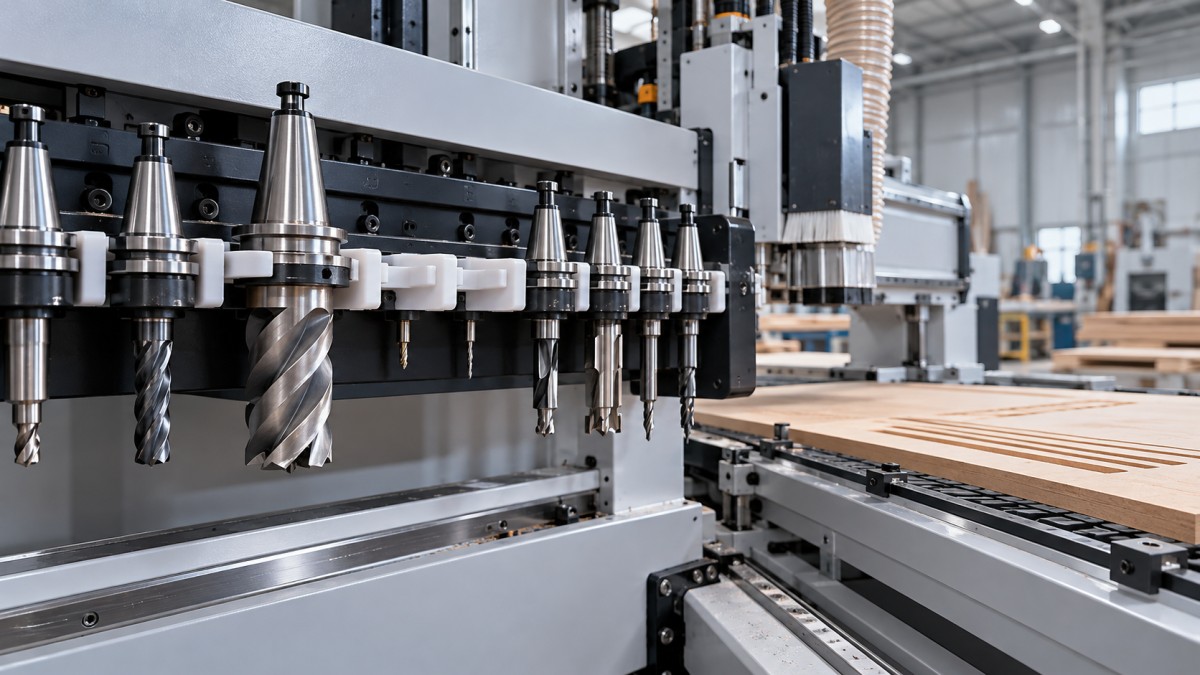
Also clarify whether the stated count describes magazine pockets or another capacity convention. Ask how the spindle-held tool is managed during an exchange and whether an empty destination pocket is required in the intended operating sequence. Do not assume an additional usable position simply because a tool can remain in the spindle.
Specialty aggregate heads need separate confirmation. Their use can depend on mechanical interfaces, orientation, clearance, control functions, and manufacturer approval. An unused pocket does not establish compatibility.
Capacity and tool-change speed solve different problems
Additional slots reduce manual intervention only when needed tools would otherwise be missing. They do not reduce the number of programmed changes or guarantee a shorter automatic change cycle. Magazine layout, axis travel, safe approach positions, and tool measurement routines can all affect the interruption.
Compare linear racks and rotary or carousel arrangements using representative programs rather than layout labels alone. The relevant question is how the proposed system reaches, exchanges, and verifies the tools used in your work. Neither arrangement is universally faster or more suitable.
Ask suppliers to distinguish the mechanical exchange time from the complete program interruption. Travel to the change position, spindle deceleration, restarting, and any measurement steps may sit outside a quoted exchange figure.
Where programs contain frequent changes, request a cycle comparison using the same parts, tools, and machining assumptions. Where a batch uses only a few tools but changes product family repeatedly, setup frequency may be the larger capacity issue.
Test whether extra positions will pay for themselves
Start with manual interventions that a larger magazine would genuinely eliminate. Separate cutter replacement caused by wear from exchanges caused by insufficient capacity. More pockets do not remove the need to replace worn tooling unless a compatible backup-tool process is configured.
- Identify capacity-related stops. Record which required assembly was missing and why it could not remain loaded.
- Measure the complete interruption. Include safe access, holder exchange, tool-data verification, required measurement, and restart checks.
- Check scheduling alternatives. Grouping similar work may eliminate some exchanges without increasing magazine size.
- Compare avoided cost with added ownership cost. Include the magazine upgrade, holders, cutters, setup effort, and relevant maintenance requirements.
Use your own measured times and production costs rather than a generic savings claim. Count only interruptions that would disappear with the larger configuration. A change already completed during another unavoidable setup may add little incremental downtime.
Unattended operation needs a stricter assessment. Every tool required by the queued programs must be available, and any planned backup strategy must work in the control. Extra pockets alone do not provide tool-life management, breakage detection, or automatic sister-tool selection. Those functions must be specified and verified separately.
Put usable capacity into the purchase specification
A purchase requirement should describe the intended result more precisely than “12-tool ATC.” Attach the proposed tool list, the production window it covers, and the dimensional limits of the assemblies. Ask the supplier to confirm which pockets each tool occupies and any restrictions on the proposed combination.
Request a demonstration or agreed acceptance test covering representative jobs without unplanned manual holder exchanges. The test should include the largest relevant tool and the actual exchange sequence, not only a magazine filled with small identical holders. Tool numbers, offsets, and program references must remain consistent throughout the test.
For future expansion, distinguish spare capacity from a retrofit promise. Confirm whether adding positions later requires changes to the magazine, guarding, control configuration, or machine structure. Obtain the supported scope in writing rather than assuming an upgrade will be straightforward.
Choose the smallest configuration that accommodates the verified resident tool set, required backups, and identifiable additions without compromising clearance or workflow. If eight positions meet that test, extra capacity needs a separate business case. If the schedule requires nine usable positions, specify a configuration that demonstrably carries all nine—not simply the next larger number in a brochure.
Send Your Inquiry
We welcome your cooperation and we will develop with you.