


News & Exhibitions
Latest Factory Updates, Industry Trends & Global Exhibition Information
CNC Door Processing Machines for Custom Door Shops: Which Functions Matter?
A custom door shop does not gain much from a CNC machine simply because it has more axes, a larger screen, or a longer list of programs. The useful machine is the one that can convert a variable door schedule into repeatable machining with minimal setup risk: lock cases at changing heights, hinge pockets for different hardware systems, handle bores on both faces, routing for seals or vision panels, and profile work that remains accurate from the first door to the last.
That distinction matters because custom door production is rarely a pure volume operation. Door dimensions, thicknesses, handing, edge details, hardware brands, and construction methods may change from order to order. A CNC Door Processing Machine should therefore be assessed less as a generic woodworking center and more as a controlled system for managing order variation. The functions that matter most are those that eliminate manual layout, preserve datum accuracy after the door is repositioned, and allow new jobs to be released without lengthy programming or fixture changes.
Start with the actual machining burden, not the advertised machine format
The first procurement question is not whether the shop needs a CNC router, a door lock machine, or a multi-function processing center. It is which operations currently create the greatest combination of labor time, rejection risk, and schedule disruption.
For a shop producing flush internal doors with standard hinges and lever locks, a dedicated or semi-dedicated door machining center may offer the shortest cycle and simplest operation. For a producer handling solid timber doors, rebated edges, decorative grooves, concealed hinges, multipoint locks, glazing apertures, and non-standard hardware, broader routing and profiling capability becomes more important. A machine selected only for standard lock and hinge work can become a bottleneck when the order mix changes.
The workpiece itself also sets the boundaries. Door blanks may be hollow-core, solid-core, laminated panel, MDF-based, plywood-based, veneered, or solid wood. Their edge integrity, surface finish requirements, weight, flatness, and clamping tolerance are not interchangeable. A vacuum-only arrangement that works well on flat panel stock may not be the right holding method for a heavy, bowed, narrow, or pre-finished door slab. The machine’s advertised spindle performance is secondary if the workholding system cannot maintain a stable reference during machining.
Lock and hardware machining is the core function—but depth of capability varies
Lock preparation is often the first operation buyers associate with door CNC equipment. The requirement is broader than cutting a mortise. A usable setup must handle the lock case pocket, faceplate recess, cylinder hole, handle/spindle holes, latch clearance, and associated drilling with consistent positional relationships. Where multipoint locks are part of the production mix, the machine must also accommodate long lock strips, multiple locking points, and the relevant machining pattern without forcing operators into manual add-on operations.
The important specification is not merely the maximum lock-pocket length. Check the usable travel range, the allowable door thickness, the tool access geometry, and whether the controller supports parameterized hardware programs. A practical program should allow the operator to enter door height, handing, lock centerline, backset, and hardware template, then generate the correct coordinates. If every variation requires editing individual toolpaths, the machine may transfer programming effort rather than remove it.
Hardware libraries deserve close scrutiny. A supplier may describe a broad library, but the procurement review should establish whether it contains the hardware families actually specified by the shop, whether templates can be created internally, and how changes are controlled. An editable template is valuable only if it is protected from accidental alteration and can be identified clearly by hardware brand, model, revision, door thickness range, and handedness.
Two further details affect day-to-day output. The first is machining from one setup. If holes on opposite faces must align precisely, the ability to process both sides, or to flip the door using a defined reference strategy, has a direct effect on accuracy and labor. The second is chip evacuation. Deep mortising in engineered or solid material produces substantial chips; weak extraction can affect cut quality, tool life, depth consistency, and cleanup time.
Hinge processing must match the hardware portfolio
Hinge work exposes a common selection error: treating all hinge machining as equivalent. Butt hinges, concealed hinges, pivot systems, adjustable hinges, and heavy-duty fire-door hardware require different pocket geometries, drilling patterns, and tolerances. The machine should be judged against the hinges that generate the most complexity or the highest cost of error, not simply the most frequently used standard hinge.
For butt hinges, the main concerns are pocket dimensions, corner treatment, screw-hole drilling, and repeatable positions relative to the door top or bottom. For concealed hinges, routing depth, drill axis access, and the relationship between the door leaf and frame specifications become more critical. A machine may cut a pocket accurately but still be unsuitable if it cannot reliably drill the required angled or face positions, or if it lacks an efficient method for switching between hinge templates.
Reference control is central. When the same door is machined for hinges, lock, and handle hardware, every operation must derive from a consistent datum. The preferred datum depends on the production method: top edge, bottom edge, lock edge, or a defined door center. What matters is that the software logic reflects the shop’s drawing conventions and that operators are not left to compensate manually for handedness or orientation.
Buyers should ask for a demonstration using an actual or representative hardware schedule, including left-hand and right-hand doors. A generic hinge pocket sample does not prove that the machine’s setup logic will prevent costly mirror-image errors.
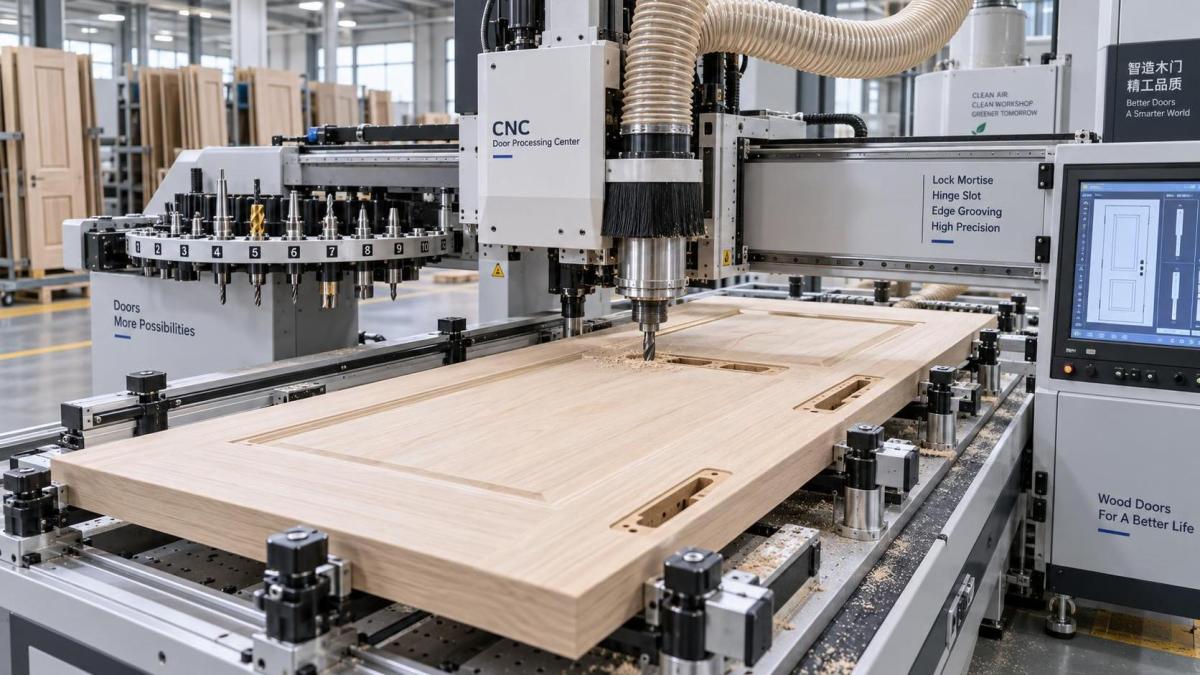
Routing and profiling determine whether the machine supports custom work or only standard preparation
A door shop with a diverse portfolio needs more than drilling and mortising. Routing capability may be needed for perimeter rebates, weather-seal grooves, drop-seal channels, flush pulls, decorative V-grooves, louvers, vision-panel openings, or intumescent seal grooves where required by the door specification. These operations vary widely in tool diameter, cutting direction, required finish, and sensitivity to material tear-out.
Spindle power matters, but it should not be considered in isolation. Evaluate the spindle speed range, collet or toolholder system, tool-change method, available tool positions, and whether the machine can complete the needed sequence without repeated manual intervention. A toolchanger with too few positions can create hidden setup time if a job requires roughing, finishing, drilling, profiling, and special hardware tools. Conversely, a large automatic toolchanger adds cost and maintenance demands that may not be justified for a narrow, stable production range.
The machine structure and support arrangement also influence edge quality. Long door slabs need support across their length. Insufficient support can permit vibration, especially during deep profile cuts near an edge. For veneered or pre-finished doors, the ability to control entry and exit cuts, use suitable scoring or finishing strategies, and avoid surface damage may be more important than achieving the shortest theoretical cycle.
Where profiled solid-wood doors are part of the mix, confirm whether the machine is intended for substantial material removal or only localized machining. A compact door lock center is not automatically a substitute for a properly specified CNC machining center or a dedicated profiling line.
Workholding, loading, and door handling are often underestimated
A CNC Door Processing Machine can have capable software and cutting units yet still underperform because handling is poorly matched to door size and weight. The procurement review should map the complete movement of the slab: loading, referencing, clamping, machining, turning where needed, unloading, and transfer to the next operation.
Vacuum pods, mechanical clamps, vertical pressing systems, and combined methods each have limits. Vacuum requires adequate sealing and contact area; it may be less dependable on textured, porous, warped, or narrow workpieces. Mechanical clamps provide stronger restraint but can obstruct tool paths or leave unmachined zones unless the program and clamping sequence account for them. For pre-finished faces, contact points must be examined for marking risk.
Door dimensions should be checked against the true working envelope rather than a simplified “maximum door size” statement. Include the smallest and largest slabs, the thickest construction, narrow leaves, heavy solid-core products, and any doors with glazing cutouts that reduce holding area. If loading is manual, ergonomic access and the risk of damaging finished surfaces deserve the same attention as nominal machine capacity.
Software should reduce interpretation, not merely display geometry
The most consequential difference between machines can sit in the software layer. Custom production depends on turning a door schedule into unambiguous instructions. Useful software accepts variable dimensions and hardware parameters, applies rules for handing and edge orientation, and produces a clear machine-side confirmation before cutting begins.
Integration with design, ERP, or order-management software can be beneficial, but only where source data is disciplined. A direct import of incorrect dimensions or hardware codes creates errors faster. The more immediate requirement is traceability: each program should be tied to a job or door identifier, and the operator should be able to verify the selected hardware, door dimensions, material orientation, and machining side.
Remote support is also a functional issue, not an optional service feature. CNC door equipment relies on controllers, drives, software versions, and parameters that may require diagnosis beyond ordinary mechanical maintenance. Before placing an order, establish how remote access is handled, what response route exists for software faults, whether backup files and restore procedures are supplied, and whether critical controller components can be sourced in the operating country.
Accuracy claims need to be translated into door-level acceptance criteria
Catalogue positioning accuracy does not by itself establish finished-door quality. Door manufacturing requires functional accuracy: hinges must permit correct reveals, lock hardware must operate freely, handles must align, and routed features must sit at the correct distance from the reference edge. These outcomes depend on machine motion, tool condition, workholding, blank consistency, calibration, and setup discipline.
A meaningful factory acceptance discussion should define the buyer’s representative door types and the features to be checked. The supplier should clarify how the door is referenced, how squareness or edge variation is handled, what calibration routine is required, and how repeated parts are verified. It is sensible to include difficult but routine conditions in the review: a left-hand and right-hand pair, more than one thickness, a long lock case, and hardware requiring both routing and drilling.
Tooling responsibility should be explicit. Some machines are supplied with basic tools but not the full set needed for the buyer’s hardware package. Tool quality, geometry, balancing, and replacement availability affect both finish and repeatability. A low initial tooling allowance can be misleading if a production-ready tooling package must be purchased separately after commissioning.
Do not confuse upstream panel sizing with door CNC machining
Door production frequently begins with cutting and sizing sheet-based components or blanks, but this is a separate process from CNC hardware and profile machining. A sliding table saw can be an appropriate upstream asset where accurate cutting of MDF, plywood, solid wood, or panel materials is required before doors reach later operations. For example, the ZD350 is specified with a 3,200 mm sliding table, a 350 mm main blade, electrically lifted saw group, and 45° to 90° blade tilt. Those features are relevant to blank preparation and panel cutting, not a replacement for a dedicated door-processing CNC.
Keeping these functions separate during sourcing prevents an expensive specification mistake. A shop may need both accurate blank preparation and flexible door machining, but the purchasing decision should identify where each process belongs, how material flows between them, and whether one machine is being asked to cover tasks outside its productive range.
Lifecycle risk is shaped by serviceability and change control
Initial price is visible; downtime exposure is less visible but often more disruptive. Evaluate the availability of wear parts, spindle service arrangements, pneumatic and vacuum components, electrical documentation, controller support, and the supplier’s ability to provide the exact machine configuration ordered. A machine built around uncommon proprietary parts may create a long recovery period after a relatively small failure.
Commissioning should include more than installation and a basic demonstration. The handover needs machine parameter backups, electrical and pneumatic drawings, maintenance intervals, lubrication requirements, tooling lists, safety instructions, alarm explanations, and a defined method for creating and approving new hardware programs. Without that transfer, the shop remains dependent on external support for routine variation.
The right machine is therefore not the one with the longest capability list. It is the one whose lock, hinge, drilling, routing, workholding, and software functions align with the door range actually being sold; whose handling method fits the physical product; and whose support model can keep production recoverable when tools, programs, or components need attention. That is the combination that turns CNC capacity into reliable custom-door output rather than another source of setup complexity.
Send Your Inquiry
We welcome your cooperation and we will develop with you.