
News & Exhibitions
Latest Factory Updates, Industry Trends & Global Exhibition Information
What Equipment Is Included in a Wood Production Line Equipment Setup?
What does a complete wood production line equipment setup usually include?
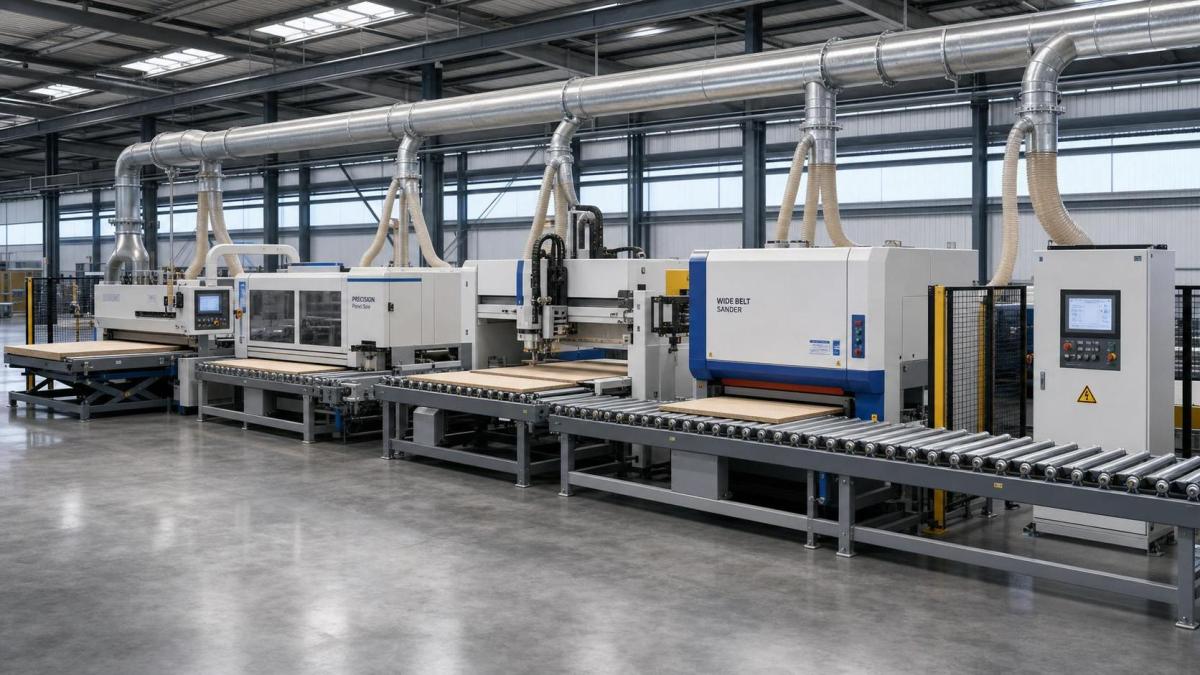
A complete wood production line equipment setup is more than a few standalone machines.
In practical terms, it is a coordinated system that moves raw boards through cutting, shaping, sanding, handling, cleaning, and final processing.
That is why the question often starts with equipment lists, but quickly becomes a discussion about workflow, matching capacity, and control logic.
Most wood production line equipment setups include these core sections:
- Material feeding and infeed tables
- Panel saws, rip saws, or cross-cut saws
- Planers, moulders, or thicknessing machines
- CNC routers or drilling units for machining
- Edge banding or finishing support equipment where needed
- Sanding machines for surface preparation
- Conveyors, transfer tables, and stackers
- Dust collection and waste extraction systems
- Electrical control cabinets and automation interfaces
The exact mix depends on whether the line handles solid wood, plywood, MDF, particle board, or furniture components.
A furniture factory will usually require different wood production line equipment from a flooring, door, or board processing operation.
A useful way to read any proposed setup is this: every machine should either transform material, move material, or protect process stability.
If one of those functions is missing, bottlenecks tend to appear quickly.
Which machines are considered essential, and which are optional?
This is where many evaluations become clearer.
Not every project needs a highly automated line from day one, but every stable line needs the right production backbone.
The table below separates common essentials from equipment that is application-dependent.
The important point is not to buy optional automation before the process itself is balanced.
A fast CNC machine cannot compensate for poor feeding, unstable sanding, or weak dust extraction.
More often, reliable wood production line equipment is built around correct sequencing and matched throughput.
How do you match wood production line equipment to the actual application?
The answer depends on what the line is expected to produce every day, not only on peak output targets.
For example, cabinet panels, solid wood strips, and decorative boards create very different equipment demands.
A panel-based line usually emphasizes nesting, drilling, edge treatment, and controlled material handling.
A solid wood line often requires stronger planing, moulding, defect control, and moisture-related processing consistency.
When reviewing wood production line equipment, these checks are usually more useful than headline speed figures:
- Material type and thickness range
- Target part size and tolerance
- Shift hours and daily production volume
- Required finish quality before painting or assembly
- Changeover frequency between product types
- Factory layout, power supply, and dust load
This is also where experience from established woodworking machinery suppliers becomes relevant.
Companies such as Qingdao Zhongding Machinery have spent years supplying both single machines and integrated woodworking solutions.
That background matters because line design is rarely just about machine specification sheets.
It also involves process continuity, spare parts planning, installation support, and realistic long-term maintenance expectations.
Why are conveyors, dust collection, and control systems so important?
These parts are often underestimated because they do not directly cut or shape the wood.
In reality, they often determine whether wood production line equipment runs smoothly or suffers repeated stoppages.
Conveyors and transfer systems do more than move material.
They protect cycle rhythm, reduce manual handling errors, and help avoid surface damage between stations.
Dust collection is equally critical.
Poor extraction affects cut quality, sanding consistency, machine wear, workplace safety, and cleaning time.
The same line can perform very differently depending on extraction design and airflow balance.
Control systems tie everything together.
A good control cabinet and interface should manage sequencing, alarms, speed matching, emergency stops, and fault visibility.
If the line includes automation, the control logic becomes even more important than the hardware count.
In actual production, weak integration creates hidden losses.
You may see waiting time between machines, repeat sanding, feeding interruptions, and inconsistent dimensional results.
That is why complete wood production line equipment should always be evaluated as a system, not as isolated units.
What mistakes are common when comparing different setups?
A common mistake is comparing only purchase price.
Lower initial cost can still lead to higher operating cost if downtime, tool wear, dust problems, or staffing needs increase.
Another mistake is focusing on the fastest machine in the line.
The real production rate is usually defined by the slowest stable step.
There is also a tendency to overbuild.
Highly complex wood production line equipment may look advanced, yet become inefficient if product variety is low and labor remains partly manual.
These checkpoints help reduce selection risk:
- Check whether upstream and downstream speeds are matched
- Confirm tooling life, consumables, and spare parts lead time
- Review installation space and maintenance access around each unit
- Ask how changeovers affect output and calibration time
- Verify safety, extraction, and electrical compatibility early
- Look at service response and technical support, not only machine specs
Support capability matters more than it may seem on paper.
Longer equipment life usually comes from proper commissioning, training, and parts availability, not just machine structure.
That is one reason experienced exporters with established after-sales systems remain relevant in this market.
How should the final decision be made before implementation?
A sound decision usually comes from narrowing the line around process evidence.
Instead of asking which wood production line equipment is best in general, ask which setup best fits the intended workflow.
The final review should connect four things: product requirements, output target, plant conditions, and service support.
At this stage, a short decision checklist is often more useful than another round of broad comparison.
In simple terms, complete wood production line equipment should improve repeatability, not only theoretical output.
It should also leave room for future adjustments, especially when product mix may expand later.
A practical next step is to map the current production flow, mark each manual transfer, and identify where quality variation begins.
That makes equipment comparison more objective.
From there, it becomes easier to compare line configurations, confirm technical parameters, and judge whether the proposed wood production line equipment will deliver stable value over time.
Send Your Inquiry
We welcome your cooperation and we will develop with you.