


News & Exhibitions
Latest Factory Updates, Industry Trends & Global Exhibition Information
When choosing a wood panel press machine for plywood, why platen flatness matters more than rated pressure
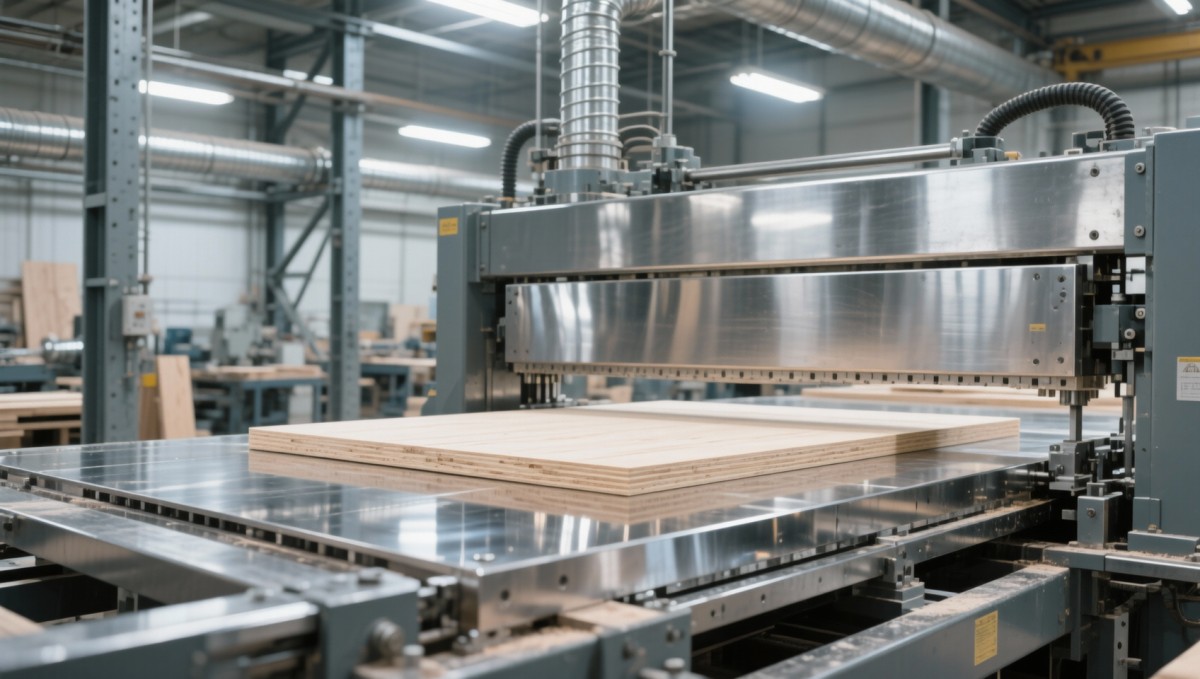
Why Platen Flatness Determines Plywood Bond Integrity—Not Just Pressure Rating
Rated pressure is often the first spec quoted—and scrutinized—when selecting a wood panel press machine for plywood. A 120-bar or 150-bar rating sounds impressive on paper. But in actual production, that number tells only half the story. What matters more is how uniformly that force transfers across the entire platen surface. If the platen deviates by even 0.15 mm over a 1,300 × 2,700 mm area, localized pressure drops below the minimum threshold required for adhesive cure—especially with modern low-emission phenol-formaldehyde or melamine-urea resins. The result isn’t just inconsistent thickness: it’s irreversible micro-delamination at veneer interfaces, which only becomes visible after sanding or edge routing.
The Physics of Force Distribution—Not Just Magnitude
Pressure (measured in bar or MPa) is defined as force per unit area. But real-world pressing involves three interdependent variables: applied load, platen rigidity, and substrate compliance. Plywood veneers vary in moisture content (8–12% typical), density (380–520 kg/m³ for poplar or birch core), and compressibility. A rigid, slightly convex platen may compensate for minor veneer curl, while a nominally flat but flexing platen—particularly near corners under high tonnage—creates a “pressure shadow” zone where effective pressure falls 30–45% below nominal. This isn’t theoretical: thermographic imaging during hot pressing shows temperature gradients exceeding 8°C across a single panel when flatness tolerance exceeds ±0.08 mm/m. Since resin cross-linking is exponentially temperature-dependent, those cooler zones yield incomplete polymerization—even with full-rated hydraulic pressure.
Flatness Tolerance: Where Millimeters Become Defects
Industry-standard flatness benchmarks are rarely specified in procurement documents—but they should be. For industrial-grade plywood (e.g., marine-grade or structural B/BB), ISO 19906 recommends platen deviation no greater than ±0.05 mm per meter of length, measured under operational load—not just at rest. That means a 2.7 m platen must hold flatness within ±0.135 mm across its full span *while* exerting full rated force. Achieving this requires more than precision machining: it demands symmetric hydraulic cylinder placement, reinforced frame cross-bracing, and thermal compensation in heated platens. Without it, edge thinning occurs consistently at panel corners, requiring post-press trimming allowances of up to 12 mm—wasting 4–6% of raw material per cycle.
How Flatness Failure Manifests in Production
Unlike pressure-related failures—which typically cause gross warping or total bond failure—flatness-induced defects are subtle, cumulative, and often misdiagnosed:
- Veneer telegraphing: Core layer irregularities become visible through face veneers after sanding, because only high-pressure zones fully compressed the glue line—leaving adjacent areas slightly “springy.”
- Moisture migration bias: Uneven compression restricts steam escape paths during hot pressing, causing localized resin boil-out in low-pressure zones and starved glue lines in high-pressure zones.
- Differential curing rates: Adjacent panels in multi-opening presses show inconsistent shear strength test results—not due to adhesive batch variation, but because slight frame twist shifts load distribution between openings.
Verification Beyond the Spec Sheet
Don’t rely solely on manufacturer flatness claims. Ask for third-party verification reports—not just initial calibration, but load-cycle validation. A credible report includes measurements taken at four load points (25%, 50%, 75%, and 100% rated pressure) using laser interferometry or coordinate measuring machine (CMM) scanning. Also request data on long-term stability: platens made from welded steel plates without stress-relieving heat treatment can drift up to 0.03 mm/year due to residual internal stresses. Cast iron platens offer better dimensional stability but require longer machining lead times and stricter vibration-damping foundations.
Material and Process Interactions You Can’t Ignore
Flatness requirements tighten significantly with certain material combinations:
- Thin rotary-cut veneers (<0.6 mm): Compress easily under uneven load, leading to irreversible fiber collapse in high-pressure zones and poor interlayer adhesion elsewhere.
- Reconstituted core (LVL or particleboard laminates): Exhibit non-linear compression behavior; slight platen curvature may improve contact but excessive deviation causes edge crushing before center bonding completes.
- High-frequency pre-heating: Reduces initial veneer moisture, increasing stiffness—and making the stack less forgiving of platen irregularity during the critical first 30 seconds of pressing.
These interactions mean that a press optimized for 2.7 mm commercial plywood may deliver substandard results with 0.4 mm decorative face veneers—even if rated pressure is identical.
Operational Realities That Amplify Flatness Sensitivity
Installation and maintenance conditions directly affect usable flatness. A foundation settling just 0.2 mm over six months can introduce torsional twist into the press frame—effectively negating factory-calibrated platen alignment. Similarly, worn guide columns or degraded hydraulic seals cause asymmetric ram extension, shifting the effective centerline of force. Regular verification isn’t optional: top-tier operations perform biannual CMM checks and recalibrate leveling jacks whenever moving the machine or replacing major hydraulic components.
Engineering Precision Over Marketing Metrics
When evaluating a wood panel press machine for plywood, shift focus from peak pressure numbers to verifiable mechanical integrity. Prioritize suppliers who disclose flatness tolerances under load, provide traceable measurement methodology, and design for thermal and mechanical stability—not just initial performance. Because in continuous plywood production, consistent bond quality isn’t delivered by maximum force. It’s sustained by uniform force—millimeter by millimeter, cycle after cycle.
Send Your Inquiry
We welcome your cooperation and we will develop with you.