


News & Exhibitions
Latest Factory Updates, Industry Trends & Global Exhibition Information
What Wood Press Capacity Pays Off for High-Volume Panel Glue-Up Lines?
Wood press capacity can make or break high-volume panel glue-up. Learn how to size platen, pressure, and cycle time to cut cost per panel and avoid costly rework.
On a high-volume glue-up line, the press is rarely the fastest machine in the building, and that is exactly the problem. Saws, moulders, and spreaders run at their own pace, but every panel still has to stop, sit under pressure for a set time, and come out flat before the next operation can touch it. If the press cannot keep up, work piles up in front of it and glue lines sit open longer than they should. Oversize it, and money sits in unused capacity instead of tooling, handling equipment, or a second shift.
So the real question is not how big a wood press you can afford. It is what capacity actually pays off: how much platen area, how much pressure, and how short a cycle you need to hit your daily panel count at the lowest cost per good panel. The three numbers interact, and getting one wrong quietly cancels out the other two.
Capacity is three numbers, not one
Press catalogues lead with tonnage, because it is the easiest number to print. But tonnage alone tells you almost nothing about output. A press earns its money through three things together: usable platen area, which decides how much panel goes in per load; the pressure it applies evenly across that area, which decides whether the glue line holds; and cycle time, which decides how many loads you finish in a shift. Multiply area by loads per hour and you have throughput. Leave pressure short, and part of it returns as delaminated panels and rework.
Start with the panel, not the catalogue
Every sizing exercise should begin with your own production figures. Write down the panel sizes that make up most of your volume, not the largest panel you have ever made. A line running standard 2440 × 1220 mm sheets all week, with an occasional oversize door blank, needs a different press from one built around the occasional job. Note the thickness range too: thin and thick panels behave differently under pressure and need different cycle times. Then set the target honestly: panels per shift in your busiest realistic week.
That target, divided by working hours, gives the hourly output the press must sustain, with allowance for loading delays, glue problems, and breaks. If the arithmetic says 40 panels an hour and a load holds eight, you need five clean cycles an hour, every hour. That calculation narrows the field faster than any sales conversation, because capacity becomes a number a machine either meets or does not.
Platen size: the capacity you can actually use
Nominal platen size is the size of the plate. Usable capacity is what remains after real loading. Panels need a margin from the platen edge so pressure stays even, gaps between them for positioning, and a layout an operator can repeat quickly. A platen that looks generous on paper can lose a fifth of its area to margins and spacing before a single panel is pressed.
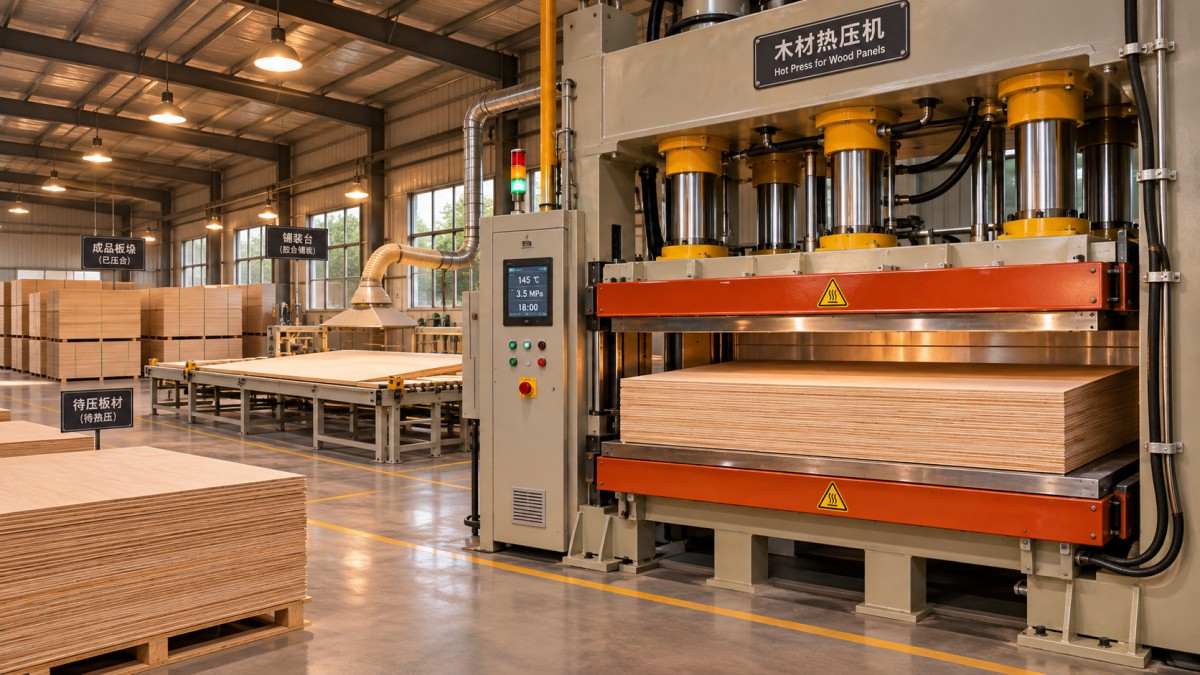
Usable area and panel layout
Before comparing machines, draw your standard panel layout on each candidate platen size, at full scale on paper. Count the panels that fit with sensible margins, and check the awkward sizes in your mix, not just the standard one. Sometimes a slightly wider platen turns a load of six panels into eight, and that difference, repeated over thousands of cycles, is worth more than a higher tonnage figure. Sometimes it changes nothing, because your sizes leave the same waste strip however the platen is cut.
Stack height and daylight opening
For cold pressing and stacked glue-up, the daylight opening between platens decides how tall a stack you can build, and stack height is capacity too. A taller stack presses more panels per cycle, but it lengthens loading, makes even pressure through the stack harder, and worsens the damage when one panel is misaligned. Cauls, the flat boards placed between layers, eat into the opening as well, so count them: the real stack is smaller than the paper one once cauls, protective sheets, and lifting gear are included.
Pressure: total force is not the figure that glues the panel
What bonds a panel is not the total tonnage of the press but the pressure on the glue line: force divided by the area it is spread over. This is where an oversized platen can work against you. Spread a 100-tonne press's force over a full load covering roughly 6 square metres, and the specific pressure on each panel is far lower than the same press on a half load. If your adhesive supplier's data sheet calls for a certain pressure range, the press must deliver it at your real load size, not its most flattering one.
Work the calculation the other way round. Take the largest total panel area you plan to press in one load, multiply it by the specific pressure your glue and material need, and the result is the force the press must genuinely deliver. Then check how it is produced. Cylinders concentrated in the middle can show a healthy total tonnage while the corners of a wide load see much less, which shows up later as open edges on the outer panels. On wide loads, even pressure matters more than a larger headline number. Excess pressure brings its own damage, too: starved glue lines, crushed cores, and defects telegraphed through thin faces.
Cycle time: where throughput is really decided
Pressing time, the minutes a panel spends under pressure, is set by the adhesive, the material, and, on a hot press, temperature and thickness. You cannot negotiate with glue chemistry. What you can control is everything around it: loading time, how quickly the press closes and builds pressure, how fast it opens, and unloading time. On many real lines, handling takes as long as pressing itself, so a faster cycle bought at a high price may add little output.
Loading and unloading are part of the cycle
Time a full cycle with a stopwatch before buying anything, and watch where the minutes go. If operators carry panels one at a time, align them by eye, and clear squeeze-out between loads, loading aids, infeed and outfeed layout, and scissor lifts at working height will often buy more capacity than a larger press. Heated platens and fast, controlled closing save minutes per cycle, but neither fixes a line where finished panels have nowhere to go. Glue open time ties it together: panels that wait too long between spreading and pressing give weak bonds, so upstream speed must match press capacity, not exceed it.
The maths: panels per shift and cost per panel
The table below puts the three numbers together in an illustrative example: standard panels, eight to a load, a seven-hour productive shift. The figures are simplified to show the method; run your own figures through the same steps.
Two lessons fall out of the arithmetic. First, the cheapest capacity increase came from loading aids, not a bigger machine: cutting three minutes of handling raised output by more than a quarter. Second, the larger platen only paid when the line could fill it. Run under-loaded, it produced barely more than the smaller press while costing more to buy, heat, and maintain. Cost per panel is where this shows in money: divide the shift's full cost by the number of good panels, not the number pressed.
When bigger stops paying off
There is a point on every line where extra press capacity stops converting into extra sales. It arrives when the press is no longer the bottleneck: when trimming, sanding, or inspection cannot absorb more panels, when curing storage runs out, or when orders do not fill the extra loads. A press bought for a peak that comes six weeks a year spends the other forty-six running part-loaded, and part-loaded running is where cost per panel creeps up. Heating a large platen costs roughly the same full or half loaded, so under-used heated capacity taxes every panel.
Glue, heat, and the limits you cannot buy your way past
Some limits sit outside the machine entirely. Adhesive spread rate, open time, and minimum pressing time come from the glue supplier's data and your materials, and no press specification overrides them. Thick panels need time for heat to reach the innermost glue line on a hot press, and that time grows faster than the thickness does. Veneers and laminates bring their own pressure ceilings, and moisture content changes both bonding and flatness after pressing. A capacity plan that ignores these figures promises output the chemistry cannot deliver.
This is also where rework is born. Panels pressed at the right pressure for the right time, on a clean, flat platen, come out flat and stay flat. Panels rushed through a short cycle, or pressed on a worn platen, look acceptable and move later, in the warehouse or at the customer's site. That rework, in remakes, credits, and reputation, belongs in any honest capacity calculation: a press that runs slightly slower and produces panels that stay sold is the cheaper machine.
Before you order: the sizing checks that matter
- Work out the panels per hour you need in a busy realistic week, then the cycles per hour that implies at your real load size.
- Draw your standard and awkward panel layouts on the platen, with margins, and count the panels per load you will actually get.
- Calculate the force you need from the largest load area and the specific pressure your adhesive supplier specifies; check cylinder layout for even pressure at the edges.
- Time a complete cycle, loading and unloading included, and cost handling improvements separately from the machine.
- Check daylight opening against your tallest real stack, cauls and lifting gear included.
- Confirm power supply, floor loading, and extraction where the press will stand, with working room for the largest panel.
- Ask about platen flatness tolerance, seal and hose replacement, spare parts, and who services the machine in your region.
Keeping capacity honest after installation
The capacity you calculated on paper belongs to a new, clean, correctly set press. Holding it takes small, regular habits. Platen surfaces need cleaning before squeeze-out builds into high spots. Hydraulic oil, seals, and hoses need attention before a slow pressure build starts stretching cycle times a minute at a time. Check pressure against a gauge you trust, and platen flatness when panels show a repeating defect in the same position. Keep a simple log of cycles per shift and rejects per week: it shows whether output drifted because the machine slowed or the mix changed.
Qingdao Zhongding Machinery Co., Ltd. has supplied woodworking machinery to furniture manufacturers, panel workshops, and industrial production lines for more than 20 years, and the presses that earn their keep were sized from the customer's panel sizes and shift targets, not a catalogue headline. A supplier worth working with will ask for your panel dimensions, adhesive, and daily target before recommending a model, will show the arithmetic behind it, and will still be supplying seals, hoses, and advice years later.
Wood press capacity pays off when it matches the work: enough platen to fill each load with your real panel sizes, enough evenly spread pressure to satisfy the glue, and a cycle your handling can sustain. Let cost per good panel, not tonnage, make the final decision.
Send Your Inquiry
We welcome your cooperation and we will develop with you.