


News & Exhibitions
Latest Factory Updates, Industry Trends & Global Exhibition Information
How to Move Timber Safely Between Woodworking Stations Without Slowing Production
Time:Nov 19, 2026
Author:Zhongding Technical Editorial Team
Number of views:
A board that leaves the saw in good condition can still arrive at the next station late, damaged, or in the wrong order. The cutting itself was not the problem. The transfer was. In most panel and solid-timber workshops, the movement between stations takes only seconds per piece, yet those seconds accumulate into waiting time, rework, and avoidable handling injuries. The fastest way to protect output is not to push operators to carry more or walk faster, but to make each handoff predictable: the right piece, in the right orientation, arriving when the next machine is ready for it.
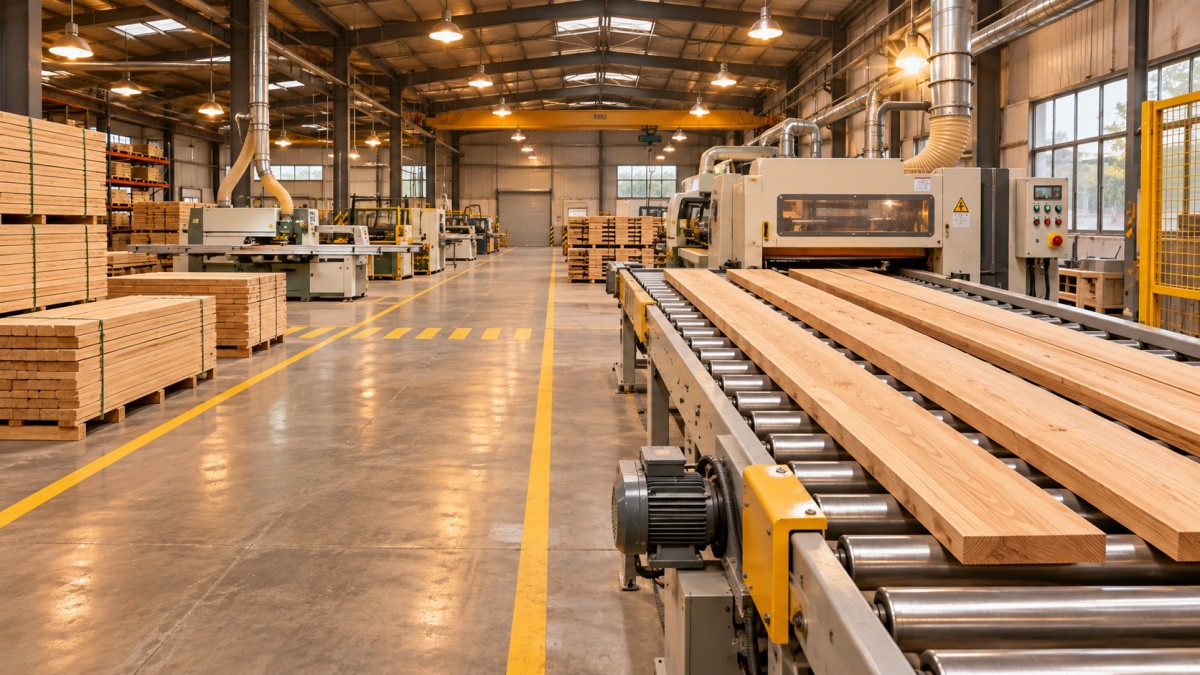
That predictability depends on three variables working together: route, load, and timing. A route that crosses a main walkway, a load that exceeds what one person can control safely, or a delivery that arrives in a batch when the next station works one piece at a time will each create a queue somewhere else. Transport machines pour le travail du bois are useful only when they resolve that mismatch. A conveyor, roller table, transfer cart, or vacuum lifter does not add speed by itself; it adds speed by removing the hesitation, lifting, turning, and searching that interrupt the main process.
Where production time is actually lost
The loss rarely shows up as a single long stoppage. It shows up as short, repeated interruptions: an operator waiting for a colleague to help lift a long panel, a stack placed too far from the infeed, a board turned the wrong way and needing to be flipped, or a trolley parked where the forklift needs to pass. Each event may cost 20 or 30 seconds. Across a shift, across several stations, that is hours of capacity that never appears on a downtime report because no machine broke down.
Damage follows the same pattern. Edges chip when boards are dragged across a hard surface, veneer scratches when pieces slide against each other, and long components bow when they are supported only at the ends during a manual carry. A damaged panel does not always become scrap. More often it becomes a repair, a downgrade, or a delay while a replacement is cut. The cost is therefore not only material, but also the disruption to the sequence that was planned for the original piece.
Plan the route before choosing the equipment
A useful starting point is to walk the actual path a board takes, from infeed to outfeed, and note every turn, threshold, doorway, and crossing. Timber rarely moves in a straight line. It moves around machines, past stacks of work in progress, and through areas where people and vehicles share space. A route that looks short on a floor plan can be slow in practice if it forces a loaded trolley to reverse, wait for a door, or navigate around stored material.
Routes work best when they are one-directional and separated from pedestrian traffic wherever possible. A return loop for empty trolleys or pallets prevents the common problem of full and empty transport meeting in the same narrow aisle. Floor markings help, but only if they reflect how material really moves, not how it was supposed to move when the layout was drawn. If operators routinely cut across a marked zone, the route is wrong, not the operators. Width matters as well. An aisle that fits a trolley does not necessarily fit a trolley plus a person walking beside it to steady a long board.
Match the equipment to load, distance, and frequency
Different transfers need different solutions, and the difference is usually load shape rather than weight alone. Short, heavy panels benefit from powered roller conveyors or scissor-lift tables that keep the work at a comfortable height and eliminate repeated bending. Long, flexible boards need support along their length, otherwise they sag, vibrate, or catch on the next station. Small, frequent batches of components are often better served by a simple gravity roller section or a well-designed cart than by a powered system that has to be started, stopped, and cleared for every piece.
Distance changes the calculation. Over a few metres, a manual trolley with good wheels and a stable frame can be faster than a powered system because there is no waiting for a cycle to complete. Over a longer distance, or where the same transfer repeats hundreds of times a day, powered transport reduces fatigue and keeps pace steady through the afternoon, when manual handling tends to slow down. Frequency is the other test. Equipment that works well for occasional large panels can become a bottleneck when it is used for a constant flow of small parts, because loading and unloading take longer than the transfer itself.
 Safety follows the flow, not the other way round
Most handling injuries in woodworking do not happen during cutting or machining. They happen during lifting, carrying, turning, and stacking. The risk rises when a load is awkward rather than simply heavy: a wide panel that blocks the view ahead, a long board that swings as it turns a corner, or a stack that has to be lifted from floor level. Reducing the number of manual lifts is therefore a safety measure as much as a productivity measure. Every lift that is replaced by a roller, a tilting table, or a mechanical aid removes one opportunity for a strained back, a trapped finger, or a dropped board.
Visibility and control deserve the same attention as lifting. A load should never obscure the path ahead, and an operator should never have to walk backwards while guiding timber into a machine. Where a transfer requires two people, the roles need to be clear before the move starts: who leads, who signals, and where the piece will be set down. Unclear handoffs are where boards slip, hands get caught between a panel and a frame, and stacks become unstable. Well-placed supports, stops, and guides at the receiving station also matter, because a board that arrives safely but has nowhere stable to rest will be held, leaned, or propped in a way that creates the next risk.
What tends to go wrong after installation
A new transport system can still fail if it does not fit the work that follows it. A conveyor set at the wrong height forces operators to lift each piece up or down at the transfer point. A cart that holds panels vertically may save floor space but make it harder to feed the next machine in the correct orientation. A powered system without a clear place for empty pallets, offcuts, and rejected pieces soon becomes a storage area, and the route narrows again.
Maintenance and changeover are part of the same judgement. Rollers collect dust and resin, wheels wear, and guides move out of alignment. A system that is difficult to clean or inspect will gradually run slower and less smoothly, and operators will start working around it. The same applies when product mix changes. A line set up for standard cabinet panels may struggle when a batch of long, narrow components or oversized doors arrives. Transport that can be adjusted in width, height, or speed, or that can be bypassed without blocking the main route, is more resilient when the order book changes.
The decision is therefore less about buying the most capable machine and more about removing the specific friction in a specific line. Look at where pieces wait, where they are lifted twice, where they are turned, and where people and material cross paths. Fix those points first, keep the route simple and one-directional, and choose transport that matches the load and the rhythm of the stations it connects. When movement becomes routine rather than improvised, safety improves, damage falls, and the machines that actually add value spend more of the shift working.
Next page:Already the last
Send Your Inquiry
We welcome your cooperation and we will develop with you.