


News & Exhibitions
Latest Factory Updates, Industry Trends & Global Exhibition Information
How to schedule woodworking machine delivery to the USA for installation
For a project manager, successful woodworking machine delivery to USA begins with one practical rule: do not book the shipment until the machine configuration, site conditions, unloading plan, and installation responsibilities match. A container arriving on time does not help if the foundation is incomplete, the electrical supply is not ready, or the machine cannot pass through the receiving door.
The delivery schedule should therefore be built backward from the planned production start date, rather than forward from the factory completion date. Commissioning, operator training, utility connection, positioning, and contingency time all need space in the plan. This approach reduces the risk of paying for storage, rescheduling technicians, or delaying a furniture or door-production project because one dependency was missed.
Start with the installation date, not the shipping date
Set a target date when the equipment must be ready for trial production. Then work backward through each stage: factory acceptance, export packing, ocean or air freight planning, port handling, inland transportation, site unloading, mechanical placement, connection, commissioning, and sample processing.
Do not treat these as separate tasks owned by separate companies. They form one installation chain. A delay in export documents can affect port release; a late delivery appointment can affect the installer’s availability; an unfinished compressed-air line can prevent a CNC machine from being tested even when the crate is already on the workshop floor.
A workable schedule normally includes an internal buffer between machine arrival and the first committed production order. That buffer is not wasted time. It is the period used to inspect for transit damage, position the equipment accurately, connect utilities, verify safety functions, make trial parts, and allow operators to become familiar with the controls.
Freeze the machine specification before arranging freight
Freight planning is only reliable after the final equipment scope is confirmed. The project file should identify the machine model, optional equipment, tool holders, spare parts, electrical requirements, air requirements, packing dimensions, gross weight, and the number of crates or pallets. If accessories are added after freight has been booked, the shipment may no longer match the planned loading method or container space.
This is especially important for equipment that includes multiple machining stations or long workpieces. A machine’s footprint is not the same as the room required to install and operate it. The plan must account for crate handling, service access, operator movement, material infeed and outfeed, dust collection ducting, and maintenance clearance.
For example, an CNC Mortising machine for furniture components, wooden doors, or custom solid-wood work should be scheduled using both its physical dimensions and the handling envelope around it. The ZD-SC1500-3/4 and ZD-SC2200-3/4 versions have different processing lengths and machine sizes, so a site that can receive one configuration may not automatically suit the other. When the machine is intended for mortises, slots, grooves, and joinery, the project team should also confirm that the material flow supports the intended production rhythm.
Choose the delivery route based on installation risk
Ocean freight is generally the practical method for full-size woodworking machinery shipped from China to the United States. The project decision is usually not just “which port is cheapest?” A lower-cost port can become expensive if it adds difficult inland transportation, requires an awkward transload, or makes it harder to coordinate delivery with the installation crew.
Evaluate the route from the factory loading point to the machine’s final position, not merely to the U.S. port. The relevant questions include:
- Can the machine be loaded in the planned container type without compromising packing or securing?
- Does the arrival port provide a practical inland route to the installation site?
- Can the final carrier deliver the crate on the required date and within site access restrictions?
- Will the site unload the container directly, or will equipment be transferred to another vehicle?
- Who controls the cargo after port arrival: the buyer, freight forwarder, customs broker, or a coordinated logistics provider?
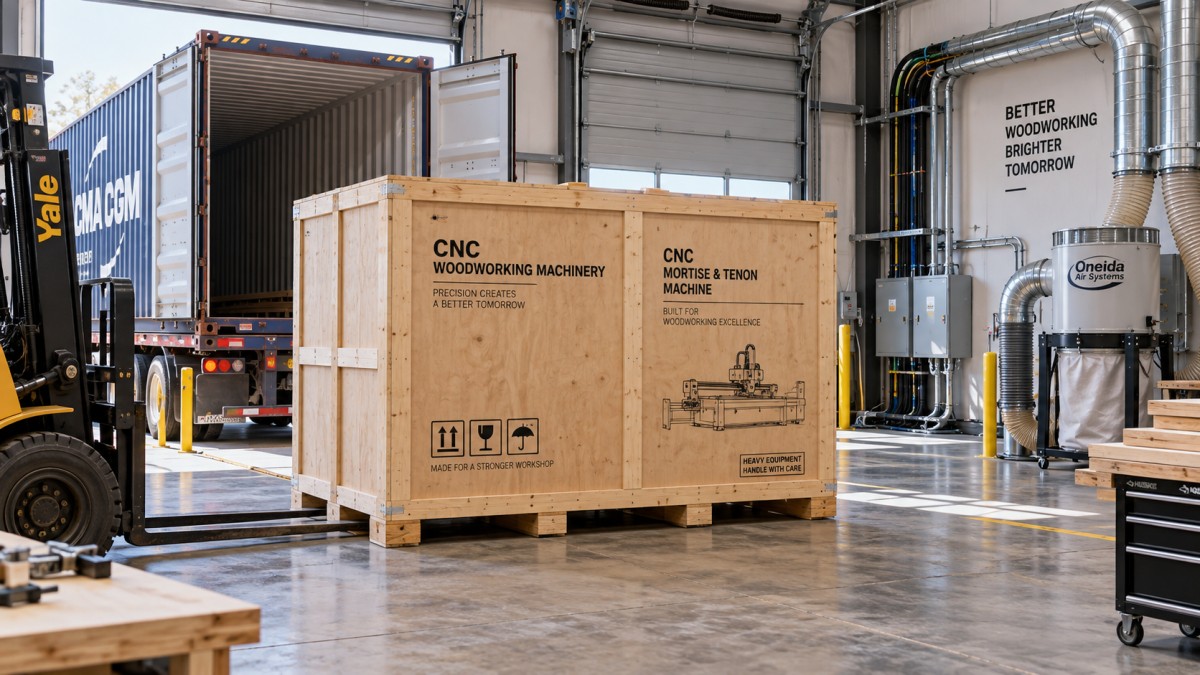
For a single major machine or an integrated cell, container loading can provide more control over handling than moving several individual pieces through multiple freight terminals. However, container delivery only works well if the receiving site can safely unload it. A workshop without a dock, forklift capacity, or enough maneuvering space may need a different final-mile arrangement.
Site readiness must be checked as a delivery requirement
The most common schedule mistake is defining “ready” as having an empty floor area. Installation readiness is broader. It includes access, floor condition, utilities, material handling, safety provisions, and people available to make decisions during commissioning.
A CNC mortising machine with a 0.7 MPa working-air requirement, for instance, should not be delivered on the assumption that any existing shop compressor is sufficient. The machine may need stable air quality and enough available capacity during normal production. Similarly, the electrical contractor needs the confirmed machine documentation early enough to prepare the correct connection rather than making assumptions based on another machine in the workshop.
Assign ownership for documents before cargo leaves the factory
Documentation problems are often treated as administrative details until they hold up cargo. A project manager should establish one document-control list that names the responsible party and required timing for every item. The shipping documents need to describe the equipment consistently across the commercial invoice, packing list, bill of lading, and customs entry information.
The practical objective is simple: the customs broker, freight forwarder, consignee, and receiving team should all be working from the same machine identity, package count, weights, and shipment terms. Differences in consignee details, product descriptions, or packing information create avoidable questions after the cargo is already moving.
Before dispatch, confirm who will handle customs clearance, who receives arrival notices, who approves charges, and who can make decisions when the carrier requests an appointment or additional information. This prevents a common handoff failure in which each party assumes someone else is arranging the release and final delivery.
Plan unloading as an engineered task
Heavy woodworking machinery should not be unloaded based on a visual estimate of what a forklift “should handle.” Use the packed weight, crate dimensions, lifting points, load center, route condition, and lift height to select the equipment. A forklift’s rated capacity changes with the load center and attachment arrangement, so the heaviest crate is not the only consideration.
Request packing photos and the crate list before arrival. These help the site team understand where the center of gravity may sit, which side must remain upright, and whether separate accessories need to be unloaded before the main machine. Keep the installation area clear before the truck arrives. Holding a loaded vehicle while the team moves stock, removes pallets, or reorganizes the shop can quickly turn a manageable delivery into an expensive and rushed operation.
Once the crate is opened, inspect the machine before signing off on final acceptance of the delivery. Check the exterior packaging for obvious impact or moisture exposure, compare the crate count against the packing list, photograph any concerns, and preserve the packing material until the condition has been recorded. This is not a substitute for commissioning, but it gives the project a clear starting point if transit damage is discovered.
Coordinate technical support with the physical arrival
Installation support should be scheduled only after the site readiness review has passed. Booking a technician solely from the vessel’s expected arrival date is risky because port release and inland appointments can move. A better trigger is confirmation that the machine has cleared, delivery is booked, utility work is complete, and the responsible site contacts will be present.
Qingdao Zhongding Machinery Co., Ltd. supplies woodworking machinery for furniture manufacturing, woodworking workshops, and industrial production lines, with support extending beyond equipment supply to technical assistance and spare-parts service. For an installation project, that support is most useful when the project team shares the finalized site layout, utility details, machine configuration, and target production material before delivery. This allows the commissioning discussion to focus on actual operating conditions rather than basic missing information.
Prepare representative workpieces for the first trial. For mortising work, that means the species, moisture condition, dimensions, and joint design should be close to planned production. A machine can run correctly while a poor trial piece still produces misleading results because of unsuitable tooling, grain behavior, clamping, or feed settings. Trial production should validate the whole process: program setup, positioning, clamping, cutter selection, machining quality, dust extraction, and operator workflow.
Build a short handover checklist
The handover should not end when the machine powers on. It ends when the project team can operate and maintain the equipment without relying on memory from the installation visit. Keep the handover focused on documents and routines that will be used later:
- Machine manuals, electrical diagrams, and packing records are stored in an accessible project folder.
- Operators understand start-up, shutdown, emergency-stop, reference procedures, and basic alarm response.
- Maintenance personnel know lubrication points, inspection intervals, cleaning requirements, and spare-parts identification.
- Tooling and consumables needed for the first production run are on site.
- Baseline trial parts are retained so future quality changes can be compared against an accepted result.
- One person is assigned to consolidate technical questions after commissioning rather than allowing conflicting requests from multiple departments.
Where schedules usually fail
Projects rarely fail because the ocean shipment itself was overlooked. They fail because arrival was treated as completion. The machine reaches the site, but the forklift cannot safely unload it; electrical work is still in progress; dust collection is being installed later; the project manager is absent; or production demands force the workshop to use the intended installation area for temporary storage.
Another weak approach is booking the cheapest freight option without reviewing the last mile. This can add transloading, difficult appointments, or delivery conditions the site cannot meet. The right logistics choice is the one that delivers the equipment in a condition and sequence that supports installation, even when it is not the lowest headline freight quote.
Keep one live schedule with named owners for production release, documents, freight, customs, final delivery, site preparation, unloading, installation, and acceptance testing. When each dependency has a clear owner and the first production date includes commissioning time, the machine arrives as part of a controlled installation plan rather than as a problem waiting at the loading dock.
Send Your Inquiry
We welcome your cooperation and we will develop with you.