


News & Exhibitions
Latest Factory Updates, Industry Trends & Global Exhibition Information
Can Woodworking Equipment Be Installed in an Existing Factory?
Yes. Woodworking equipment can often be installed in an existing factory, but the answer depends on more than whether the machines physically fit through the door. A successful installation requires the building, utilities, material flow, extraction system, and safety arrangements to work together. An older site can support a panel-processing line, solid-wood machining area, or mixed furniture production operation when those conditions are reviewed before equipment is ordered or moved.
The most common mistake is to assess only the floor area. A factory may appear spacious enough for a beam saw, edge bander, CNC router, wide-belt sander, or four-sided moulder, yet still be unsuitable because boards cannot be staged safely, dust ducting has no practical route, electrical capacity is limited, or finished components must cross the same path as incoming raw material. Installation is possible when these constraints are identified early and treated as layout decisions rather than last-minute site problems.
Start with the actual production route
Equipment should be placed according to the sequence in which material is processed, not according to where an empty corner happens to be available. For panel furniture, sheet material commonly moves from storage to cutting, edge processing, drilling or routing, then assembly and packing. For solid wood work, the route may include rough stock storage, cutting, planing, moulding, sanding, machining, and finishing. The best arrangement reduces handling between those stages while leaving room for inspection, rework, and temporary buffering.
A machine footprint alone does not show the area it needs. A sliding table saw requires travel space for the carriage and a clear loading zone for full panels. A CNC nesting router requires access around the bed for loading, unloading, tool changes, vacuum maintenance, and removal of offcuts. An edge bander may have a modest machine width but needs straight infeed and outfeed space, especially when long cabinet sides or doors are processed. Sanding equipment requires room for infeed, outfeed, abrasive changes, and access to dust connections.
Material dimensions should guide this review. A plant that produces narrow frame parts has different clearance needs from one that regularly handles large sheet goods, long worktops, door blanks, or stair components. Also account for trolleys, vacuum lifters, forklift paths, return conveyors, carts for parts between operations, and pallet locations. A layout that works during a quiet trial may become obstructed as soon as production batches are staged around the machines.
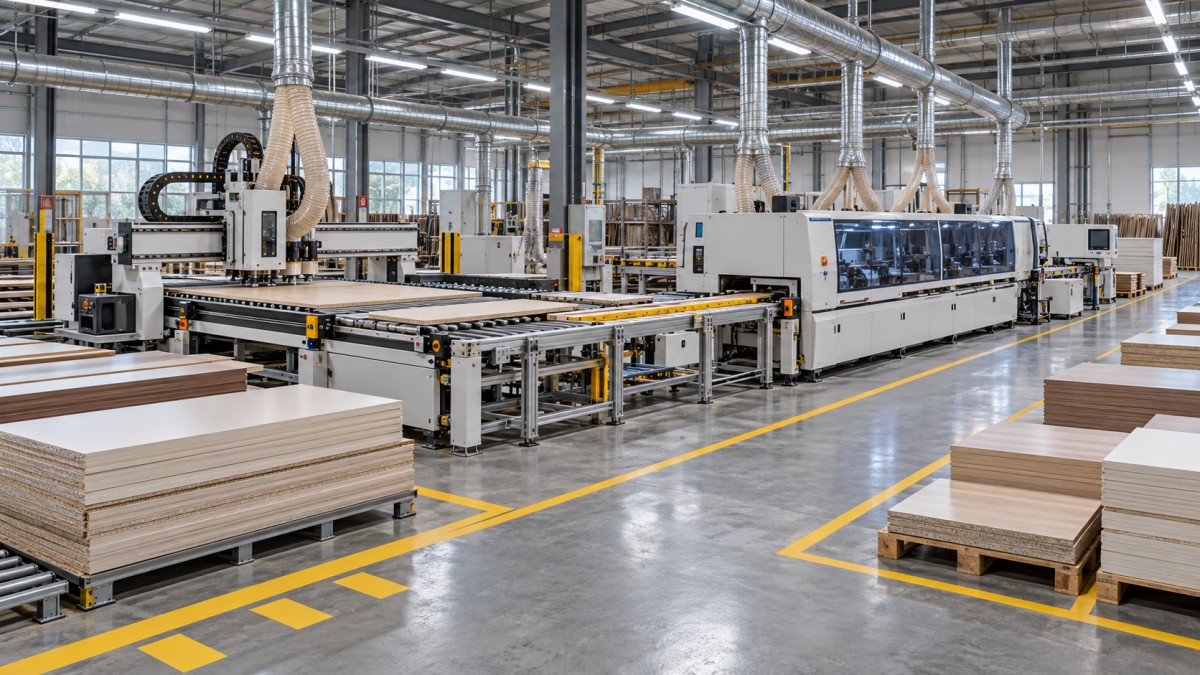
Can the building support the equipment?
Floor loading and floor condition deserve closer attention than they often receive. Many woodworking machines distribute their mass through levelling feet or a limited number of base points. A sound concrete slab is normally suitable for standard stationary machinery, but cracks, uneven areas, weak repairs, trenches, raised joints, or suspended floors require assessment before positioning heavy equipment. Precision machines also need a stable base to retain alignment. An uneven foundation can contribute to inaccurate cuts, inconsistent edge-banding pressure, vibration, and repeated adjustment.
Floor flatness matters particularly for equipment with long bed sections, transfer tables, automated loading devices, or material return systems. Packing under a machine may correct small local variation, but it does not solve a floor that slopes across the working area or moves under load. Drain channels and floor pits can create difficult gaps beneath conveyor legs and machine frames. Their positions should be measured before a final layout is approved.
Ceiling height can become a limiting factor even when the machinery itself is low. Overhead extraction ducts, sprinkler clearances, cable trays, lifting equipment, and sheet-handling devices all occupy vertical space. A compact factory with low roof beams may still accommodate individual machines, but the extraction design could need low-level routing, smaller branches, or a different machine orientation. These choices affect airflow resistance and maintenance access, so they should not be improvised after the machines arrive.
Electrical power is a capacity question, not just a connection question
Existing factories often have an electrical service, but its available capacity may already be committed to lighting, compressors, welding equipment, heating, other production cells, or older machinery. The relevant figure is the usable capacity at the distribution point, together with the voltage, frequency, phase arrangement, protection method, and cable route to each machine. A machine nameplate provides part of the picture, yet associated loads must also be included: extraction fans, vacuum pumps, conveyors, hydraulic units, tool changers, control cabinets, and ancillary handling equipment.
High-load woodworking equipment can create startup demand that is different from its normal running demand. A dust collector fan or large motor may affect the selection of breakers, cable sizing, and motor starting arrangements. Long cable runs can also introduce voltage drop, particularly where a remote addition is supplied from an older panel. Electrical planning should therefore be based on the complete operating group rather than a list of machine motor ratings considered separately.
Compressed air is similarly easy to underestimate. Pneumatic clamps, edge banders, automatic tool systems, spray equipment, and cleaning blowguns can place intermittent but significant demand on the air system. Insufficient pressure at the machine may resemble a mechanical fault: clamps respond slowly, pneumatic functions become inconsistent, or edge-banding units fail to operate in sequence. The cause may be undersized pipework, water in the air line, a weak compressor, or concurrent demand elsewhere in the factory. A clean, dry air supply near the equipment is as important as nominal compressor output.
Dust extraction determines whether the layout will work day to day
Wood dust collection cannot be treated as a final accessory. Each machine produces a different dust type and volume. A planer or moulder can discharge chips rapidly, while a sander produces fine dust that places different demands on filtration and duct design. CNC routers also create fine dust, and their collection performance depends on the hood design, spindle position, workpiece geometry, and whether the machine is cutting through sheet material or machining shallow pockets.
Connecting every machine to an existing collector does not guarantee acceptable extraction. The collector must have enough airflow for the machines intended to run together, and the duct network must maintain suitable transport velocity so chips do not settle in long horizontal runs. Small branch connections, abrupt bends, poorly sealed joints, and excessively long flexible hose can reduce performance. A system may seem adequate when one machine runs alone yet leave visible dust around several machines once parallel production begins.
The duct route must also fit the building. Overhead ducts need clearance from structures and services, while low-level ducts need protection from carts and material handling. Blast gates, cleanout access, filter maintenance space, waste container removal, and outdoor discharge arrangements all influence the location of the collector. If the existing system was designed for lighter equipment, upgrading the fan without reviewing the ductwork can simply move the restriction to another point in the network.
Separate machine access from material traffic
An installed machine needs open access after commissioning. Electrical cabinets, lubrication points, drive belts, pressure rollers, saw blades, cutterheads, sanding belts, and extraction ports all require periodic service. Positioning a machine tightly against a wall may preserve floor space on paper but can make basic maintenance slow and unsafe. Access should also be available for removing a motor, opening a control enclosure, or lifting a heavy component without dismantling adjacent production equipment.
Traffic paths need equally deliberate planning. Forklifts and pallet trucks should not pass through areas where panels are being loaded into a saw or router. Long boards can swing beyond their normal path during manual handling, so crossings near machine infeed zones create avoidable conflict. Finished, sanded, or veneered parts should be protected from raw-board dust, impact damage, and moisture near loading doors. Where space is limited, a marked staging area is often more useful than a large but undefined open floor.
Existing columns are a frequent source of layout errors. A column may not obstruct the machine body, yet interfere with a sliding table, overhead duct, panel turner, safety enclosure, or board-handling path. Measure from the machine's operational envelope, not from its outer panels. The same principle applies to doors: equipment delivery and installation routes must accommodate the largest crated section, not merely the finished machine dimensions shown in a brochure.
Noise, fire separation, and finishing areas need their own review
Machining equipment, extraction fans, compressors, and vacuum pumps can change the noise environment of an older factory. Equipment placed beside offices, inspection areas, or other noise-sensitive activities may require physical separation or a revised position. Vibration from some machines can also travel through the floor or building structure, especially where the equipment is poorly levelled or a fan assembly is unbalanced.
Finishing operations should not be treated as an extension of the machining floor. Sanding dust, open machining, and coating application create conflicting cleanliness and safety conditions. If an existing factory includes spraying, drying, or coating preparation, the movement of parts between those areas needs to avoid contaminating freshly finished surfaces with dust. The location of extraction equipment, storage of finishing materials, air movement, and any required separation must be evaluated against the actual process used at the site.
Installation planning should begin before delivery
A site survey is most useful when it produces a scaled layout and utility plan rather than a general statement that the factory has sufficient room. Record internal door widths and heights, overhead obstructions, column positions, floor levels, electrical panel locations, compressed-air routes, extraction connection points, and the direction of material movement. For replacement projects, identify what equipment will remain in operation during installation and where temporary stock will be placed.
Delivery sequencing matters when the factory has restricted access. Large machines may arrive in several sections, but the heaviest base frame or longest conveyor can still dictate the unloading method. Confirm whether a forklift, crane, pallet jack, or lifting equipment can reach the final position. A machine that is unloaded successfully at the entrance can still become trapped behind a narrow passage, low beam, or operating line.
Before commissioning, the installed equipment should be levelled, secured where required, connected to correctly sized utilities, and checked for free movement of guards, tables, conveyors, and access panels. Dust connections should be complete before cutting trials begin. Initial test pieces should reflect the intended material range, such as particleboard, MDF, plywood, laminated panels, hardwood, or softwood, because the same machine settings may not produce the same result across all materials.
Common installation questions
Is a new factory required for an automated woodworking line?
No. Automation can be integrated into an existing plant when the floor space, material route, electrical supply, extraction capacity, and installation access support the system. Older buildings often require a revised layout or utility upgrade rather than complete replacement.
Can existing dust collection be reused?
It can be reused when its airflow, filtration arrangement, duct sizes, and available connection points match the new operating load. The condition of the fan, filters, duct joints, and waste handling arrangement should be reviewed before relying on it for additional machines.
Why does a machine layout that fits on a drawing fail after installation?
Drawings sometimes omit loading space, board overhang, maintenance access, ductwork, control cabinet clearance, pallet staging, and movement around the machine. A workable plan uses the full operational envelope rather than only equipment length and width.
An existing factory can become an effective woodworking production site when installation is based on measured conditions and the real processing route. The building does not need to be new, but its limits need to be understood before machinery, extraction, and handling arrangements are fixed.
Send Your Inquiry
We welcome your cooperation and we will develop with you.