


News & Exhibitions
Latest Factory Updates, Industry Trends & Global Exhibition Information
When does a CNC panel drilling center make sense for small batches?
For woodworking businesses producing small batches, the decision to invest in a cnc panel drilling center is rarely about volume alone.
Frequent design changes, complex hole patterns, setup time, labor availability, and the cost of errors can all affect the return on investment.
This article examines when automated drilling can make economic sense, what decision-makers should evaluate, and how the right equipment and support can improve flexibility without compromising production efficiency.
When Does the Investment Make Sense?
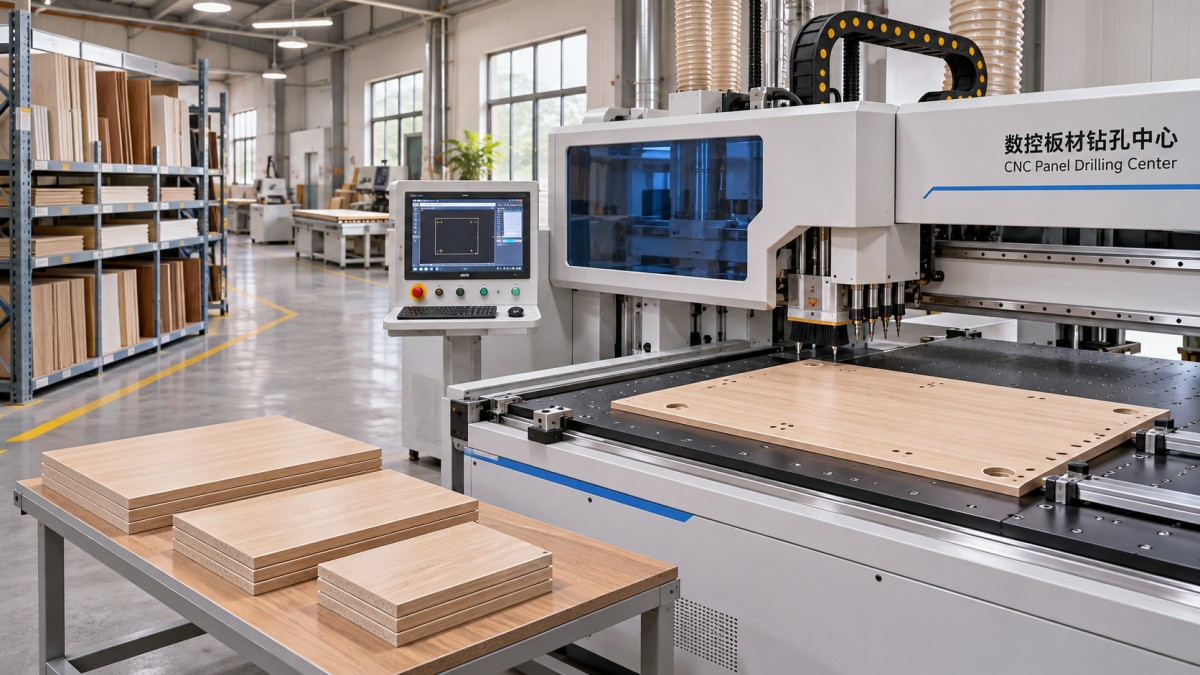
A CNC panel drilling center is most compelling when a workshop handles many different panels, changes jobs frequently, and spends substantial time positioning, drilling, and checking holes.
Small batches do not automatically justify automation. The stronger indicator is whether repeated setups, complex patterns, and correction work consume enough capacity to affect delivery or profitability.
For example, a cabinet maker producing customized kitchens may drill relatively few identical panels but repeat the same hinge, shelf, and connector operations across many orders.
If those operations are prepared digitally and transferred reliably to the machine, the business can reduce repetitive manual work without needing long production runs.
Conversely, a shop drilling a few simple holes each week may find that existing equipment remains more economical, particularly if programming and financing costs are significant.
The decision should therefore be based on total workflow costs and constraints, not a single production-volume threshold or an assumed improvement in machine speed.
Which Small-Batch Workflows Benefit Most?
Customized cabinet and furniture production is a strong candidate when dimensions change between orders but hardware locations follow repeatable rules that software can manage.
Products with many connector, hinge, shelf-pin, and drawer-slide holes can also benefit because manual positioning and inspection become more demanding as hole counts increase.
Another favorable situation is frequent switching between orders. When programs are ready in advance, changeovers may require fewer manual adjustments than conventional drilling setups.
Automation can be valuable where a skilled operator is difficult to recruit or retain. It can reduce dependence on repetitive positioning skills, although trained supervision remains necessary.
Businesses experiencing avoidable rework should examine whether drilling errors cause scrapped panels, assembly delays, replacement shipments, or installation visits that are currently underreported.
The case is weaker when panels arrive inconsistently sized, drawings change after release, or hardware specifications are unreliable. Automation cannot correct inaccurate production information by itself.
It is also weaker when drilling is not the constraint. If cutting, edging, assembly, or order approval controls delivery, improvements elsewhere may provide better returns.
How Should You Calculate the Business Case?
Start with actual orders rather than a supplier's maximum throughput figure. Select a representative period that includes standard work, custom projects, and normal interruptions.
Record the number of panels drilled, setups completed, holes or operations required, and hours spent preparing, drilling, inspecting, and correcting work.
Separate productive time from waiting and handling. A machine may drill quickly while operators still spend significant time loading panels, checking programs, or moving material.
Next, estimate the annual cost of the current process. Include labor, tooling, maintenance, scrap, rework, and any outsourced drilling that the investment could realistically replace.
Then calculate the expected annual cost of the proposed process using comparable assumptions. Include programming, machine operation, consumables, maintenance, software, and additional material handling.
Annual operating savings equal current annual process costs minus projected annual process costs. Add incremental contribution from extra sales only when demand and downstream capacity support it.
For a simple payback estimate, divide the total installed investment by expected annual net benefit. This is a screening measure, not a complete financial appraisal.
For example, suppose installation and training bring the investment to $80,000, while verified labor, rework, and outsourcing savings total $25,000 per year.
If added software, tooling, and maintenance costs are $5,000 annually, net annual benefit is $20,000 and simple payback is approximately four years.
This illustration excludes financing, tax, depreciation, inflation, and residual value. Include those factors in a discounted cash-flow assessment when comparing capital projects.
Test conservative, expected, and favorable scenarios. Vary utilization, actual labor hours saved, error reduction, and programming time to see which assumptions determine the outcome.
Be careful not to count theoretical labor savings as cash savings unless hours can actually be reduced, overtime avoided, outsourcing eliminated, or capacity reassigned productively.
What Costs Are Easy to Miss?
The purchase price is only part of the commitment. Request a written breakdown covering delivery, unloading, installation, commissioning, operator training, and any required building modifications.
Confirm electrical supply, compressed air, extraction, network access, and floor-space requirements before finalizing the budget. Site preparation can materially change the project cost.
Ask whether software licenses, post-processors, updates, technical support, and additional user seats are included or billed separately, including their renewal terms.
Budget for drills, replacement parts, calibration, scheduled maintenance, and potential downtime. Ask which parts are stocked locally and how quickly critical components can be supplied.
Training has an opportunity cost as well. Allow for reduced output during commissioning, programming setup, trial production, and the period before operators become confident.
Finally, evaluate financing and cash flow. A project with attractive long-term savings may still strain a small business if repayments arrive before production benefits are established.
How Do You Choose the Right Machine?
Begin with your panel mix: minimum and maximum dimensions, thicknesses, materials, hole diameters, and drilling directions. Ask suppliers to confirm compatibility for actual components.
Check whether the machine can reach all required faces and edges, and identify operations that still need another setup or a separate machine.
Review drill-bank configuration, spindle options, clamping, positioning, and material support against your most common jobs. Extra capability has value only when you will use it.
Accuracy should be evaluated on finished parts, not a brochure alone. Request a demonstration using representative materials, tolerances, and hardware installation requirements.
Examine how the control handles mirrored parts, offsets, reference edges, and last-minute revisions. These details often determine whether custom work flows smoothly.
Ask how programs are created and imported, which file formats are supported, and whether your existing design software requires a paid integration or custom post-processor.
Measure the full process during the demonstration: program preparation, loading, drilling, unloading, inspection, and changeover. Include small and irregular jobs, not just ideal samples.
Clarify safety provisions, guarding, extraction requirements, and applicable compliance obligations for your location. Obtain the relevant documentation before making a purchase decision.
Finally, compare service response, remote diagnostics, training language, spare-parts availability, warranty exclusions, and the supplier's ability to support your production schedule.
Why Cutting Quality Still Matters
Drilling accuracy depends on reliable panel dimensions and reference edges. Poor cutting upstream can create alignment problems even when drilling programs and machine positioning are correct.
A workshop should therefore assess cutting and drilling together, particularly when custom panels move between operators or when finished dimensions vary across jobs.
For panel preparation, the ZD3200 is a sliding table saw, not a CNC drilling center, and serves a different stage of production.
Its 3,200 mm sliding table and stated 3,200 mm maximum cutting length support panel-cutting work; suitability still depends on material, handling, and production requirements.
The saw also has an electrically lifted main blade and a manually tilting saw group. Confirm specifications and available configuration with the supplier before ordering.
Improving the cutting process can support a drilling investment, but a new saw is not automatically necessary if existing equipment already produces consistent panels.
How Can You Reduce Implementation Risk?
Before signing, provide prospective suppliers with sample drawings, material specifications, hardware requirements, and expected order volumes. Request a documented proposal based on those inputs.
Agree on acceptance criteria for hole positions, repeatability, supported panel sizes, software connectivity, and operator training. Define how each requirement will be tested.
Run a pilot with a manageable product family. Compare actual preparation time, throughput, errors, and operator workload with the baseline used in your business case.
Assign ownership for drawings, program revisions, tooling, and maintenance. Clear responsibility prevents incorrect files or worn drills from undermining the expected gains.
Keep a fallback procedure for urgent work during installation or downtime. Depending on the operation, that may involve existing equipment or a qualified subcontractor.
Review results after the team has completed training and processed a representative mix of orders. Adjust programming standards and scheduling before expanding to additional products.
Qingdao Zhongding Machinery describes its offering as woodworking equipment and support for international customers. Confirm drilling-center availability, specifications, and local service arrangements directly for your project.
When Should You Wait?
Postpone the purchase when the business case depends on unconfirmed orders, optimistic utilization, or labor savings that cannot be converted into measurable financial benefit.
Waiting may also be sensible if your design data is inconsistent, panel flow is disorganized, or a downstream bottleneck would prevent additional output from becoming sales.
In those situations, standardizing hardware libraries, improving drawings, maintaining existing machines, or outsourcing occasional complex work may provide a lower-risk first step.
A CNC panel drilling center makes sense for small batches when repeatable process savings and operational benefits outweigh the full investment under realistic production conditions.
Use representative jobs, documented assumptions, and a supplier demonstration to decide. The right investment should improve the whole workflow, not simply automate one operation.
Send Your Inquiry
We welcome your cooperation and we will develop with you.