


News & Exhibitions
Latest Factory Updates, Industry Trends & Global Exhibition Information
How Does CNC Side Drilling Equipment Keep Hole Patterns Aligned Across Batches?
CNC side drilling equipment keeps hole patterns aligned across batches with rigid frames, servo positioning, and stored programs. Learn how datum control, clamping, and calibration prevent rework.
Anyone who has run panel furniture in batches knows where the trouble appears. It is rarely on the first cabinet. The first batch assembles well, the second is close enough, and by the fifth or sixth batch a side panel that should accept a row of dowels needs persuasion, a shelf sits slightly out of level, or a stack of parts has to be re-drilled. Nothing dramatic has broken. The pattern has simply wandered, a fraction of a millimetre at a time, until the tolerance assembly can absorb is used up.
That slow wander is what this type of equipment is built to prevent. A manual jig depends on the operator setting and resetting it for every job, and every reset lets a small difference enter. CNC side drilling equipment takes a different approach: it fixes the reference once, moves to stored coordinates under servo control, and repeats the same cycle without asking anyone to measure again. Keeping patterns aligned across batches is not one feature. It is datum control, a frame that does not flex, clamping that holds the panel in a known position, and calibration that keeps the machine's numbers honest, working together.
Alignment is a system, not a single setting
Three things meet at the moment the bit enters the panel edge: the position of the panel against its references, the position of the drilling unit along its axes, and the program that told the unit where to go. If any one of the three changes between batches, the pattern changes with it, even if the other two are perfect.
Older methods usually control only one of the three well. A well-made jig controls the panel position, but drilling position still depends on stops set by hand, which can be knocked or reset slightly differently. A powerful drilling unit on a light frame controls the cut, but the frame moves under load. CNC side drilling equipment holds patterns consistently because it controls all three at once, and removes the hand-set steps where most batch-to-batch variation used to enter.
The datum: where every batch starts from
Every accurate hole pattern starts from a datum — the fixed reference the machine measures from. On a side drilling machine the datum is normally two surfaces: a fence or stop that locates the panel along its length, and a support that locates it through its thickness. The panel is pushed to the same datum at the start of every cycle, so hole number one is always measured from the same origin, whether it is the first panel on Monday or the four hundredth on Friday.
This is where conventional setups quietly lose accuracy. If the operator sometimes references from the left end of a panel and sometimes from the right, any small error in panel length appears inside the hole pattern. If panels are flipped differently between batches, the pattern shifts with the reference face. A CNC setup removes that choice: loading position, reference edge and zero point are fixed in the machine and the program, so the fiftieth batch starts from the same origin as the first.
One reference face, used the same way every time
The practical rule is simple: pick one face and one end of the panel as the reference, and use them for every operation that has to match. When the cutting list, the drilling program and the assembly drawing all work from the same reference, small variations in panel size fall on the non-critical side of the part instead of inside the hole pattern. When a pattern suddenly shifts by the thickness of an edge band, the cause is almost always a changed reference, not a faulty machine — and a fixed datum makes that mistake hard to make twice.
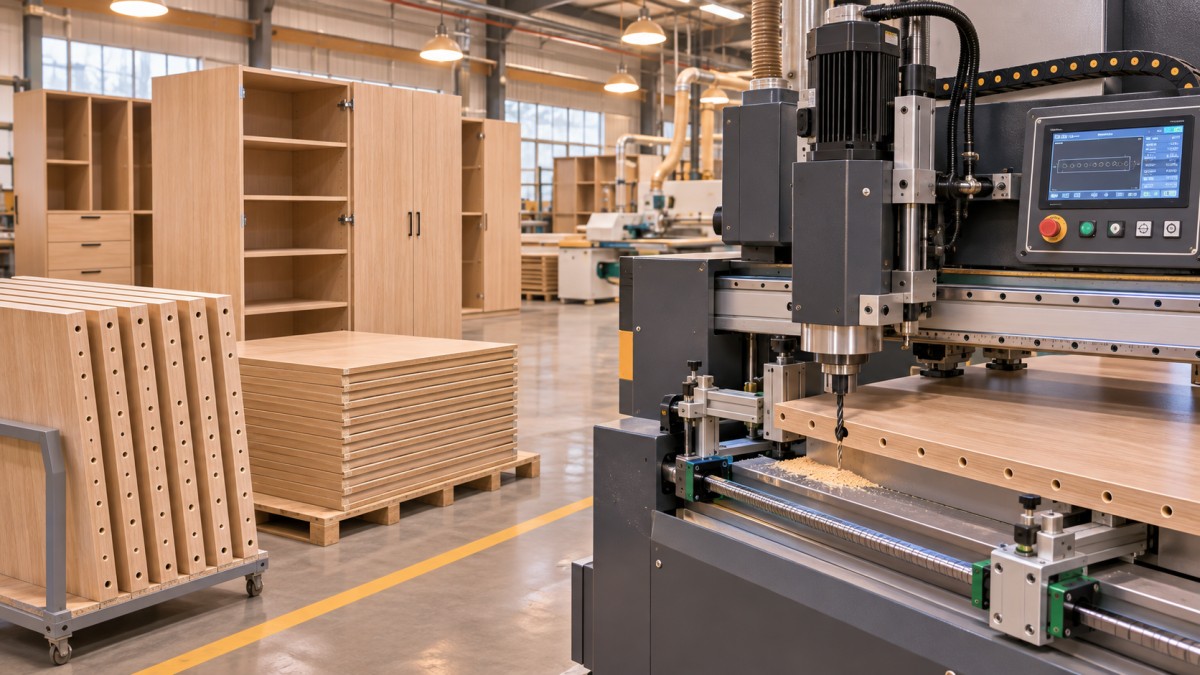
A rigid frame and guided movement remove play before it becomes error
A drilling unit does not push gently. Each bit entering a panel edge applies side load and vibration, and a batch multiplies that load by thousands of cycles. If the frame or guideways flex even slightly, the drill arrives a fraction off its commanded position — usually in the same direction, which is why flex shows up as a consistent pattern shift rather than random scatter.
Well-built cnc side drilling equipment answers this with mass and guidance rather than correction after the fact. A heavy, stress-relieved frame absorbs vibration instead of transmitting it to the workpiece. Linear guides and ball screws keep the carriage on a defined path with minimal play, so the position the control asks for is the position the spindle reaches, in both directions of travel. Backlash — the small dead movement when an axis reverses — is designed out mechanically and compensated in the control for what remains. It is the difference between a machine that holds its pattern for a shift and one that holds it for a season.
Servo positioning and stored programs repeat a position instead of re-measuring it
A stored program does more than save time: it removes re-measurement from the process. When a hole pattern is created once, checked once and saved, every later batch runs those same coordinates. Nobody scales from a drawing again, nobody sets a stop against a ruler again, and nobody transposes two digits on a Friday afternoon. The pattern cannot drift because of a setting error that was never re-entered.
Servo drives make those coordinates physical. Each axis moves under closed-loop control: the drive is commanded to a position, an encoder reports the actual position, and the control corrects any difference before the cycle continues. That loop runs continuously, so a change in resistance or a dull bit slowing the axis does not quietly become a position error. Add automatic program recall — selecting the job on the control, or scanning a label on the panel — and the machine also removes the wrong-program risk, which in practice scraps more batches than mechanical wear does. The operator's job shifts from measuring and setting to loading correctly and checking the first piece.
Clamping that holds the panel without distorting it
None of the above matters if the panel moves. A panel that creeps a third of a millimetre as the first bit bites carries that error through every hole in the cycle — neat, repeatable and wrong. Pneumatic clamps and pressure beams on CNC equipment work in sequence: first seat the panel firmly against the datum, then hold it flat and still while drilling happens.
The detail that separates good clamping from merely strong clamping is restraint without distortion. Too little pressure and the panel shifts under drilling load, especially long panels held near one end. Too much, in the wrong place, and a thin panel bows, is drilled in its bowed state, and springs back afterwards with the holes displaced. Correct pressure, clamp positions matched to panel size, and clean datum surfaces keep the workpiece in the one position the program assumes. Extraction matters to accuracy for the same reason: fine dust packed against a fence is a shim nobody intended to fit.
Calibration and compensation keep the numbers honest
A machine can repeat a wrong position perfectly. Repeatability keeps batches consistent with each other; calibration keeps them consistent with the drawing. Over time, bits are changed, a spindle is serviced, a stop takes a knock, and thermal growth moves things by small amounts. Calibration compares what the machine does against a known standard and corrects the difference before it becomes rework.
In practice this is a short list of checks done on a rhythm rather than after a failure: a test panel measured after a tool change, axis positions verified against a gauge or reference part, tool values updated when bits are replaced, and compensation reviewed when the same offset appears twice in a row. One offset is a warning. The same offset on the next check is a correction waiting to be entered.
Corrections are entered as values, from measurements, one at a time — never adjusted by feel. That discipline stops a well-meaning tweak from becoming the next batch's problem.
What the machine cannot correct: the panels themselves
Honesty about limits matters here. The equipment references the panel it is given. If panels arrive with edges that are not straight, faces not square to the edge, or thickness varying across a batch, the holes will be accurate relative to a faulty reference — which on the assembly bench reads as misalignment. A batch of nominally 18 mm board running from 17.6 to 18.4 mm will show hole centres wandering through the thickness however well the machine is calibrated, because the centre of the edge genuinely sits in a different place on each panel.
The fix is upstream: cutting accuracy, storage that keeps panels flat, and sorting or rejecting stock that is out of tolerance before it reaches the drill. Shops with the best batch consistency treat panel preparation and drilling as one process. The machine stops adding its own variation on top of the material's — and first-piece checks expose material problems on panel one instead of panel one hundred.
When a pattern still drifts, read the error before touching a setting
Even a well-kept machine will occasionally produce a shifted batch, and the shape of the error is the best guide to its cause. If every hole has moved by the same amount in the same direction, something at the datum or in the program origin has changed — a stop, a reference face, or the wrong job file. If the error grows along the panel, look for flex, a worn guide, or a panel not seating along its full length. If the error is random from hole to hole, suspect movement during the cut: clamping, a dull bit deflecting, or dust under the panel. If the first batch is right and later batches wander, think about heat and datum faces slowly packing with fine dust.
Work in that order — panel, datum, clamp, then machine settings. Compensating for a dirty datum or a slipping clamp writes a false correction into a stored program, where it will quietly damage the next batch that never had the original fault.
Qingdao Zhongding Machinery Co., Ltd. has supplied woodworking machinery to furniture manufacturers, panel workshops and industrial production lines for more than 20 years, and batch consistency is one of the subjects buyers raise most often. The answer is rarely a single component. It is the frame, the datum design, the servo system, the clamping and the calibration routine working together — and a supplier who can explain how those parts interact on your panels, and support the machine after installation, is worth as much as any figure on a specification sheet.
Hole patterns stay aligned across batches when nothing in the process is left to be re-decided each time. The datum is fixed, the frame does not flex, the servos go to stored coordinates and report back, the clamps hold the panel where the program expects it, and calibration removes the small errors that wear and time introduce. Set that system up once, check the first piece of every batch, and the tenth batch assembles like the first — which, in a furniture workshop, is the whole point.
Send Your Inquiry
We welcome your cooperation and we will develop with you.