


News & Exhibitions
Latest Factory Updates, Industry Trends & Global Exhibition Information
Preventing Unplanned Downtime With a Woodworking Machine Spare Parts Service Plan
Downtime Is Usually a Parts-Readiness Problem Before It Becomes a Repair Problem
When a woodworking machine stops unexpectedly, the visible fault may be a worn bearing, damaged sensor, failed contactor, broken belt, or leaking pneumatic valve. The production loss, however, often begins earlier: the required part is not identified correctly, is not stocked, cannot be dispatched quickly, or arrives without the information needed to install and calibrate it.
For after-sales maintenance personnel, a woodworking machine spare parts service plan is therefore more than an inventory arrangement. It is a practical method for reducing the time between fault identification and stable restart. It defines which parts matter, where they should be held, how they are verified, who can authorize their use, and what technical support is available when a replacement alone will not solve the problem.
A service plan is most valuable where a machine supports a production bottleneck, a short batch schedule, a continuous line, or an operation that depends on consistent dimensional accuracy. It may be less elaborate for a lightly used standalone machine with readily available standard components. The right approach depends on the machine’s role, failure history, lead times, and the maintenance team’s ability to diagnose faults accurately.
Start With the Consequences of a Stop, Not a Generic Spare Parts List
Many spare-parts programs fail because they begin with a broad catalog and end with shelves full of components that are rarely used. A more useful starting point is to ask what happens when each machine or subsystem stops. A fault on a dust extraction accessory may be inconvenient; a fault on the feed system of an edge bander, CNC router, panel saw, sanding line, or drilling center may halt downstream work immediately.
Maintenance teams should classify equipment by production consequence rather than by purchase value alone. An inexpensive limit switch can create a long outage if it is model-specific and the machine cannot operate safely without it. Conversely, an expensive motor may not require local stocking if it is robust, can be repaired through an approved route, and does not have an excessive supply lead time.
A workable review normally separates parts into three groups:
- Production-critical parts: Components whose failure stops the machine or prevents safe operation, especially where the replacement is machine-specific or has a long lead time.
- Wear and service parts: Items expected to be consumed or replaced during planned maintenance, such as belts, chains, bearings, filters, brushes, seals, cutters, pressure rollers, and lubricating-system components.
- Repair-on-demand parts: Lower-risk or high-cost components that do not justify local stock but require an identified supplier route, clear technical specifications, and an agreed response process.
This classification should be specific to the installed machine configuration. Two machines with the same basic model designation can have different electrical layouts, controller versions, spindle options, safety devices, or pneumatic assemblies. A parts list that ignores those differences can look complete until the first urgent repair reveals that the connector, voltage, firmware, dimensions, or mounting arrangement does not match.
Build the Plan Around Failure Modes That Cause Long Recovery Times
Maintenance personnel generally know which parts fail often. Those parts deserve attention, but frequency is only one factor. A component that fails rarely can still be a priority if it takes days to source, requires a special setting procedure, or can cause secondary damage when it fails.
Consider a servo drive, inverter, PLC module, encoder, or specialized touch-screen interface. It may not be appropriate to keep one of every electronic assembly in local inventory. Yet if a particular control component is unique to a production-critical machine, has a constrained supply route, and cannot be substituted safely, its absence can turn a short diagnosis into an extended shutdown. The decision to stock it should be based on outage exposure, not only on historical failure count.
The same principle applies to mechanical components. Feed rollers, pressure pads, linear guide blocks, spindle bearings, timing belts, chain assemblies, and pneumatic cylinders can affect both availability and product quality. A machine may continue to run with a degrading part, but the result may be poor edge quality, inaccurate drilling, inconsistent panel dimensions, vibration, burn marks, or surface damage. By the time the machine stops completely, the repair may involve more than the original worn component.
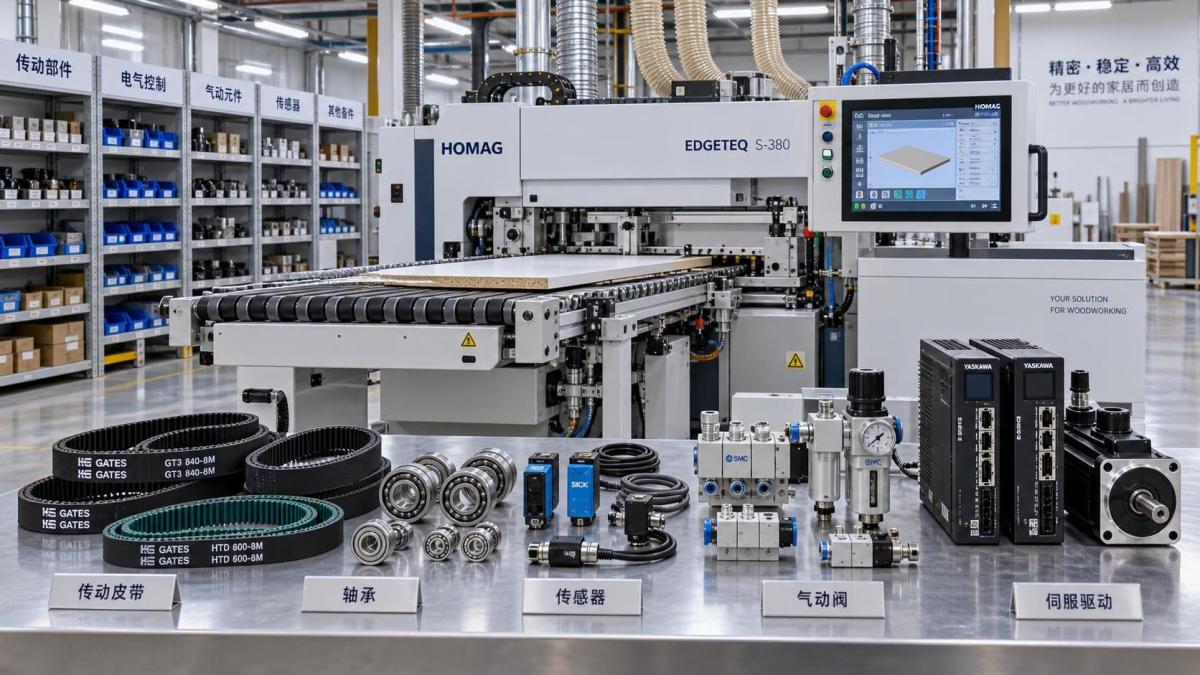
A useful failure-mode review records four practical details for each significant part:
- The symptoms that maintenance staff are likely to observe before complete failure.
- The impact of failure on safety, production capacity, and finished-part quality.
- The correct replacement part number, revision level, and applicable machine serial number.
- The expected replacement procedure, including alignment, parameter backup, software settings, lubrication, and functional checks.
This information prevents a common problem in emergency repairs: a team receives the correct-looking part but lacks the supporting details needed to return the machine to its previous operating condition.
Part Identification Is a Technical Control, Not an Administrative Detail
Incorrect part identification is one of the most avoidable causes of extended downtime. It is especially common with electrical parts, cutterhead assemblies, pneumatic components, and items that have been modified during the machine’s life. A label may be worn, a part may have been replaced by an earlier technician, or an equivalent-looking component may have different performance characteristics.
For every critical spare, the service record should connect the component to the machine rather than relying on a generic description such as “proximity sensor” or “spindle belt.” The record should include the machine model, serial number, subsystem location, manufacturer part number where applicable, internal stock code, technical rating, connector or mounting information, and photographs where those reduce ambiguity.
For electronic components, configuration control matters as much as physical compatibility. A replacement drive may require parameter loading. A controller may need a program backup, communication setting, or axis configuration. A servo motor may require encoder compatibility and correct tuning. Replacing a failed unit without restoring these settings can create a second failure that appears unrelated to the original problem.
A good woodworking machine spare parts service arrangement should also define when an alternative part may be used. Substitution can be reasonable for standardized bearings, pneumatic fittings, contactors, filters, and certain sensors, provided the technical specification is checked. It is riskier for safety devices, control hardware, precision mechanical assemblies, and parts that affect motion accuracy. “Close enough” is not a reliable standard where machine safety, panel quality, or control stability is involved.
Stock Levels Should Reflect Lead Time and Exposure, Not Guesswork
Keeping too few parts creates emergency freight, rushed decisions, and prolonged production interruptions. Keeping too many creates aging inventory, obsolete electronics, duplicated stock, and poor visibility over what is actually usable. The service plan needs a defined stock policy for each critical item.
The basic questions are straightforward. How long does the part take to obtain? Is it available locally or only through the machine supplier? Is it common across several machines? Can the failed unit be repaired? Does the machine have a temporary operating mode? How much production is affected during the wait? Is the part vulnerable to shelf-life limits, moisture, corrosion, or software obsolescence?
Some stock decisions are simple. Consumables and predictable wear parts can often be replenished through planned maintenance cycles. Other parts need a more deliberate decision. For instance, a drive belt may be inexpensive but deserve two or more units if it is specific to a high-use feed system. A specialized electronic module may warrant one controlled spare shared across similar machines, provided it is stored properly and its compatibility is documented.
Inventory quality also matters. Bearings and belts should be protected from contamination and deformation. Electronics require dry, controlled storage and protection against electrostatic damage. Pneumatic seals and adhesives can have storage limits. Spare parts should be periodically inspected, labeled clearly, and reconciled with the current equipment list. A part that exists in a warehouse but cannot be found, has deteriorated, or belongs to a retired machine does not protect uptime.
Connect Spare Parts Supply to Preventive Maintenance
A spare parts plan works best when it follows the maintenance schedule rather than operating as a separate emergency function. Planned inspections create early warning: abnormal vibration, heat buildup, air leaks, belt wear, loose connectors, inconsistent feed pressure, unusual spindle noise, or repeated alarms can indicate that a replacement should be prepared before failure interrupts production.
For woodworking machinery, preventive work should be tied to the conditions that accelerate wear. Dust contamination, inadequate extraction, insufficient lubrication, unstable compressed air, voltage fluctuation, poor panel handling, and incorrect tool setup can shorten component life. Replacing parts without addressing these contributors simply resets the failure cycle.
After replacing a part, the technician should confirm more than machine movement. The return-to-service check should cover safety circuits, guarding, axis reference positions where applicable, feed behavior, pneumatic pressure, lubrication flow, extraction effectiveness, alarm history, and output quality. On precision equipment, a short verification piece or dimensional check can reveal alignment or parameter issues before production resumes.
That final check is often where a parts service plan delivers its largest value. The objective is not merely to make the alarm disappear. It is to restore stable operation without creating a quality problem that reaches the next process or the customer.
Define the Supplier Support Needed During an Urgent Repair
Not every fault can be resolved by sending a component. A machine may show symptoms caused by wiring damage, poor grounding, air contamination, incorrect adjustment, failed safety interlocks, mechanical binding, or a parameter issue. In these cases, spare parts availability must be supported by a clear technical communication path.
Maintenance teams should know what information to prepare before requesting assistance. A concise fault package can include the machine identification, alarm code, photographs of the affected assembly, video of the operating condition where useful, recent maintenance history, electrical readings taken under safe procedures, and confirmation of any parts already replaced. This reduces the risk of repeated shipments based on an incomplete diagnosis.
Supplier responsiveness is important, but so is the quality of the information exchanged. For machinery used in furniture plants, workshops, and industrial production lines, support is more effective when the supplier can trace the machine configuration and provide installation guidance, wiring references, adjustment instructions, or parameter recovery steps relevant to that unit.
Before relying on a spare-parts service provider, maintenance managers should establish practical expectations for part identification, quotation detail, stock visibility where available, shipment options, technical escalation, and documentation. These are operational controls, not contractual formalities. During an unplanned stop, unclear ownership between the maintenance team, purchasing department, and supplier can add more delay than the repair itself.
Use Each Failure to Improve the Next Response
Unplanned downtime should leave behind a better maintenance record. After a significant repair, record the failed part, observed symptoms, root cause where it can be established, replacement time, parts lead time, production impact, and any setup actions required after installation. The purpose is not to create a lengthy report for every incident. It is to identify repeat failures, missing critical spares, weak preventive checks, and parts that are difficult to source correctly.
Patterns are especially useful when a machine repeatedly stops for related reasons. A recurring sensor failure may point to cable routing, vibration, dust ingress, or incorrect mounting. Repeated bearing damage may indicate alignment, overload, contamination, or lubrication issues. Frequent pneumatic valve problems may be linked to air quality rather than the valve itself. Adding more stock without correcting the cause increases inventory cost but does little for availability.
A disciplined woodworking machine spare parts service plan gives after-sales maintenance personnel a clearer path during the pressure of a breakdown: identify the fault accurately, obtain the right component, install it with the required technical controls, verify the machine’s output, and feed the lesson back into the plan. That is how spare parts move from being a warehouse expense to becoming a practical defense against avoidable downtime.
Send Your Inquiry
We welcome your cooperation and we will develop with you.