


News & Exhibitions
Latest Factory Updates, Industry Trends & Global Exhibition Information
CNC Saw vs. Beam Saw: Which Cutting Method Fits High-Mix Panel Orders?
For high-mix panel production, the better cutting method is usually determined by how often the cutting pattern changes, how much material variety must be handled, and whether the shop needs optimization at the individual-job level. A beam saw remains hard to beat when similar cabinet parts or standard panels run in repeatable batches. A CNC saw becomes more compelling when order composition changes throughout the day, parts include irregular shapes or cutouts, and manual re-planning is starting to consume too much production time.
The common mistake is to compare only feed speed or sheets per shift. That comparison favors the beam saw in many stable production environments, but it does not capture the cost of waiting, reprogramming, sorting, remaking, or moving work to a second machine for non-rectangular operations. Technical evaluators should assess the entire path from incoming order to correctly labeled parts ready for the next process.
High-mix work changes what “efficient” means
A high-mix panel operation may process a different combination of board thicknesses, decors, grain directions, cabinet dimensions, hardware patterns, and order quantities every day. One job may be a small batch of customized wardrobes; the next may involve office furniture components, utility cabinets, or replacement panels. Batch size can be low even when the total daily sheet volume is substantial.
In this environment, efficiency is less about maintaining one long uninterrupted cutting cycle and more about reducing the friction between jobs. The cutting method has to absorb frequent changes without creating excessive setup work or increasing the chance that the wrong program, material, orientation, or label reaches production.
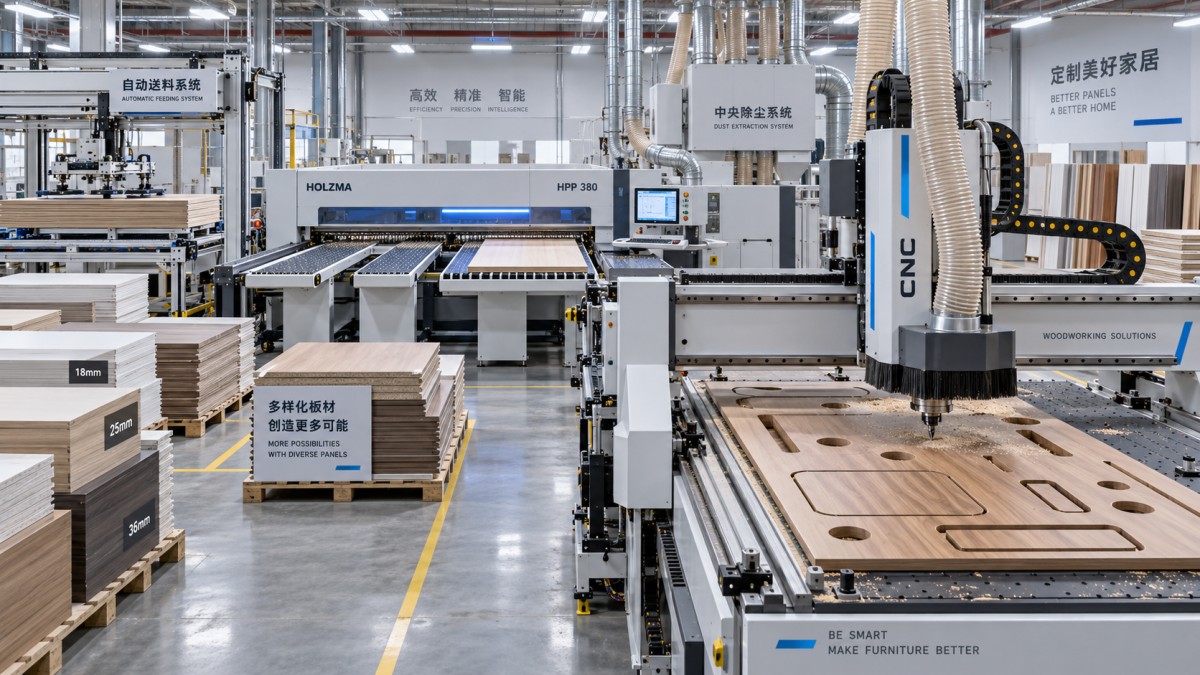
A beam saw is designed around a disciplined flow: panels are loaded, clamped, cut according to an optimized pattern, and pushed through a controlled sequence of rip and cross cuts. For rectangular components from sheet goods, this remains a highly productive method. When jobs have repeated dimensions and the production schedule can group similar materials, beam-saw throughput is often excellent.
A CNC saw, including equipment commonly described in searches as a scie cnc, works from a different production logic. It trades some pure straight-cut throughput for flexibility. The machine can cut shaped parts, machine cutouts, process drilling patterns, and adapt to individual part geometry within the same programmed workflow, depending on its configuration. That broader capability matters when the order mix makes separate cutting and machining stages difficult to coordinate.
Where a beam saw still has the stronger case
Choosing a beam saw for high-mix work is not automatically a compromise. It can be the sounder investment when the “mix” is mostly a variation in dimensions rather than a variation in process requirements. A shop making many different cabinet sizes may still have a strong beam-saw profile if nearly all parts are rectangular, panel materials are reasonably standardized, and downstream drilling or edge processing is already organized around labeled parts.
Beam saws tend to fit well when the operation can do the following:
- Combine orders into material-based cutting batches without delaying delivery.
- Use repeatable cutting patterns for a large share of production.
- Keep the majority of parts rectangular and free of internal cutouts.
- Maintain a clear labeling and part-sorting process after cutting.
- Send panels to dedicated CNC machining centers only when secondary operations are required.
In this setup, the beam saw performs the role it was built for: converting sheet material into a high volume of square, accurately sized blanks with low cutting time per part. Its strengths are especially visible when sheets are handled automatically and the cutting list software reduces offcut waste and operator calculation. The machine is also easier to justify when a separate machining center already has available capacity for holes, grooves, and shaped components.
However, a high cutting rate does not eliminate the need to look at material flow. A beam saw may produce a large number of parts quickly, but those parts must be identified, stacked, protected, and delivered to the correct downstream operation. As order variety increases, the sorting burden can become a larger source of errors than the cutting operation itself.
When CNC cutting brings more value than a faster saw cycle
A CNC cutting solution earns its place when the shop is repeatedly breaking the normal beam-saw flow. This often happens when rectangular cutting is only the first step and panels then require routing, internal openings, grooving, drilling, contouring, or hardware-related machining. Moving partially completed parts between machines can be practical for regular production, but it becomes less attractive when each batch has its own requirements.
Consider a typical custom furniture order containing side panels, doors, shelves, gables, curved parts, cable openings, and panels with a different drilling pattern. A beam saw can produce many of the rectangular pieces efficiently, but the work still has to be organized around multiple handoffs. The production team must ensure that each panel is cut correctly before machining, that grain direction is preserved, and that the right program is selected later. A CNC solution can reduce those handoffs by processing more of the part definition in one controlled operation.
That does not mean every high-mix manufacturer should replace a beam saw with a CNC router or CNC panel-processing system. CNC cutting commonly introduces its own constraints: tool changes, routing time, hold-down requirements, vacuum performance, tooling management, nesting strategy, and the possibility of slower sheet processing for simple rectangular parts. The benefit appears when these added capabilities remove larger losses elsewhere in the workflow.
Do not confuse nesting yield with total material efficiency
Nesting is often presented as a decisive argument for CNC cutting, especially for variable shapes. It can improve utilization when parts cannot be arranged in straight saw-cut patterns, when offcuts have little reuse value, or when the job includes many small and irregular components. Yet the best nesting percentage on screen is not automatically the best result for the factory.
Technical evaluation should include the practical cost of the nesting plan. Very tight layouts can increase routing distance, produce small unstable remnants, complicate unloading, or require more tabs and cleanup. They may also create part sequences that are inconvenient for edge banding, drilling, or assembly. A modestly lower theoretical yield can be the better production choice when it produces cleaner part handling and fewer interruptions.
Beam-saw optimization has a similar limitation. It can minimize trim loss on rectangular panels, but the outcome depends on whether planned offcuts can actually be stored, identified, and used later. A shop that accumulates irregular remnants without a disciplined reuse system may see less real benefit than its optimization report suggests.
The relevant calculation is therefore broader: usable yield per sheet, labor spent handling remnants, risk of damage or mix-ups, and the likelihood that leftover material will be consumed by future orders. Neither method should be selected on material yield alone.
Accuracy is a system issue, not a machine brochure figure
Both beam saws and CNC machines can produce precise panel parts when they are properly installed, maintained, programmed, and operated. For high-mix work, repeatability across changing jobs often matters more than the machine’s stated positional accuracy. A technically capable machine can still produce poor assemblies if panel references are inconsistent, programs are generated from incomplete design data, or operators compensate for wrong dimensions outside the controlled workflow.
With a beam saw, focus on squareness, repeatable fence positioning, cut quality on the material range, and the stability of panel support during cutting. Chip control deserves particular attention when working with coated panels, veneered boards, or decorative surfaces. Scoring arrangements, blade selection, pressure settings, and material condition all influence edge quality.
With a CNC cutting system, verify more than axis positioning. Check the condition and capacity of the vacuum zones, spoilboard management, tooling suitability, chip extraction, panel registration, and the behavior of small parts during machining. A program that looks correct can still fail in production if workholding is not sufficient for the part shape, board surface, or machining load.
For either option, ask suppliers to demonstrate representative production files using the material types and part families that create the most difficulty in the proposed application. A demonstration based only on full-size melamine rectangles will not reveal much about a production mix containing narrow rails, small panels, routed openings, high-gloss faces, or grain-sensitive components.
Changeover should be measured from the last good part to the next good part
Published setup time often describes only a portion of a real changeover. For a beam saw, the practical transition may include material loading, saw-program selection, label preparation, offcut decisions, stack clearing, and operator confirmation that the next batch is organized correctly. For CNC cutting, it may include tool preparation, vacuum configuration, spoilboard inspection, nesting generation, material positioning, and first-part verification.
The right question is not which machine has fewer setup steps in isolation. It is how reliably the factory can complete those steps when the schedule changes several times a day. High-mix production rewards methods that make it difficult to process the wrong part, use the wrong board, or lose the connection between the digital order and the physical component.
Software integration is central here. A beam saw paired with robust cut-list generation, barcode labels, and downstream part tracking may handle a diverse order stream far better than an isolated CNC machine. Conversely, a CNC system connected directly to design and production data may reduce interpretation and re-entry errors that arise when the same job passes through separate cutting and machining programs.
A practical decision framework for technical evaluators
Rather than starting with a machine category, begin with a representative sample of orders. Select jobs that reflect the difficult end of the normal mix: short runs, multiple materials, unusual dimensions, shaped pieces, internal machining, and tight delivery requirements. Map the route each part follows from board issue through cutting, machining, edge banding, and assembly.
Then compare the two methods against the production losses that actually occur:
- How many times does a panel need to be handled before it is ready for the next process?
- How often must operators sort, relabel, or search for parts after cutting?
- Which parts require a second machine after beam-saw processing?
- How many orders are delayed because they cannot be grouped efficiently?
- Which material and part types create the highest reject risk?
- Can the available operators maintain the programming, tooling, and maintenance discipline required by the selected method?
There is also a legitimate hybrid answer. Many furniture manufacturers benefit from retaining a beam saw for repetitive rectangular components while using CNC processing for customized, shaped, or machining-intensive parts. This approach can preserve high output on straightforward work while keeping complex orders from disrupting the main cutting flow. It requires deliberate scheduling and data control, but it may fit a business whose order mix spans both standard and custom production.
For a predominantly high-mix operation, the decision should favor the method that reduces total order complexity, not simply the seconds required to cut a sheet. Choose a beam saw when parts remain largely rectangular and the factory can batch, label, and route them with discipline. Favor CNC cutting when changing geometry and integrated machining are the recurring sources of delay, handling, and error. The best fit is the machine that leaves the next process with the right part, in the right condition, at the right time.
Send Your Inquiry
We welcome your cooperation and we will develop with you.