


News & Exhibitions
Latest Factory Updates, Industry Trends & Global Exhibition Information
How Qingdao Zhongding Machinery Co., Ltd supports beam saw installation
A beam saw installation can fall behind schedule even when the machine itself is ready to ship. The usual pressure points are not limited to unloading the equipment: the available floor space may not match the planned material flow, electrical preparation may be incomplete, dust extraction connections may be treated as a later task, or the team may not have a clear sequence for alignment, trial cutting, and handover.
Qingdao Zhongding Machinery Co., Ltd supports beam saw installation by combining precision-engineered woodworking machinery with technical guidance, responsive after-sales communication, and spare-parts support. For an installation team, the practical value is having a clearer path from site preparation to stable production rather than treating delivery as the end of the project. The machine must be positioned, connected, checked, tested, and understood as part of a working panel-processing process.
Installation starts before the beam saw reaches the site
A beam saw is often selected to improve cutting accuracy and panel throughput in furniture manufacturing or industrial woodworking. Yet the installation result depends heavily on decisions made while the machine is still being planned. A saw that is correctly specified but placed in an unsuitable location can create avoidable handling delays, difficult maintenance access, poor dust collection performance, and unnecessary panel movement.
The first useful step is to define the actual operating envelope, not just the machine footprint. The planned area needs to accommodate panel loading, cutting travel, finished-part removal, operator movement, service access, and safe movement of lifting or handling equipment. Where material is introduced from one side and parts leave from another, the direction of flow should be established before floor markings or utility routing are finalized.
Installation preparation should also account for the condition of the floor. A beam saw needs a stable supporting surface so that machine positioning and leveling can be completed properly. Project teams should review whether the floor is sufficiently flat, whether there are drains, expansion joints, obstructions, or uneven zones under the intended machine position, and whether surrounding traffic could interfere with safe operation or future servicing.
Information worth confirming at the planning stage
- The final machine layout, including panel infeed and cut-part discharge areas.
- Unloading route from the delivery point to the installation location, including door openings, turning space, and internal height restrictions.
- Required electrical supply characteristics and the location of isolation equipment.
- Dust extraction routing, connection position, available capacity, and space for ducting.
- Compressed-air requirements where applicable to the machine configuration.
- Floor condition, leveling considerations, and access around the machine.
- Availability of suitable lifting, moving, and positioning resources.
These checks are not paperwork for its own sake. They prevent the familiar situation in which a machine arrives but cannot be moved into place, connected, or tested without additional building work. Early technical communication is especially useful when the site has restricted access, a compact production area, or an existing line that must remain partly operational during the installation period.
Turning a site layout into an installation sequence
Once the location is confirmed, the work should follow a controlled sequence. Trying to solve positioning, utilities, safety access, and calibration at the same time often makes faults harder to trace later. A structured sequence allows the team to isolate each stage and confirm that the machine is ready to proceed.
- Inspect the delivered equipment. Before assembly or connection, compare delivered components with the agreed packing information and inspect visible parts for transport damage. Record any concern before installation work continues.
- Move and position the machine carefully. Follow the appropriate handling points and lifting instructions. Beam saw assemblies contain precision components, so uncontrolled lifting, dragging, or poor support can affect alignment or damage exposed parts.
- Set the machine in its operating position. Confirm clearance for loading, unloading, cleaning, blade-related servicing, electrical access, and dust-extraction connections. Avoid placing the machine so close to walls or other equipment that routine work becomes difficult.
- Level and align the installation. The machine should be leveled in accordance with the applicable technical instructions. An unstable or poorly leveled foundation can contribute to inconsistent cutting performance and can complicate later diagnosis.
- Connect utilities in the correct order. Electrical work, extraction ducting, and any air connections should be completed by qualified personnel and checked before the machine is run. Connections should be accessible for inspection rather than buried behind fixed structures.
- Perform controlled startup and trial cutting. Initial operation should verify machine movement, control response, safety functions, extraction performance, cutting quality, and the repeatability of the selected cutting program.
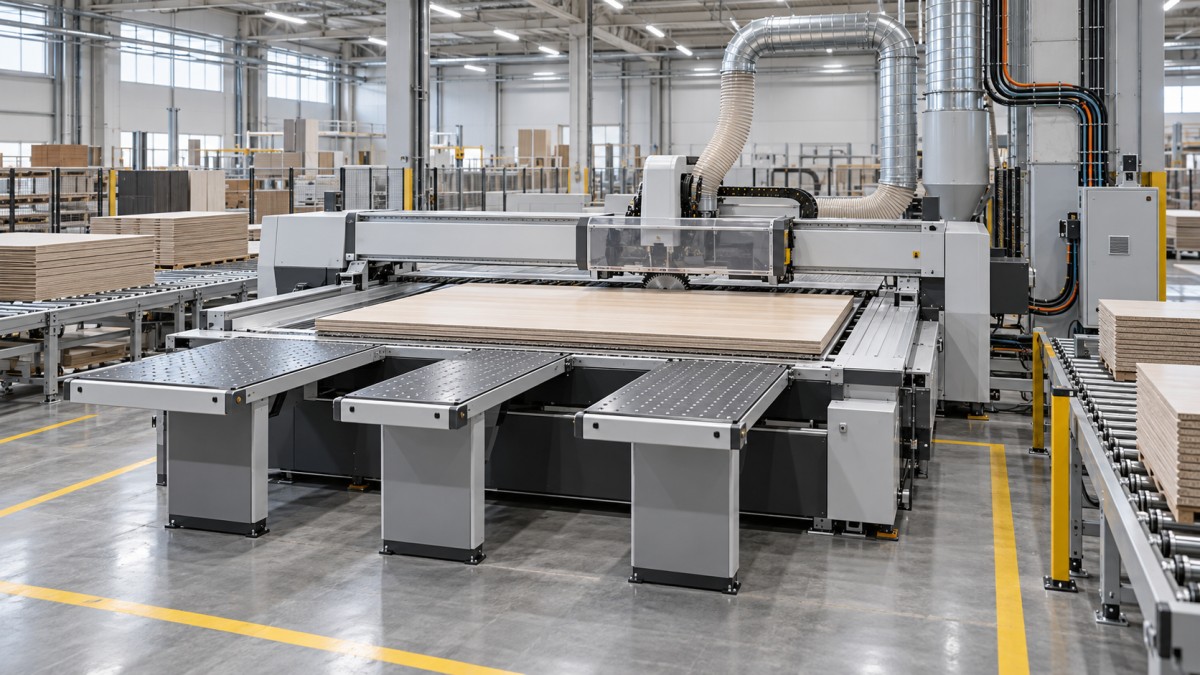
Qingdao Zhongding Machinery Co., Ltd can contribute at several points in this sequence through professional technical support. The useful question for the project lead is not simply whether support is available, but which site information should be supplied in advance. Floor plans, utility details, machine access constraints, photos of the proposed location, and intended panel types can help make technical communication more relevant before the installation window begins.
Why utility preparation deserves close attention
Utility readiness is one of the easiest areas to underestimate because it is often handled by different contractors. A beam saw may be physically installed while electrical connection, extraction ducting, and operating-area controls are still unresolved. This creates an artificial impression that the installation is nearly complete, even though productive commissioning cannot begin.
Electrical preparation should follow the machine documentation and local site requirements. The team should confirm supply compatibility, protective devices, cable routing, grounding arrangements, and access to isolation controls. Temporary electrical arrangements may be useful during construction, but they should not be mistaken for a finished production connection.
Dust extraction needs the same level of planning. Sawing panel materials generates dust and chips that must be removed effectively to support clean operation and maintain visibility around the cutting area. A duct route that is too restrictive, poorly supported, or added after the machine is positioned can be difficult to correct. The connection should be considered alongside the machine layout, not as an accessory to be fitted at the end.
Where compressed air is required by the configured equipment, its supply should be clean, stable, and routed so that hoses do not create a trip hazard or interfere with service access. The exact requirements should be confirmed against the equipment documentation rather than estimated from other machines already in the factory.
Commissioning is a production-readiness check, not a brief power-on test
A successful first power-on does not prove that the beam saw is ready for daily production. Commissioning should test how the equipment performs under the conditions it will actually face: the panel materials being processed, the intended cutting patterns, normal loading methods, and the available extraction system.
Trial cutting should begin with a controlled set of representative panels rather than immediately moving to urgent production work. The team can observe cut edge quality, dimensional consistency, squareness, panel support, material movement, and whether offcuts are managed safely. Where a result is outside expectation, the issue should be traced methodically. A poor edge, for example, may relate to blade condition, material characteristics, machine setup, feed conditions, support, or extraction—not necessarily to a single mechanical fault.
Documentation of these checks helps prevent confusion between installation issues and normal process tuning. It also gives the operating team a baseline for later troubleshooting. A record does not need to be elaborate; it should clearly state what was checked, which materials were used, what settings were tested, and which items remain open before routine production starts.
Operator handover should focus on decisions made during daily use
Installation support is incomplete if the people running the saw only know how to start and stop it. Operators and maintenance personnel need a practical understanding of the actions that protect cutting quality and machine availability. This includes safe loading practices, correct program selection, cleaning routines, blade-related checks, response to alarms, and the limits of adjustments that should be made without technical confirmation.
Handover is more effective when it follows the real work sequence. Start with the preparation of panels and programs, then cover loading, cutting, removal of parts and offcuts, cleanup, shutdown, and routine inspection. The team should also know where to find machine documentation and how to report a fault with enough detail for remote technical support to be useful.
A useful fault report normally identifies the machine condition, the relevant operating step, the panel material, the selected program or operation, the exact alarm or observed symptom, and any recent adjustment or maintenance work. “The saw is not cutting properly” is difficult to diagnose remotely; “the issue appears on a specified panel type after a particular cutting cycle” provides a more workable starting point.
Planning for maintenance and spare parts from day one
Production interruptions are easier to manage when wear-related maintenance and spare-parts planning are considered during installation rather than after the first stoppage. The appropriate stock level depends on the machine configuration, production schedule, local lead times, and the site’s maintenance capability. It is not necessary to hold every possible part, but critical items should be identified based on the equipment documentation and operating conditions.
Qingdao Zhongding Machinery Co., Ltd provides spare-parts supply as part of its long-term support approach. Before handover, it is sensible to establish the correct machine identification details, parts-reference process, and communication route for support requests. Clear records reduce the risk of ordering an incorrect item or losing time while confirming the exact configuration of the equipment.
Routine care also affects the installation result over time. Dust accumulation, neglected checks, damaged cutting tools, loose extraction connections, and changes to the surrounding material flow can gradually reduce performance even when the original installation was sound. A short, site-specific maintenance routine is more useful than a generic schedule that no one follows.
When installation support should be requested before proceeding
Some issues should not be solved by trial and error. Technical guidance should be requested when the site layout differs materially from the planned arrangement, the required utilities cannot be provided as specified, the machine shows abnormal movement or recurring alarms during startup, cutting results remain unstable after basic checks, or a safety-related function does not operate as expected. Continuing production in those conditions can make the original issue harder to identify and may create avoidable risk.
With more than 20 years of experience in woodworking machinery, Qingdao Zhongding Machinery Co., Ltd is positioned to support customers beyond machine delivery through technical communication, after-sales response, and parts availability. The strongest installation outcome comes from using that support early: confirm the site, prepare the utilities, complete controlled commissioning, and make sure the operating team has a clear basis for keeping the beam saw productive after handover.
Send Your Inquiry
We welcome your cooperation and we will develop with you.