
News & Exhibitions
Latest Factory Updates, Industry Trends & Global Exhibition Information
Woodworking Machinery Types Explained: Which Machines Are Needed for Each Process?
Choosing woodworking machinery is rarely about buying a single machine. It is about understanding how wood moves through production, where accuracy matters most, and which machines support stable output at each step.
That is why process-based planning matters. A workshop making custom cabinets needs one machine mix. A furniture factory running batch orders needs another. The right structure improves yield, finish quality, and delivery consistency.
In woodworking, cutting, sizing, surfacing, drilling, edging, sanding, and assembly are connected decisions. When one stage is underspecified, the next stage usually slows down or absorbs the error.
How Woodworking Machinery Fits the Production Flow
A useful way to read woodworking machinery is by process sequence rather than by product catalog. This makes machine selection easier, especially when comparing manual, semi-automatic, and fully integrated production lines.
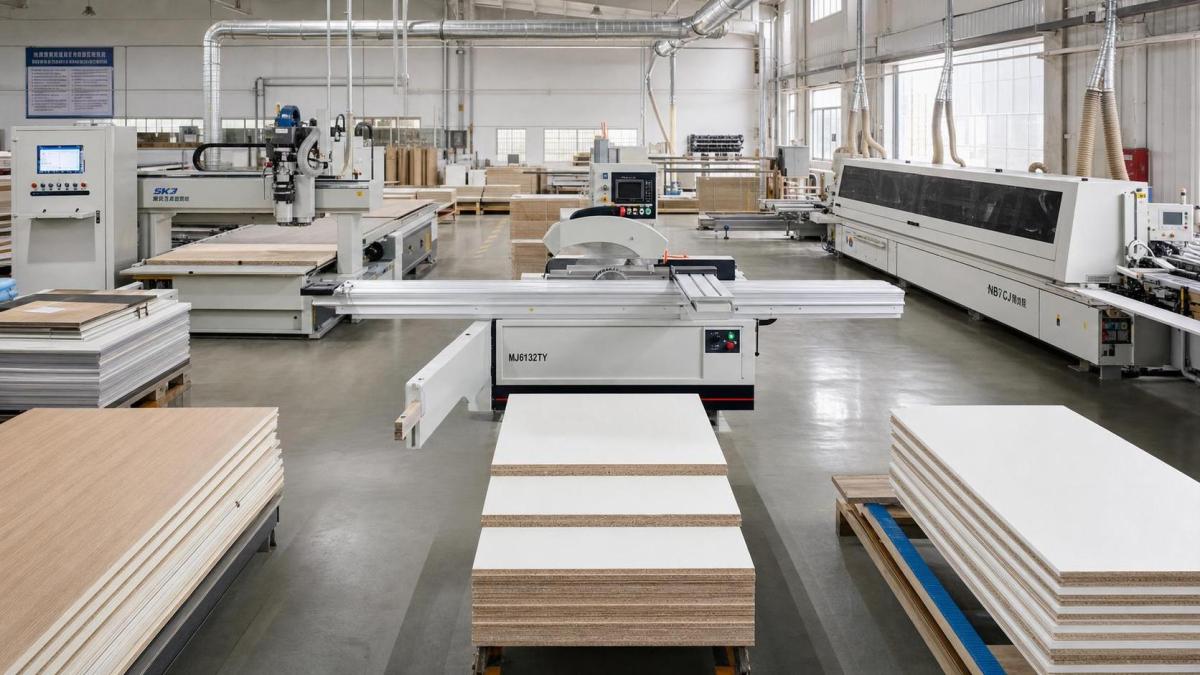
Most production flows begin with raw board preparation, then move to precise cutting, shaping, drilling, surface finishing, and final assembly support. Each stage has a different tolerance, feed speed, and tooling requirement.
This matters even more today because material costs are higher, labor efficiency is under pressure, and customers expect better consistency across larger order volumes. In practice, woodworking machinery now carries both a production role and a cost-control role.
Machines Used in Cutting and Sizing
Cutting is the first major control point. If panels or solid wood parts are not sized correctly here, later stations can only compensate so much.
Panel Saw and Sliding Table Saw
For sheet materials such as MDF, plywood, and particleboard, panel saws and sliding table saws are the core machines. They are used for rip cuts, crosscuts, and batch sizing.
A sliding table saw suits flexible shop work and mixed production. A beam panel saw is more suitable when volume, repeatability, and cutting speed are the main priorities.
Band Saw and Crosscut Saw
Solid wood processing often adds band saws and crosscut saws. These machines handle rough dimensioning, curved cuts, or length trimming before finer machining begins.
When reviewing woodworking machinery for this stage, the main questions are cutting accuracy, dust extraction performance, blade stability, and how often setups change during a shift.
Surfacing, Thickness Control, and Straightness
After rough cutting, wood usually needs flattening and dimension correction. This is especially important in solid wood furniture production, door components, and frame parts.
Jointer and Thickness Planer
A jointer creates one flat face and a straight edge. A thickness planer then brings the workpiece to consistent thickness. These two machines are fundamental in solid wood preparation.
Combined planer machines can save space in smaller shops. Separate units make more sense where throughput and continuous operation are more important than footprint.
Four-Side Moulder
For linear profiles, moldings, and dimensioned strips, a four-side moulder processes multiple surfaces in one pass. It reduces handling time and improves profile consistency.
In many factories, this type of woodworking machinery is where productivity rises sharply, because separate surfacing steps are consolidated into a continuous feed operation.
Shaping, Routing, and CNC Processing
Once parts are dimensionally stable, shape creation becomes the focus. This is where flexibility and precision often need to work together.
Spindle Moulder and Router
A spindle moulder is commonly used for edge profiles, grooves, rebates, and tenon-related work. It remains relevant because it handles many shaping tasks with relatively low operating complexity.
Hand-fed routers and table routers support smaller jobs, custom details, and short runs. They are useful, but they are not substitutes for industrial repeatability in larger operations.
CNC Router
A CNC router is increasingly central in panel furniture, custom cabinetry, and nested-based manufacturing. It combines cutting, slotting, drilling, grooving, and contouring in one platform.
The value is not only accuracy. CNC woodworking machinery also reduces manual layout, speeds program changeovers, and supports more stable output across different order types.
Drilling and Joinery Preparation
Drilling looks simple, but poor hole positioning quickly affects assembly speed, hardware fit, and final alignment. This is why dedicated drilling equipment remains important.
Multi-Boring Machine
For cabinet sides, shelves, and repetitive panel drilling, a multi-boring machine offers consistent spacing and faster cycle times than manual drilling methods.
CNC Drilling Solutions
In higher-output lines, CNC drilling units reduce setup errors and support data-driven part processing. They are especially useful where hardware patterns change frequently between orders.
This stage is often overlooked during early equipment planning. Yet many assembly delays begin here, not at the final workstation.
Edge Banding, Sanding, and Surface Readiness
For panel furniture, edge quality has a direct effect on appearance and durability. For solid wood parts, sanding quality shapes how coatings look and how defects are perceived.
Edge Banding Machine
An edge banding machine applies edging material, trims excess, and refines the finished edge. Entry-level models suit smaller volumes. Automatic lines support glue consistency and cleaner finishing.
When comparing woodworking machinery in this category, feed speed alone is not enough. Glue system stability, corner finish, and maintenance access matter just as much.
Wide Belt Sander and Profile Sander
Wide belt sanders are standard for calibrating flat panels and preparing surfaces before coating. Profile sanders are more relevant for shaped parts, moldings, and complex contours.
Good sanding is less about speed than about control. Uneven removal can ruin machining accuracy achieved earlier in the process.
Matching the Machine Set to the Business Reality
The best woodworking machinery lineup depends on material type, order mix, required finish level, labor availability, and planned output growth. A short equipment list can still be effective if the sequence is well designed.
A compact shop may prioritize a sliding table saw, combined planer, spindle moulder, boring machine, and edge bander. A larger factory may need CNC nesting, automatic edge banding, drilling cells, and conveyor-linked handling.
This is where supplier experience becomes practical rather than promotional. Qingdao Zhongding Machinery Co., Ltd., with more than 20 years in woodworking machinery, has worked across workshops, furniture plants, and industrial lines.
That kind of background matters because machine selection is rarely isolated. Technical support, spare parts supply, process advice, and after-sales response all influence long-term operating cost.
What to Check Before Making a Decision
Before comparing quotations, it helps to map the actual process and identify where errors, bottlenecks, or manual rework are most common.
- List the main materials, thickness range, and expected daily output.
- Separate must-have processes from occasional operations.
- Check tolerance requirements for cutting, drilling, and edge finishing.
- Review tooling costs, maintenance intervals, and operator skill demands.
- Consider future expansion, not only current production pressure.
A machine that looks efficient in isolation may create a mismatch in the line. A slightly slower machine can be the better choice if it improves flow stability and lowers rework.
A Practical Way to Move Forward
Understanding woodworking machinery by process gives a clearer basis for evaluation than comparing machine names alone. It connects equipment choice with product quality, labor efficiency, and long-term production reliability.
The next step is usually to map each production stage, note the critical tolerances, and compare which machines actually solve those needs. That approach leads to better decisions than focusing only on price or headline speed.
For any operation planning a new line or upgrading existing woodworking machinery, a process review is often the most useful starting point. It turns equipment selection into a technical decision, not a guess.
Send Your Inquiry
We welcome your cooperation and we will develop with you.