


News & Exhibitions
Latest Factory Updates, Industry Trends & Global Exhibition Information
What Power, Space and Capacity Does a Single-Phase Combination Machine Really Need?
Single phase combination woodworking machine: check power, space and capacity before you buy. Avoid tripped breakers, cramped outfeed and narrow planing — get the right fit for your workshop.
A combination machine puts five operations on one chassis: planing, thicknessing, sawing, spindle moulding and, on many models, mortising. For a small workshop that cannot give floor space to five separate machines, that is a genuinely sensible answer. But a single phase combination woodworking machine is not just a smaller version of the three-phase machines used in factories. The single-phase supply sets a hard ceiling on motor power, and that ceiling shapes everything else: how wide you can plane, how deep you can cut, and what else can run in the workshop at the same time.
Most disappointment with these machines comes not from build quality but from a mismatch bought on the day the order was placed. The planing width looked generous until the first batch of wide boards arrived. The motor looked powerful until it shared a circuit with the dust extractor. The footprint looked compact until a 2.4 metre board needed feeding through the thicknesser and there was a wall in the way. Power, space and capacity are the three checks that prevent all of that, in that order, because each one limits the next.
Why single phase changes the whole calculation
Three-phase power delivers more torque more smoothly, which is why industrial machines use it. A single-phase supply, the ordinary small-workshop supply, typically supports motors up to about 2.2 to 3 kW (roughly 3 to 4 hp) before starting current becomes a practical problem. That is enough power for serious work, but not for running several functions at once or taking very deep cuts in dense hardwood.
This matters because combination machines are often sold on their largest number: the planing width, the blade diameter, the table size. On a single-phase machine, the honest question behind every one of those numbers is whether the motor can drive it at the stated size, in the material you actually use. A 310 mm planing width is real capacity only if the motor can take a sensible cut across that full width in your timber, not just in softwood with a freshly sharpened cutter block. Read every capacity figure as a maximum under favourable conditions, and plan around a comfortable figure below it.
Power: the rating on the plate is only the starting point
Start with the supply you actually have, not the one you assume. Find the rating of the circuit the machine will run on: the breaker size, the socket rating and the cable run. A 2.2 kW motor draws roughly 10 to 13 amps in steady running, which sounds comfortable on a 16 amp circuit. It is the starting current that causes the trouble.
Starting current is what trips the breaker
An induction motor can draw five to seven times its running current for a second or two at start-up. On a single phase combination woodworking machine, that surge arrives every time you start a function, and you start functions all day. A sensitive breaker, a long cable run with voltage drop, or a circuit shared with other loads will turn that surge into nuisance tripping, usually mid-cut or mid-batch. Before buying, ask the supplier for the motor's stated current draw and starting arrangement. A breaker with a slower trip curve, fitted by an electrician, solves many of these cases legitimately; some machines also offer soft-start. What you should not do is fit a bigger breaker on cable that was not sized for it. If the workshop needs a new dedicated circuit, price that work into the purchase; it is a common hidden cost.
Extraction, lighting and everything else on the circuit
The machine never runs alone. The dust extractor starts with it, and in many workshops the extractor is another 1 to 1.5 kW. Add lighting, a compressor cutting in, or a second person on a router table, and a supply that looked adequate on paper starts tripping. Work out the real simultaneous load: machine motor, extractor, and whatever else genuinely runs at the same time. If the total sits close to the limit of the supply, that is a finding, not a detail. It may push you toward the smaller motor option, an extractor on a separate circuit, or staggered starts so the two motors never surge together — all easy once planned, all problems when discovered on the first production day.
Space: the footprint is the smallest number that matters
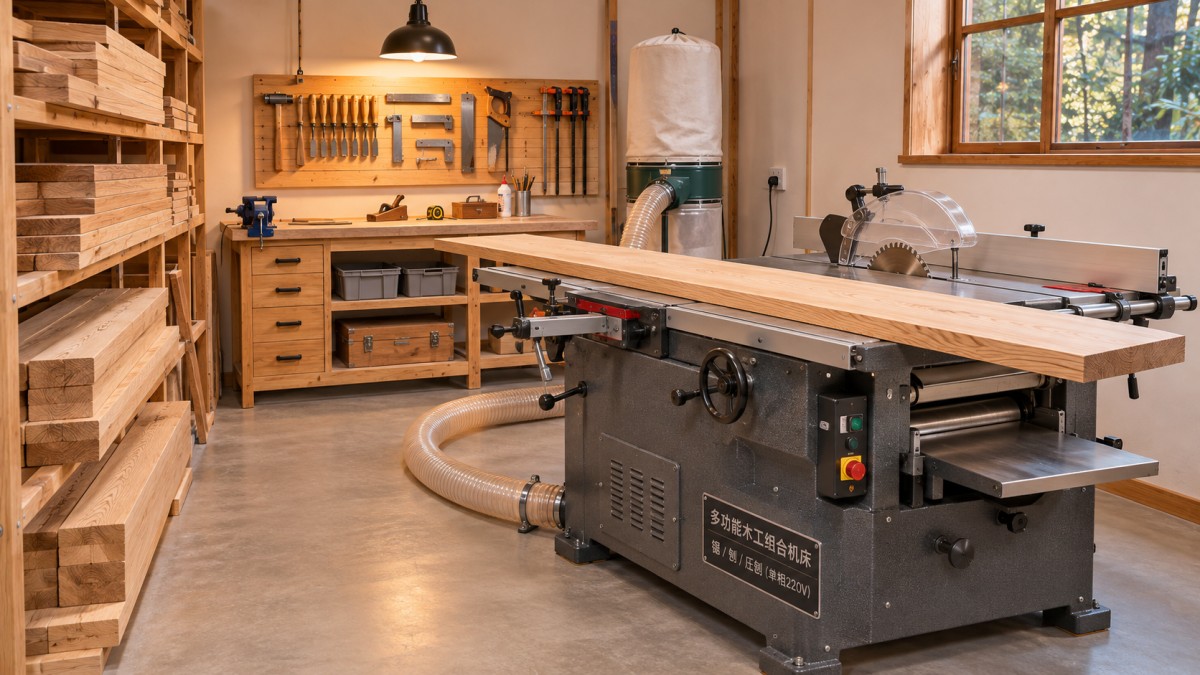
Suppliers quote the footprint of the machine as it stands, and that figure is nearly useless for planning. Each function needs space in a different direction, and the largest envelope is the one your workshop has to provide. The machine itself might occupy 1.5 square metres. The working envelope around it can be four or five times that.
The working envelope, operation by operation
Thicknessing and planing are the hungry operations. The board passes through or over the machine, so you need clear space on both the infeed and outfeed sides at least equal to your longest board, plus room to stand and handle it. For 2.4 metre boards, that means close to five metres of clear run in line with the planer tables. Sawing needs outfeed space behind the blade for the longest rip, and side space for breaking down sheet material. Spindle moulding needs less length but clear access in front. Sketch the workshop to scale and draw your longest board passing through each function; the drawing takes twenty minutes and settles arguments that specifications cannot.
Room to change over is room you use every day
A combination machine asks you to change it over: raise or swing the planer tables to thickness, move fences, change from saw to spindle, swap cutter blocks and tooling. Every one of those operations needs elbow room, somewhere to put the fence or the guard you just removed, and safe access to the thicknessing side. A machine pushed hard against a wall on its working side will be changed over slowly, reluctantly, and eventually unsafely, with guards left off because refitting them is awkward. Leave clear access on at least the two working sides, and check the delivery route too: door widths, corners and steps have stopped more installations than any electrical problem.
Capacity: five functions, five different limits
Capacity on a combination machine is not one number. Each function has its own limiting dimension, and the right machine is the one whose limits all sit just above your regular work, not the one with the single biggest figure. Oversizing costs money and space; undersizing costs you the job the machine cannot do.
Planing width decides more than anything else
Planing width decides more purchases than any other figure, because it cannot be worked around: a board wider than the planer must be ripped down and rejoined, which changes the job entirely. Common single-phase widths run from about 250 mm up to 410 mm, with thicknessing capacity typically between 200 and 250 mm, and a depth of cut per pass around 3 to 4 mm, less in practice in hardwood. Measure your actual work: the widest board or glued panel you regularly flatten, not the widest you can imagine. Many small workshops find that 90 percent of their work fits within 260 or 310 mm, and that the jump to 410 mm buys a bigger machine to house and maintain, for a handful of jobs a year.
The saw and the spindle set the other limits
On the saw, blade diameter sets depth of cut: a 250 mm blade gives roughly 80 mm of cut depth, a 315 mm blade around 100 mm. Check also the rip capacity to the fence and whether a scoring blade is fitted if you cut melamine-faced or veneered board. On the spindle moulder, the useful numbers are the spindle diameter (30 mm is the common standard), the table opening and the maximum tooling diameter the guard allows. If a mortising unit is fitted, check its chuck capacity and table travel against the mortises you actually cut. Match the tooling standard to what is available locally and what you already own; a machine whose tooling you cannot source easily loses capacity every time a cutter is damaged.
Read the table as a starting point, not a specification: figures vary between manufacturers, and long planer tables are worth more in daily accuracy than a small increase in width.
Matching the machine to the work you actually do
The reliable way to size a single phase combination woodworking machine is to work backwards from a month of real jobs. List the boards and panels you machined — widths, thicknesses, lengths, material — and which operations each job used. That list gives you the planing width you need at the 90 percent level, the board length your space must handle, and a realistic sense of how often two functions would be wanted at once.
It also exposes the changeover question, the honest weakness of any combination machine, whose functions share one motor and only one runs at a time. If your typical job alternates constantly between sawing and planing, you will spend real time each day reconfiguring the machine; the saving on separate machines is handed back in labour. If your work naturally batches, all the planing together, then all the sawing, the combination machine is efficient and the changeovers shrink to a few per day. Neither pattern is wrong, but they point to different purchases.
Before you order: measure three things, not thirty
- The supply: breaker size and type on the intended circuit, the machine's stated running and starting current, and the extractor's load added on top. If a new circuit is needed, get it quoted now.
- The space: a scale sketch showing your longest board passing through the planer and over the saw, clear access on the working sides, and the delivery route.
- The work: the widest board you regularly flatten, the deepest saw cut you regularly make, and the spindle tooling standard you already own or can buy locally.
The machine that fits all three measurements, with a small margin in each, is the right one. The machine that wins on one figure and fails on another will remind you of it every week.
What a good supplier should ask you
A supplier who knows these machines will ask about your supply, your longest board and your widest panel before quoting, and will talk about changeover time and tooling as readily as about price. Qingdao Zhongding Machinery Co., Ltd. has manufactured and exported woodworking machinery for more than 20 years, supplying furniture manufacturers, woodworking workshops and industrial production lines, and its combination machines are specified with buyers in exactly these terms: motor and supply first, working envelope second, capacities third. A supplier who only quotes the largest numbers is selling you the machine that ships.
So, what does a single-phase combination machine really need? Enough power to start and run on your circuit alongside your extraction. Enough space not for its footprint but for your longest board, in every direction the work travels. And enough capacity on each of its five functions to cover the work you do every month, with the exceptional job handled some other way. Get those three right on paper before you order, and the machine will feel well chosen for years. Get any one of them wrong, and no amount of build quality will make up for it, because the machine will be fighting your workshop instead of working in it.
Send Your Inquiry
We welcome your cooperation and we will develop with you.