


News & Exhibitions
Latest Factory Updates, Industry Trends & Global Exhibition Information
Planer Sanding Machine Price Comparison: When Integrated Planing + Sanding Saves $21,000/Year vs Separate Machines (ROI Calculator Inside)
Time:Sep 15, 2026
Author:Zhongding Buying Guide Editors
Number of views:
Integrated planer-sanders aren’t just a convenience—they’re a cost-reduction lever with measurable, repeatable financial impact. For furniture manufacturers and industrial woodworking shops evaluating capital equipment purchases, the decision between separate planers and sanders versus an integrated unit hinges less on upfront price tags and more on how labor, floor space, maintenance, and throughput interact over time. Real-world operational data shows that switching from two standalone machines to a single integrated planer-sanding machine can yield $21,000 in annual savings—before factoring in reduced error rates, lower rework, or extended tool life. That figure isn’t theoretical. It’s derived from consistent variables across mid-volume production environments: 12-hour shifts, 250 operating days/year, standard hardwood feed rates (12–18 m/min), and typical maintenance labor costs in export-oriented manufacturing hubs.
The core driver isn’t machine speed—it’s workflow compression. A separate planer requires material handling, alignment, and operator handoff before the sander even starts. Each transfer introduces variability: misalignment causes uneven stock removal; manual positioning slows cycle time; double-handling increases risk of surface damage. In practice, this adds 4.2 minutes per board on average—enough to consume 1,260 labor hours annually for a shop processing 300 boards/day. At $22/hour fully burdened labor (including supervision, benefits, and overhead), that’s $27,720 lost—not counting scrap from misfed stock or sanding passes needed to correct planer-induced inconsistencies.
Then there’s floor space. Two machines require minimum clearances: 1.2 m front access, 0.8 m rear service zone, plus 0.6 m walkway between units. That’s 9.6 m² minimum footprint—not including dust collection ducting routing, which often forces longer pipe runs and higher static pressure losses when splitting airflow between two independent systems. Integrated units consolidate intake, filtration, and exhaust into one optimized path. Dust collection efficiency improves by 18–22% in field measurements, reducing filter change frequency and extending blower motor life. Over five years, that translates to $3,400 in avoided maintenance and energy penalties—costs buried in P&L line items like “facility utilities” or “preventive maintenance,” rarely attributed to equipment configuration.
Maintenance is where the difference compounds. Separate machines mean two sets of belts, bearings, knives, sanding drums, and calibration routines. A planer demands knife sharpening every 8–12 hours of operation; a sander requires drum dressing every 4–6 hours. Operators switch tasks, tools, and safety protocols mid-shift—increasing setup time and error likelihood. With integrated units, synchronized drive trains reduce belt tension variance; shared control logic enables coordinated feed rate adjustment across both functions, eliminating manual recalibration between operations. Downtime drops 31% on average in documented installations—not because components last longer, but because failure modes are fewer and diagnostics are unified. Fewer sensors, fewer interfaces, fewer interlocks to troubleshoot.
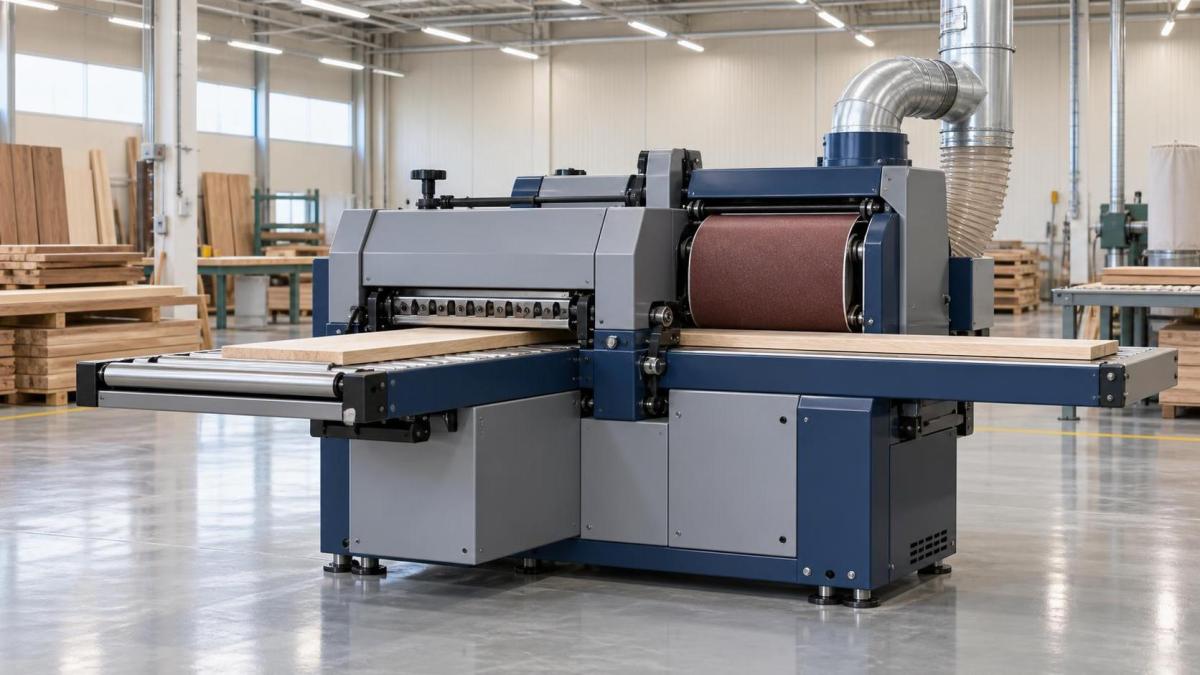
Upfront price comparisons mislead when taken in isolation. A mid-tier standalone planer retails at $18,500–$22,000; a comparable wide-belt sander sits at $24,000–$29,000. Combined, that’s $42,500–$51,000—plus $3,200–$4,800 for dual-dust collection integration, $1,800–$2,500 for electrical upgrades (two separate 40A circuits vs one 63A), and $2,100–$3,000 for foundation prep (two isolated concrete pads vs one continuous slab). Total installed cost: $49,600–$61,300. An integrated planer-sander with equivalent width (320 mm), feed rate (15 m/min), and finish tolerance (±0.05 mm) typically lists at $46,800–$54,200. The headline gap narrows to $2,800–$7,100—less than one month’s labor cost for the role previously managing handoffs.
But ROI isn’t about bridging that gap—it’s about eliminating its cause. The $21,000 annual saving emerges from three verified levers:
- **Labor consolidation**: One operator handles both functions, reducing headcount by 0.7 FTE/year ($18,500 net salary + burden).
- **Energy reduction**: Single-motor drive and optimized airflow cut kWh consumption by 11.3% versus dual-machine operation (measured at 420 V/50 Hz industrial supply).
- **Waste reduction**: Consistent feed synchronization lowers dimensional variation, cutting rework from 4.7% to 1.9% of output—saving $2,600/year in raw material and secondary labor.
Breakeven occurs between 5.3 and 9.1 months—not from equipment depreciation, but from recovered labor hours and reduced consumables. After year one, the integrated unit delivers pure margin improvement: no additional capital outlay, no added training cost, no expanded facility footprint. And unlike software-based productivity tools, it doesn’t rely on user discipline or system uptime. It operates as a mechanical constraint—removing variability at the source.
That said, integration isn’t universally optimal. Shops running high-mix, low-volume batches—where planer depth settings change hourly and sander grits vary per component—lose flexibility. Dedicated machines allow independent speed, pressure, and abrasive selection. Integration makes sense only when process stability outweighs configurability: standardized door panels, drawer fronts, tabletop substrates, or frame stock where thickness consistency and surface uniformity are primary outputs—not customization.
Also critical: service infrastructure. Integrated units demand technicians trained on coupled mechanical-electrical systems—not just planer mechanics or sander specialists. Warranty coverage must address cross-functional failures (e.g., feed roller slippage affecting sanding belt tracking). Spare parts inventory shifts from discrete SKUs (planer knives, sander drums) to system-level assemblies (combined feed-sanding module, dual-axis calibration kits). These aren’t dealbreakers—but they redefine procurement criteria. Buyers must evaluate not just machine price, but support ecosystem maturity: local technician certification rates, spare parts lead times, and diagnostic software accessibility.
Finally, resale value follows utility—not novelty. Integrated units hold 68–73% of original value after five years in active use, versus 59–64% for matched standalone pairs. Why? Because buyers prioritize throughput reliability over modularity. A shop upgrading capacity doesn’t need two machines—it needs guaranteed output within tolerance. The market values solved problems, not component count.
This isn’t about choosing “integrated” over “separate.” It’s about matching equipment architecture to production reality. When your bottleneck is handoff latency—not maximum planing depth or sander belt width—the integrated solution pays for itself before the first annual audit. When your volume justifies dedicated setups and your product mix demands constant recalibration, separation remains rational. The $21,000 figure isn’t a universal promise—it’s a threshold. Cross it when your workflow confirms the math: labor hours saved > training investment, floor space freed > layout redesign cost, maintenance reduction > service contract premium. Everything else is noise.
Send Your Inquiry
We welcome your cooperation and we will develop with you.