

News & Exhibitions
Latest Factory Updates, Industry Trends & Global Exhibition Information
Panel Drilling Machines Compared: Through-Feed vs. Point-to-Point Designs
A through-feed machine is usually the better investment when panel volume is high, dimensions are relatively standardized, and drilling is part of a continuous production flow. A point-to-point machine is usually the safer choice when product variety, custom sizing, and frequent program changes matter more than maximum linear throughput. The purchase decision is less about which design is “more advanced” and more about where variation enters the factory.
For procurement teams, the expensive mistake is comparing only drilling heads, spindle counts, or quoted cycle times. A panel drilling machine performs inside a larger system: panel cutting, edge banding, buffering, material handling, labeling, programming, quality control, and rework all affect its useful output. A machine that looks faster in isolation can become an underused bottleneck if the surrounding line cannot keep it supplied. Conversely, a highly flexible machine can create unnecessary cost when most orders are repeatable cabinet components.
Start with the flow of work, not the machine specification
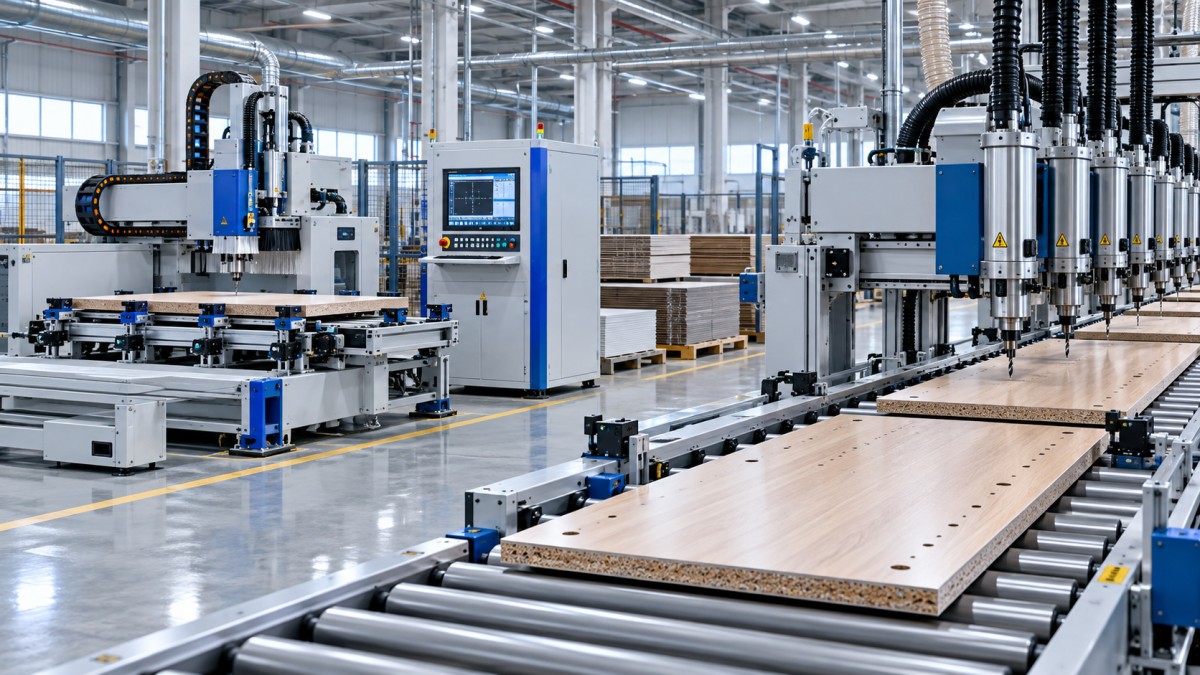
Through-feed drilling machines move a panel through the working zone on conveyors or powered transport systems. Drilling units work as the panel passes through, often processing multiple faces or edges in a defined sequence. They fit a production model built around repeated parts, controlled orientation, and predictable material flow.
Point-to-point designs place and position each panel for a programmed set of drilling operations. The machine can move its heads, clamps, gantry, or workpiece positioning system to create holes at different locations without relying on a fixed through-line sequence. This makes it well suited to batch-one furniture, customized cabinets, irregular parts, and factories where the drilling pattern changes throughout the day.
The practical dividing line is not simply batch size. It is the amount of variation that must be absorbed after panel cutting. A producer may run many panels per day but still benefit from point-to-point technology if orders contain different cabinet depths, hardware systems, hole patterns, and special drilling requirements. Another producer may have moderate volume yet find through-feed more productive because the same component families recur continuously.
Before requesting quotations, map one representative week of production. Separate recurring components from exceptional pieces. Record how often programs change, how often operators turn or reorient panels, how many panels wait between cutting and drilling, and how frequently drilled parts require correction. Those observations will reveal more about machine fit than a supplier comparison based on maximum stated capacity.
Where through-feed systems earn their cost
A through-feed design earns its place where continuous flow has real value. In a line producing standardized kitchen cabinets, wardrobes, office furniture components, shelving, or similar repeatable panel products, the machine can reduce manual positioning and support a consistent pace from one operation to the next. It becomes particularly attractive when drilling must match upstream cutting data and downstream assembly requirements with minimal handling.
Its advantage is not merely speed. A well-organized through-feed cell can reduce the number of times an operator touches each panel. Fewer handoffs can improve rhythm, lower the chance of orientation errors, and make output easier to plan. When paired with reliable identification and material routing, the system can support a more disciplined production environment than a collection of standalone stations.
That benefit depends on maintaining flow. If operators must frequently stop the line to resolve uncertain part identification, missing programs, wrong panel orientation, or damaged material, the expected productivity drops quickly. Through-feed equipment is generally less forgiving of disorder upstream. Its value rises when cutting output is sequenced correctly, panel dimensions fall within the machine’s operating range, and material arrives consistently.
Procurement teams should therefore treat conveying and panel handling as part of the investment, even when the initial proposal separates them from the drilling machine price. Infeed and outfeed tables, return conveyors, transfer devices, buffering, barcode scanning, dust extraction connections, and safety integration can determine whether the equipment operates as a production line or as an expensive standalone machine with manual loading at both ends.
Through-feed designs can also have a less obvious limitation: their productivity favors a stable routing logic. Frequent changes to drilling patterns are possible on many modern systems, but every added exception complicates sequencing, program management, and operator control. A factory that sells heavily customized furniture may discover that the line is technically capable of processing variation but operationally inefficient at doing so.
Why point-to-point machines remain strong in mixed production
Point-to-point machines are designed to deal with variation at the machine level. They can drill faces, edges, construction holes, shelf-pin holes, connector locations, and hardware patterns according to the program assigned to each part. This flexibility reduces the need to group parts into long, uniform runs before machining.
For a shop producing custom cabinetry or a furniture factory handling a wide order mix, that can have direct commercial value. Shorter batches can move without waiting for enough matching parts to justify a setup. Engineering changes can be introduced with less disruption. Nonstandard components can remain within the normal production route rather than being diverted to manual drilling or a secondary process.
The tradeoff is that point-to-point capacity is sensitive to actual part complexity. A quoted cycle time for a simple rectangular panel with a basic drilling pattern may not represent the output of a cabinet side containing multiple construction bores, shelf holes, hinge cups, dowel positions, and special hardware requirements. Panel loading, positioning, clamping, turning, unloading, and exception handling also consume time. The correct comparison is completed parts per shift for the company’s own part mix, not nominal holes per minute.
Operator and programming discipline matter as well. Flexible machinery shifts more responsibility into data preparation and job control. A point-to-point machine cannot compensate for incomplete drilling data, inconsistent references between cutting and drilling, or unverified changes in cabinet design software. In a low-volume custom operation, this is often manageable and worthwhile. In a larger operation, it may require stronger program release procedures and better integration between design, cutting, and machining.
The cost comparison is broader than purchase price
A direct price comparison between a through-feed and point-to-point panel drilling machine can be misleading because the two designs distribute cost differently. Through-feed equipment may require a larger footprint, more connected equipment, installation work, and material-handling investment. Point-to-point equipment may have a lower line-integration burden but can require more labor per panel, more active machine supervision, or additional capacity as volume rises.
Labor should be assessed by the whole process, not by the number of people standing at the drilling station. A through-feed line may reduce direct loading and unloading labor but create new needs in material staging, line supervision, maintenance, and production scheduling. A point-to-point machine can look labor-intensive, yet it may avoid the hidden labor associated with sorting, batching, rerouting, and managing exceptions in a rigid line.
Downtime exposure also differs. If a through-feed machine sits in the middle of a tightly connected production route, a fault can affect upstream and downstream work. Buyers should ask how panels can be bypassed, where work-in-process can accumulate, and whether individual parts can be recovered without losing identification. For point-to-point equipment, the concern is often capacity loss within a cell: can priority parts be shifted to another machine, or does one machine hold up the entire order?
Accuracy claims need to be translated into production conditions
Both machine types can deliver repeatable drilling when they are correctly installed, calibrated, and supplied with consistent material. The more useful procurement question is where accuracy risk enters the process. A drilling machine may position accurately while finished assemblies still show misalignment because panels were cut from different references, labels were mixed, boards were warped, tooling was worn, or operators loaded the wrong face.
Through-feed systems place greater emphasis on panel tracking and transport stability. Buyers should examine how the machine establishes its reference edge, how it maintains panel position through the process, and how it handles panels at the minimum and maximum size range. Thin, narrow, warped, coated, or unusually shaped parts deserve explicit discussion during technical review. A system optimized for standard cabinet sides may not behave the same way with small drawer components or narrow strips.
Point-to-point systems make clamping, reference selection, and panel support especially important. Ask how the machine handles workpieces with incomplete support areas, whether vacuum or mechanical clamping suits the intended material, and how the program establishes a common datum between machining operations. For furniture components, consistent hole location relative to the assembly reference is often more important than a broad accuracy claim stated without context.
Tooling and maintenance should not be treated as afterthoughts. Drill bit condition affects hole quality, breakout, heat generation, and the reliability of boring depth. Procurement specifications should clarify the spindle arrangement, compatible tool types, tool-change method where applicable, lubrication requirements, chip extraction expectations, access for cleaning, and the process for replacing commonly used parts. The cost of a stopped machine often comes from ordinary service items being unavailable or difficult to change, not from a major mechanical failure.
Questions that expose a poor fit before an order is placed
A useful supplier discussion should move from brochure capability to the buyer’s own parts and operating conditions. Provide representative panel sizes, thicknesses, materials, drilling patterns, daily mix, and expected shift arrangement. Then ask for the proposed process, not only a machine model.
- Which of our parts will require special loading, turning, manual handling, or a separate operation?
- What assumptions are used in the stated output rate: hole count, panel dimensions, loading method, program changes, and operator involvement?
- How does the machine reference a panel, and what happens when a panel is bowed, narrow, short, or incorrectly oriented?
- Which components are included in the quotation for infeed, outfeed, scanning, safety, dust collection interfaces, and control integration?
- What production data format is accepted, and who is responsible for verifying post-processed drilling programs before release?
- Which wear parts and critical electrical or pneumatic components should be stocked locally?
- What remote support, commissioning support, documentation, and operator training are included in the delivery scope?
- How can the factory continue processing urgent work if this machine is unavailable?
Requesting a demonstration with representative files is more informative than watching a generic machine video. The goal is not to force a supplier to reproduce every future order. It is to see how the machine handles the part characteristics that create most of the factory’s delays: unusual dimensions, high hole density, edge drilling, small components, varying hardware patterns, or repeated program changes.
A practical selection rule
Choose through-feed when drilling demand is sufficiently stable to keep panels moving in a planned sequence and when the factory can support the machine with reliable upstream and downstream flow. Its strongest business case is built on repeatability, lower handling per panel, and a line that remains productively loaded for much of the shift.
Choose point-to-point when the order book is defined by customization, mixed batches, frequent design changes, and parts that would otherwise require repeated setup or manual intervention. Its value comes from making variation routine rather than treating every exception as a disruption.
For businesses between those two conditions, the decision should be made from a workload study rather than a preference for automation level. Review the proportion of recurring parts, the cost of delayed custom work, expected growth in standardized volume, available floor space, and the capability of the programming and material-handling teams. The better machine is the one whose operating logic matches the factory’s likely work, including the inconvenient parts that quotations and cycle-time charts tend to leave out.
Send Your Inquiry
We welcome your cooperation and we will develop with you.