


News & Exhibitions
Latest Factory Updates, Industry Trends & Global Exhibition Information
Automatic CNC Nesting Machines: Which Features Cut Sheet Waste at Scale?
Sheet yield is decided before the cutter starts
For a factory processing large volumes of MDF, particleboard, plywood, laminated panels, or compact board, an automatic CNC nesting machine can reduce waste substantially, but only when its software, material handling, and cutting accuracy work as one system. A high spindle rating or an automatic loading table may improve output, yet neither feature alone guarantees better sheet utilization.
The features with the strongest effect on waste are usually less visible in a showroom: the nesting engine's treatment of grain and offcuts, the machine's ability to hold a full sheet flat and immobile, the repeatability of its reference system, and the reliability of automatic loading and unloading. Technical evaluators should assess these elements as a linked process. A machine that creates an efficient nest but loses positional accuracy during machining can turn theoretical yield into remakes. Conversely, a rigid, accurate router with weak nesting logic may cut cleanly while leaving usable material on the table.
The first purchasing question is therefore not, "What nesting percentage can the machine achieve?" It is, "Can this machine produce usable parts, reusable remnants, and predictable cycle times from our real order mix?"
Intelligent nesting needs production rules, not just an optimization claim
Nesting software is often presented as the primary waste-reduction feature, and it is important. Its value depends on the rules it can apply without creating downstream problems. A layout that minimizes empty space may be unsuitable if it ignores panel grain, face direction, drilling orientation, edge-banding allowances, label requirements, or part sequencing for assembly.
For cabinet components and furniture panels, evaluators should inspect whether the software can distinguish between parts that may rotate and parts that cannot. Door fronts, matched veneer panels, and textured melamine surfaces often have a visual direction. Rotating these components can produce a mathematically efficient nest and a commercially unacceptable product. The nesting engine should allow grain constraints at the part level while continuing to optimize the remaining components around them.
Material libraries matter for the same reason. The system should retain clear definitions for sheet dimensions, thickness, kerf allowance, edge trim, usable cutting area, grain direction, and material identity. If operators need to recreate these details manually for each job, consistent yield will depend too heavily on individual discipline. A controlled material database also reduces the risk of nesting a part set onto an incorrect board thickness or finish.
Offcut management deserves particular scrutiny. Many machines can show leftover panel areas on screen. That is not equivalent to managing reusable remnants. A useful system records the remnant's dimensions, material code, grain direction, surface condition, and storage location, then makes it available for later jobs. It should also apply a sensible minimum remnant size. Saving every narrow strip may improve a report's apparent utilization figure while adding handling work and warehouse confusion.
Ask suppliers to demonstrate how the nesting software handles these situations using representative production data:
- mixed cabinet parts with fixed grain direction and varying quantities;
- orders containing both standard components and one-off custom sizes;
- parts requiring different tool diameters, drilling patterns, or edge treatments;
- an order split between full sheets and catalogued remnants;
- a priority job inserted after the original nesting plan is prepared.
The purpose of this exercise is not to force the highest possible yield from a demonstration. It is to see whether the optimization logic remains usable when real production constraints are introduced. An automatic CNC nesting machine that supports controlled rules, remnant tracking, and shop-floor-friendly job changes is generally more valuable than one that achieves an impressive result only on a clean sample list.
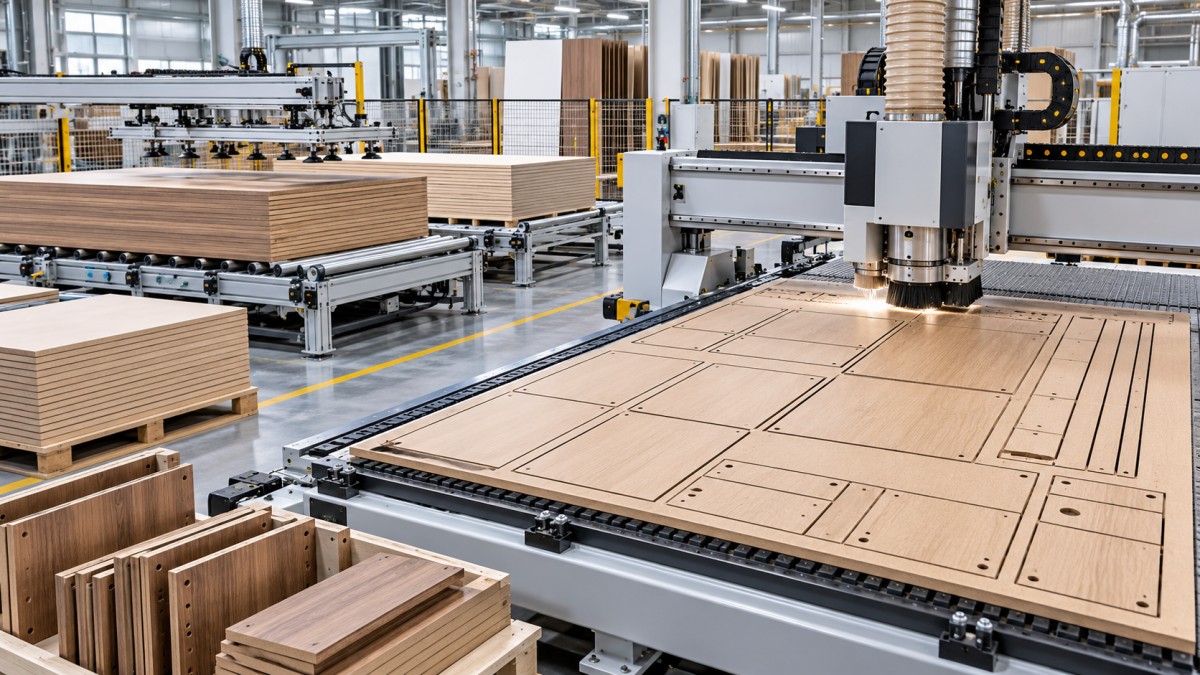
Vacuum zoning and panel stability protect the yield promised by the nest
A nest only has value if every part stays in position until the operation is complete. This is where vacuum performance, spoilboard design, zoning control, and machining strategy directly affect material waste.
Nested processing creates small or narrow components late in a cycle, especially when the layout is optimized tightly. These parts can shift if vacuum coverage falls, if air leaks through open cut paths, or if the spoilboard surface is uneven. A shifted part may be damaged by the cutter, cut undersize, or collide with the tool. Even a single failed component can require a replacement part and, in matched sets, may require a replacement panel face or an entire assembly group.
Technical evaluation should go beyond the stated vacuum pump capacity. Pump size is relevant, but the working result depends on the whole hold-down system: pump technology, vacuum zones, valves, gasket condition, spoilboard porosity, table flatness, sheet condition, and the machine's cutting sequence. A large pump cannot fully compensate for unmanaged leakage or a worn spoilboard.
Independent vacuum zones are particularly useful where a production mix includes different board sizes or partial sheets. They allow the machine to concentrate holding force beneath the active material area rather than drawing air through unused zones. The controls should be simple enough for operators to set correctly and, ideally, linked to the nesting program or table layout. Complex manual zoning can become a source of setup errors during busy shifts.
Look closely at the machine's strategy for final cut-through. Common approaches include leaving small tabs, using onion-skin machining, or controlling the sequence so that larger surrounding material supports smaller parts until late in the program. Each method has tradeoffs. Tabs create a secondary trimming task. Onion-skin techniques depend on consistent material thickness and spoilboard condition. Sequenced cutting may increase programming complexity. The right choice depends on part geometry, material type, finish sensitivity, and downstream labor capacity.
For high-value coated panels, evaluate cut quality at both the top and bottom faces. Poor tool selection, excessive feed rates, incorrect spindle speed, or inadequate support can cause chipping that turns an otherwise dimensionally correct part into scrap. The machine should support a practical tool-management process: defined tool records, compensation where appropriate, wear monitoring, and easy replacement without losing production control. Yield is reduced by rejected edge quality just as surely as by empty space between parts.
Accuracy and calibration prevent hidden scrap
When sheet waste is discussed, attention often goes to unused material. In production, hidden waste can be equally expensive: parts that fit the nest but fail at assembly. A nesting machine needs stable positioning from sheet loading through routing, drilling, unloading, and labeling.
The relevant question is repeatability under production conditions, not only nominal positioning accuracy in a specification sheet. Machine structure, gantry rigidity, drive systems, rack or screw quality, servo tuning, and control response all influence repeatability. So do workshop conditions, maintenance routines, and the machine's ability to remain calibrated over time.
Reference methods are especially important when panels are loaded automatically. A sheet that enters the machine skewed or fails to reach its intended stop position can affect every component in the nest. Check whether the loading system uses reliable alignment features, whether the control detects board position, and how the machine responds to misalignment or a missing sheet. The desired outcome is not merely automated movement; it is reliable material registration without repeated operator correction.
Vision or camera-assisted registration can be useful for printed boards, pre-processed panels, and applications where existing features must be recognized. It should be assessed against the actual workflow rather than treated as a universal upgrade. For standard raw panel nesting, consistent mechanical referencing and sound loading discipline may provide the more direct benefit. For complex printed or pre-marked work, registration technology may prevent errors that would otherwise consume expensive material.
Drilling accuracy also affects yield. Cabinet production frequently combines routing with vertical drilling, horizontal drilling, or dowel-hole machining. If the nesting platform cannot maintain a dependable relationship between these operations, parts may need rework or be discarded during assembly. Evaluate the complete machining sequence and the handoff to any separate drilling or edge-banding equipment. The lowest sheet waste figure is of limited value if downstream fit-up defects rise.
Automation improves material utilization when it makes production more consistent
Automatic loading, unloading, labeling, and part sorting are often justified by labor savings. Their effect on waste can be just as important. These systems reduce variation in how boards are fed, how parts are identified, and how quickly finished components leave the cutting area.
A loading system should be evaluated for the panel range it will actually handle: sheet size, thickness, weight, surface finish, warp, and dust conditions. Smooth, flat panels behave differently from bowed particleboard or protective-film-coated sheets. The system needs reliable separation between sheets. Double-sheet loading can disrupt the vacuum hold-down process, damage tools, or create a costly stop.
Unloading and labeling should be considered together. If a machine cuts efficiently but operators must manually identify hundreds of nested parts, sorting errors can create remakes that erase the material benefit. A labeling process that links each component to its order, cabinet, machining status, and downstream route helps preserve the value created by nesting. Labels must be readable, durable enough for the next operation, and applied in a way that does not slow the cell excessively.
For plants with high product variety, the most useful automation may be the automation that reduces setup dependency. Barcode-driven job loading, material confirmation, tool verification, and automatic program selection can prevent an operator from running the correct file on the wrong panel. These features may appear secondary to throughput specifications, but they address a common source of avoidable scrap: process mismatch rather than poor cutting geometry.
Automation should not be selected solely because it reduces headcount around the router. A heavily automated cell requires adequate space, panel staging discipline, preventive maintenance, dust extraction capacity, and a recovery process for faults. If frequent stops leave sheets half-machined or force operators to bypass controls, the practical yield may decline. The preferred level of automation is the level the facility can support consistently across shifts.
Evaluate waste at the cell level, not the router level
Material yield should be measured from incoming sheet to accepted finished part. That includes trim loss, kerf loss, damaged parts, rejected surfaces, wrong-material runs, remakes caused by machining errors, and remnants that cannot realistically be used. A supplier demonstration that reports only the empty area left on a nesting layout offers a narrow view of the result.
Before selecting equipment, prepare a sample set of recent orders that reflects the actual work mix. Include recurring cabinet bodies, irregular custom components, grain-sensitive doors, parts with machining on both faces where relevant, and material types that are difficult to hold or cut cleanly. Run the same data through each candidate's nesting software under identical production rules. Then review the resulting layouts with production, engineering, purchasing, and downstream assembly personnel.
During the machine assessment, request evidence of how the configuration handles normal operating variation: tool changes, spoilboard resurfacing, vacuum leakage, sheet alignment, remnant reuse, label printing, and a restart after interruption. These details determine whether the equipment can maintain its expected yield after installation rather than only on its first day of operation.
A well-chosen automatic CNC nesting machine reduces waste because it produces fewer unusable spaces, fewer unstable parts, fewer setup mistakes, and fewer remakes. The strongest configuration is rarely defined by one headline feature. It is the one whose nesting rules, hold-down performance, motion accuracy, and material flow match the factory's panel mix and can be maintained by the people running it every day.
Send Your Inquiry
We welcome your cooperation and we will develop with you.