
News & Exhibitions
Latest Factory Updates, Industry Trends & Global Exhibition Information
Furniture Manufacturing Machinery Buying Guide: Comparing Manual, Semi-Auto, and Auto Lines
Why Furniture Manufacturing Machinery Choice Matters
Choosing the right furniture manufacturing machinery can directly impact production efficiency, labor costs, and product consistency.
For any factory expansion plan, the machine decision shapes delivery speed, defect rate, and long-term operating cost.
That is why comparing manual, semi-auto, and auto lines is not just a technical exercise.
It is a purchasing decision tied to margin, capacity, and future flexibility.
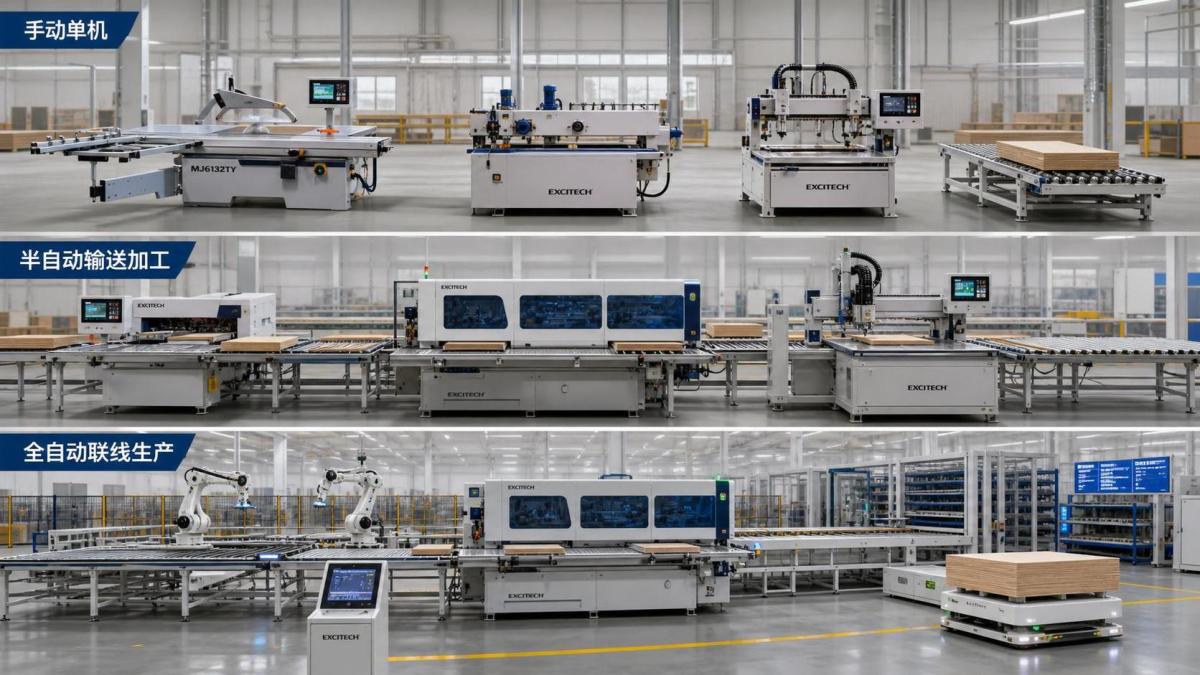
In furniture production, different workflows need different levels of automation.
A small custom workshop may value flexibility more than speed.
A large factory usually needs stable output, repeatable quality, and lower labor dependence.
This guide explains how to compare furniture manufacturing machinery in practical business terms.
It also helps connect machine features with production goals, budget limits, and return expectations.
Manual Lines: Best for Flexibility and Lower Entry Cost
Manual furniture manufacturing machinery usually includes stand-alone machines with operator-controlled feeding, positioning, and handling.
Typical examples include panel saws, edge banders, drilling machines, and sanding equipment used separately.
The main advantage is lower upfront investment.
This setup works well for startups, job shops, and factories handling many custom orders in small batches.
Manual lines also make process changes easier.
Operators can adjust quickly when materials, dimensions, or product styles change during the day.
Still, the tradeoff is clear.
Output depends heavily on operator skill, shift stability, and handling speed between machines.
That often means higher labor cost per unit and greater variation in finished quality.
- Best for custom furniture, prototyping, and low-volume orders
- Lower capital pressure at the early stage
- Higher dependence on trained operators
- More difficult to scale without adding labor
Semi-Auto Lines: A Practical Middle Ground
Semi-auto furniture manufacturing machinery combines machine automation with manual support at selected production points.
For many factories, this is the most balanced option.
It improves speed and consistency without the full cost of a complete automatic line.
Common examples include CNC cutting with manual loading, edge banding with assisted transfer, or drilling cells linked by simple conveyors.
From a purchasing perspective, semi-auto systems often deliver the fastest operational improvement.
They reduce bottlenecks in critical steps while keeping the layout flexible.
This matters when demand is growing, but order structure still changes frequently.
In actual factory operations, semi-auto lines also support easier staff training.
The process becomes less dependent on individual experience and more controlled by machine parameters.
For medium-volume cabinet, wardrobe, and panel furniture production, this approach is often the most economical path.
Where Semi-Auto Lines Deliver the Most Value
- Growing factories moving from workshop mode to standardized production
- Manufacturers facing labor shortages or rising wages
- Plants needing better quality control without a full automation budget
- Operations that require both efficiency and product variation
Fully Automatic Lines: Built for Volume and Consistency
Fully automatic furniture manufacturing machinery is designed for continuous, connected, and highly standardized production.
These lines may include automatic feeding, CNC processing, transfer systems, labeling, drilling, edge banding, sorting, and data integration.
The biggest benefit is repeatability at scale.
When output targets are high, automation reduces manual handling errors and improves production rhythm.
It also supports better production planning because cycle times are more predictable.
That said, full automation is not automatically the best choice for every plant.
It requires stronger process discipline, stable order flow, sufficient utilities, and clearer technical management.
The investment is higher, and the planning stage is more demanding.
However, for large-scale furniture manufacturers, the long-term cost advantage can be significant.
Signals That an Auto Line Makes Sense
- Daily output targets are consistently high
- Product specifications are standardized
- Labor availability is unstable or expensive
- Quality claims from manual variation are affecting margins
- Management wants better digital control over production data
Manual vs Semi-Auto vs Auto: Side-by-Side Comparison
A simple comparison table can make furniture manufacturing machinery selection more practical.
The right answer depends less on machine type alone and more on production reality.
Key Questions Before Buying Furniture Manufacturing Machinery
Before comparing quotations, define what the line must achieve over the next three to five years.
This step prevents underbuying and overbuying at the same time.
- What is the expected daily and monthly output?
- How standardized are the products?
- What is the current labor cost and turnover rate?
- Which process creates the main bottleneck today?
- How much workshop space and power capacity are available?
- What level of technical support will be needed after installation?
These questions turn furniture manufacturing machinery selection into a structured investment decision.
They also make supplier discussions faster and more accurate.
Beyond the Machine: Service, Parts, and Technical Support
Machine performance matters, but support quality often determines the real ownership experience.
When buying furniture manufacturing machinery, look closely at spare parts response, training scope, and after-sales communication speed.
A cheaper machine can become expensive if downtime lasts too long.
This is especially true for semi-auto and auto lines, where one failure can affect the full production flow.
Qingdao Zhongding Machinery Co., Ltd. has focused on woodworking machinery for more than 20 years.
The company supplies reliable machines and complete woodworking solutions for furniture manufacturers worldwide.
Its experience covers precision engineering, technical support, spare parts supply, and responsive after-sales service.
That combination is important when the goal is long-term productivity rather than a one-time purchase.
How to Make the Final Decision
If the business is still highly customized, manual furniture manufacturing machinery may remain the right starting point.
If production is growing and consistency matters more each quarter, semi-auto equipment often offers the best balance.
If the factory already runs stable, repeated orders at scale, a fully automatic line can create the strongest long-term return.
The most effective buying process starts with process mapping, not price comparison alone.
Review throughput targets, labor structure, floor layout, and maintenance capacity before locking the specification.
Then compare furniture manufacturing machinery suppliers on machine reliability, solution design, and support commitment.
A good supplier should help match the line to the factory, not force the factory to fit the line.
In practical terms, the best investment is the one that improves output, controls cost, and stays serviceable over time.
That is the real benchmark when choosing furniture manufacturing machinery for the next stage of growth.
Send Your Inquiry
We welcome your cooperation and we will develop with you.