


News & Exhibitions
Latest Factory Updates, Industry Trends & Global Exhibition Information
Which Woodworking Machine Maintenance Service Terms Matter for High-Volume Lines?
For a high-volume woodworking line, a maintenance agreement is not an accessory to the machine purchase. It determines how quickly a stoppage is diagnosed, whether a critical part is available before production is disrupted, and who carries the cost when a fault sits in the gray area between operator practice, installation conditions, and machine design.
The most important terms are not necessarily the longest sections of a supplier’s service document. The terms that matter are those that convert broad promises—such as “technical support,” “fast response,” or “parts available”—into measurable obligations with clear boundaries. A line producing cabinet panels, flooring components, doors, or furniture parts cannot rely on an agreement that defines service only after a breakdown has already occurred.
When comparing woodworking machine maintenance service offers, the central question is: what level of production risk remains with the factory after the equipment is commissioned? The answer depends on response commitments, maintenance scope, spare-parts planning, remote diagnostics, warranty exclusions, and escalation rules—not on the service brochure alone.
Response time must distinguish acknowledgement from actual recovery
“Response within 24 hours” is one of the most common service statements in machinery quotations, but it can mean very different things. It may mean the supplier confirms receipt of an email, a technician joins a remote call, or an engineer begins traveling to the site. None of these is equivalent to restoring production.
For high-output lines, service terms should separate at least four events:
- Fault acknowledgement: the supplier confirms that the issue has entered its support system.
- Technical triage: a qualified person reviews alarm records, wiring information, process conditions, photos, or video and identifies the likely fault category.
- Remote intervention: the supplier provides a corrective action that can safely be performed without a site visit, where appropriate.
- On-site attendance: a technician arrives when the issue requires mechanical inspection, alignment, replacement, commissioning, or safety validation.
These milestones should be stated separately in the agreement. A remote response may be sufficient for an HMI setting issue, a parameter backup restoration, or basic sensor troubleshooting. It is not sufficient where a machining center has spindle vibration, an edge bander has glue-system contamination, a panel saw has positioning errors, or a sanding line has mechanical tracking problems.
The required service level should reflect the production role of the machine. A standalone drilling unit with available backup capacity does not need the same support obligation as the only CNC nesting cell feeding an entire assembly line. The agreement should identify critical machines or bottleneck stations by model, serial number, and installed location rather than applying one generic response commitment to all equipment.
It is also worth defining the time basis. “Within one business day” can leave a weekend failure unresolved for several days if the supplier and factory operate in different time zones. Terms should clarify support hours, public-holiday coverage, languages available for technical communication, and whether emergency calls receive a different escalation route from routine service requests.
Preventive maintenance must be specific enough to audit
A preventive maintenance clause has little operational value if it simply says that the supplier will “inspect the machine periodically.” The useful question is what will be inspected, by whom, how often, and what evidence will be delivered after each visit.
The maintenance schedule should be based on operating hours, production intensity, material conditions, and the machine’s subsystem design. A lightly used machine in a controlled workshop can follow a different plan from equipment running multiple shifts with MDF, particleboard, plywood, solid wood, or laminated panels. Dust load, adhesive use, compressed-air quality, humidity, and abrasive wear all change the maintenance burden.
For example, an actionable maintenance scope may include checks of lubrication delivery, pneumatic filters and pressure stability, vacuum system performance, belt and chain condition, axis reference accuracy, safety interlocks, dust-extraction connections, electrical cabinet cleanliness, cooling circuits, spindle condition, and critical fasteners. For edge banding equipment, glue pot condition, application rollers, trimming assemblies, scraper settings, and cleaning systems deserve explicit treatment. For CNC equipment, axis backlash, tool changer operation, vacuum zoning, spoilboard condition, and control-system backups may be relevant.
Not every item needs a supplier technician. Daily cleaning, basic lubrication, tool inspection, and consumable replacement are often more efficiently handled on site. The agreement should divide responsibilities clearly. If operator-level tasks are a condition of warranty or service eligibility, they need to be documented in a usable maintenance manual and training record. A supplier should not be able to reject a claim on the basis of “insufficient maintenance” without identifying the required task, interval, and evidence.
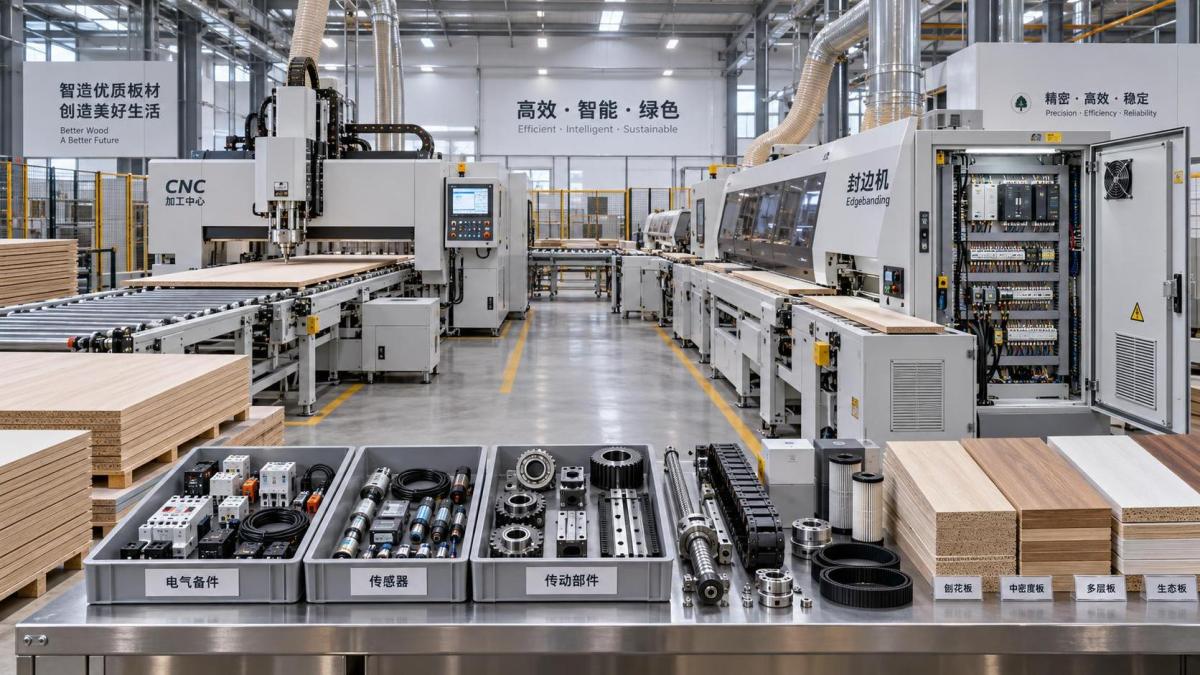
Service reports matter because they turn maintenance from an informal activity into a traceable record. A useful report identifies measured conditions, completed work, parts replaced, items nearing end of service life, safety findings, recommended corrective actions, and any issue that requires a planned shutdown. A checklist filled with only “normal” or “checked” offers little support when the same fault recurs.
Spare-parts commitments need part numbers, stock locations, and lead-time logic
High-volume operations are rarely protected by a vague statement that spare parts are available. The critical issue is whether the parts that can stop the line are available in the correct region, at a known lead time, and under a workable ordering process.
A maintenance service agreement should distinguish between:
- routine consumables and wear items;
- recommended on-site critical spares;
- parts held by the supplier or distributor;
- made-to-order mechanical components;
- third-party components such as drives, PLC modules, sensors, bearings, pneumatic valves, and electrical protection devices.
These categories have different supply risks. A standard sensor may be obtainable locally if the exact specification is disclosed. A custom-machined carriage component or proprietary control board may depend entirely on the original machine supplier. Buyers should request a recommended critical-spares list before contract signature, with part numbers, quantities, storage conditions, shelf-life limits where relevant, and the consequences of not holding each item on site.
The list should not be copied blindly from a standard catalogue. It should reflect the line configuration. A factory running one shift with replacement equipment may accept a longer lead time for some components. A facility with a single high-capacity panel-processing line may decide to hold selected drives, HMI hardware, vacuum valves, contactors, belts, bearings, and machine-specific electronic modules locally. The cost of holding a spare should be compared with the cost of losing the machine, not merely with the purchase price of the part.
Stock-location language also deserves attention. “Available from warehouse” is incomplete unless the agreement indicates which warehouse, whether stock is reserved or shared, whether export documentation is included, and who bears expedited freight costs. For cross-border machinery purchases, customs clearance and carrier handovers can add more delay than the supplier’s internal dispatch time.
Remote support depends on access, data ownership, and safe boundaries
Remote diagnostics can reduce downtime substantially when the machine control system is properly configured and the local team can carry out guided checks. It is particularly useful for alarm interpretation, PLC or CNC parameter verification, servo-drive diagnostics, software settings, backup restoration, and identifying whether a site visit is necessary.
However, a remote-support clause should not assume that a video call alone solves a production fault. The agreement should define the connectivity method, authorization process, cybersecurity responsibilities, supported software versions, and who may approve remote changes to machine parameters. A factory should retain copies of PLC, HMI, CNC, servo, and inverter backups created at commissioning and after approved software changes. Recovery from a failed control component becomes harder when only the supplier holds the latest configuration file.
Access rights should also be practical. If remote support requires a temporary VPN connection, local IT approval, a dedicated industrial gateway, or a specific operating-system environment, these requirements should be addressed before installation. Otherwise, a contractual remote-response commitment may be impossible to use when the fault occurs.
Safety is another boundary. The agreement should state that remote guidance does not override lockout procedures, guarding requirements, or qualified-person restrictions. No service term should encourage operators to bypass interlocks, enter hazardous areas, or perform electrical work beyond their competence simply to avoid the delay of an on-site technician.
Warranty coverage is only meaningful when exclusions are operationally clear
Warranty periods receive attention because they are easy to compare. Coverage boundaries are more important. A 24-month warranty with broad exclusions may offer less protection than a shorter warranty supported by defined labor coverage, clear parts obligations, and practical claims handling.
Key points include whether the warranty covers parts only or both parts and labor; whether travel, accommodation, freight, import duties, and commissioning after repair are included; and whether replacement components restart, extend, or inherit the original warranty period. For a line supplied internationally, the allocation of travel and logistics costs can materially affect the real value of warranty support.
Exclusions should be reviewed against actual operating conditions. Common exclusions concern improper installation, unstable power supply, contaminated compressed air, inadequate dust extraction, unsuitable materials, unauthorized electrical modifications, accidental damage, and failure to complete prescribed maintenance. These are not inherently unreasonable. They become problematic when the machine supplier has not defined the required site conditions or when acceptance testing did not verify them.
Installation and commissioning records should therefore be treated as part of the service package. They should document electrical supply requirements, grounding, compressed-air specifications, extraction capacity, environmental limits, machine leveling, software versions, safety devices, calibration status, and operator training completed at handover. This creates a reference point if a later warranty dispute concerns site conditions.
Service scope should address production quality, not just machine motion
A machine can be technically operational while still causing substantial production loss through reduced quality. Chipping on panel edges, inconsistent drilling positions, poor edge-banding adhesion, sanding defects, dimensional drift, or repeated tool breakage can increase scrap and rework long before the machine reaches a complete stop.
Maintenance terms for high-volume lines should define whether support covers process-related fault diagnosis when the problem may involve machine settings, tooling, material variation, adhesive condition, extraction performance, or operator practice. The supplier does not need to accept responsibility for every quality issue, but the agreement should establish a diagnostic process rather than leaving the factory to determine the cause alone.
This is especially relevant where machine performance depends on interfaces outside the machine itself. An edge bander depends on panel quality, edge-band material, adhesive selection, ambient conditions, extraction, and setup. A CNC router’s output is affected by tooling, workholding, board flatness, vacuum integrity, program strategy, and cutter condition. A service agreement that covers only component failure may not adequately support stable output from an integrated line.
Escalation and accountability prevent unresolved recurring faults
Many service agreements work adequately for isolated failures but provide no mechanism for recurring problems. A repeated alarm, intermittent positioning fault, chronic glue application issue, or recurring drive trip can consume more productive time than a single major breakdown. The service terms should define when a case is escalated from routine support to engineering review.
Escalation triggers can be based on repeated occurrence of the same fault, inability to restore stable operation after a specified number of interventions, safety-related malfunction, or downtime above an agreed threshold. The resulting review should identify the suspected root cause, actions already taken, required site checks, parts or design changes proposed, and the party responsible for each action.
Service credits or downtime penalties are sometimes requested, but they are not automatically the most useful protection. They can be difficult to enforce across borders and do not restore lost production. In many cases, stronger value comes from defined escalation contacts, access to senior technical support, clear approval paths for emergency parts shipments, and a requirement to provide a written corrective-action record for major failures.
Training and handover terms determine whether the service model can function
Maintenance support is weakened when the local team cannot provide fault codes, operating-hour records, photos of relevant assemblies, electrical measurements, or an accurate description of what changed before the failure. Training should therefore cover more than normal machine operation.
The handover scope should include routine inspection tasks, safe cleaning procedures, alarm reporting, basic fault isolation, tool and consumable management, backup procedures, parts identification, and the conditions that require immediate shutdown. Training materials should match the delivered configuration, including optional units, automation interfaces, and control software. Generic manuals often omit the details needed to identify a component quickly during an urgent repair.
Where production runs across shifts, the agreement should also clarify whether refresher training is available and whether it is included or separately charged. Staff turnover does not alter the machine’s maintenance requirements, but it can change the reliability of day-to-day care and fault reporting.
What should be resolved before issuing a purchase order
The strongest maintenance terms are agreed before the machine is installed, when service scope can still be compared between suppliers and commercial leverage is greatest. A practical agreement should state response milestones; support hours and escalation contacts; preventive-maintenance tasks and intervals; division of operator and supplier responsibilities; parts lists and lead-time commitments; remote-access requirements; warranty inclusions and exclusions; travel and freight allocation; documentation ownership; and the process for recurring faults.
It should also align with the acceptance criteria used at commissioning. If the machine is accepted only on the basis that it powers on and runs sample parts, later disagreements are more likely. Acceptance should reflect the operating functions that are material to the line: repeatability where applicable, safety operation, integration interfaces, dust extraction connection, tooling setup, control backups, and production-relevant output conditions.
A reliable woodworking machine maintenance service arrangement does not eliminate mechanical wear, material variation, operator error, or unexpected component failure. Its value is that it makes responsibility visible before a disruption occurs. For high-volume lines, that clarity is often more valuable than a broad promise of after-sales support, because the real commercial exposure is measured in lost production time, unstable quality, and the delay required to return the line to controlled operation.
Send Your Inquiry
We welcome your cooperation and we will develop with you.