


News & Exhibitions
Latest Factory Updates, Industry Trends & Global Exhibition Information
Is it risky to buy a 1325 CNC nesting machine without verified export packaging standards?
Time:Sep 13, 2026
Author:Zhongding Buying Guide Editors
Number of views:
Yes — it is meaningfully risky to buy a 1325 CNC nesting machine without verified export packaging standards. Not because packaging is an afterthought, but because it is the first and most consequential layer of risk mitigation in international machinery procurement. Transit damage is only the most visible failure mode; hidden consequences — delayed customs release, unrecorded moisture ingress, undocumented shock events, or misaligned crating that compromises structural integrity during handling — often surface only after installation, when diagnostics point to “unexplained mechanical drift” or “recurring spindle alignment issues” rather than shipping trauma.
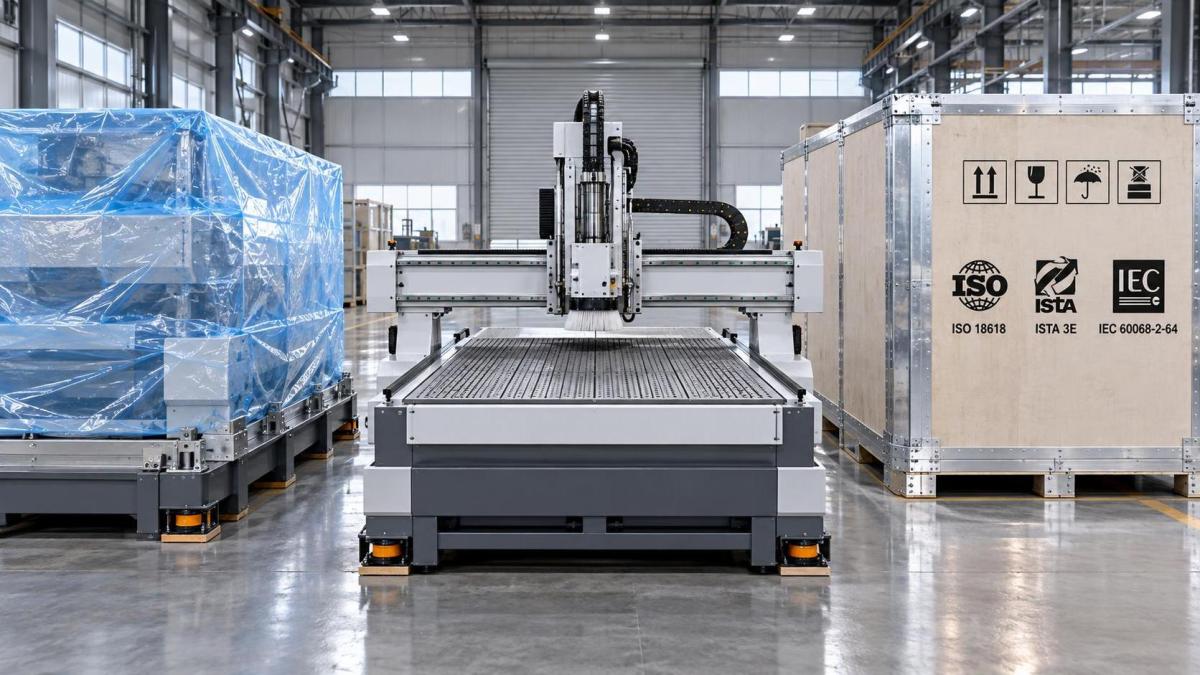
A 1325 CNC nesting machine is not a commodity item. Its working envelope (1300 × 2500 mm), integrated vacuum table, multi-axis servo synchronization, and precision linear guide systems demand dimensional stability within microns across its entire frame. That stability begins not at the factory floor, but in how the machine is isolated from vibration, compression, humidity, and lateral shear forces during sea freight — a journey routinely lasting 30–45 days under variable temperature and humidity regimes. Without packaging verified against internationally recognized benchmarks — specifically ISO 18618:2016 (packaging for heavy machinery), ISTA 3E (simulated containerized shipment), and IEC 60068-2-64 (random vibration testing) — there is no objective basis to confirm whether the machine will arrive functionally equivalent to its pre-shipment state.
The misconception lies in equating “wooden crate” with “export-ready.” A standard pine crate lined with foam does not meet export packaging requirements for CNC woodworking machinery. Verified standards require layered engineering: primary isolation via custom-cut polyurethane shock mounts anchored to load-bearing chassis points; secondary containment using climate-stabilized VCI (vapor corrosion inhibitor) film wrapped under controlled dew point conditions; tertiary protection through hermetically sealed, desiccant-equipped aluminum-lined crates rated for IP65 environmental ingress resistance; and full documentation — including shock-log data from onboard sensors, relative humidity timestamps, and third-party witnessed crating reports. These are not luxury upgrades. They are response protocols calibrated to known failure modes observed across thousands of cross-border shipments of nested-panel machinery over two decades.
Customs clearance risk is equally concrete. In major import corridors — EU (under EU Regulation 2019/1020), U.S. CBP’s ISF-10 filing requirements, and ASEAN’s ASEAN Single Window — packaging documentation is increasingly treated as part of the conformity assessment. A missing or non-verifiable ISTA 3E test report triggers physical inspection at port, adding 5–12 business days to clearance. More critically, if moisture damage is discovered during inspection and no VCI certification or humidity log is provided, customs authorities may classify the shipment as “non-compliant with Annex II of the Machinery Directive” — halting release until re-certification is completed locally, at buyer expense.
Operational risk compounds post-delivery. Machines arriving without verified packaging often exhibit subtle but persistent issues: inconsistent vacuum hold-down due to warped T-slot aluminum table frames; premature linear rail wear from undetected micro-impact deformation; or encoder signal noise traced to compromised cable routing paths compressed during transit. These do not appear in commissioning checklists. They emerge only after 200–300 operating hours, when thermal cycling exposes latent stress points. Diagnosing them requires disassembly — and often leads to disputes over warranty coverage, since most manufacturers exclude “transit-induced structural compromise” unless packaging compliance is demonstrable.
Procurement teams frequently underestimate the verification burden. “Verified” means more than a supplier’s self-declaration. It requires traceable evidence: test reports issued by accredited laboratories (e.g., SGS, TÜV Rheinland, or Bureau Veritas), with serial-number-matched sensor logs tied to the specific machine unit, not generic batch certificates. It also requires alignment between the documented crating configuration and the actual machine’s weight distribution — a mismatch that invalidates all test assumptions. For example, adding an optional auto-tool-changer after crating validation voids the original ISTA 3E certification, unless retesting is performed with the updated mass and center-of-gravity profile.
There is no universal “safe” alternative when verified packaging is absent. Air freight does not eliminate risk — it increases vibration exposure per hour and introduces rapid pressure differentials that exacerbate condensation inside improperly sealed enclosures. Local crating at destination is rarely viable: specialized CNC machinery crating requires certified riggers, calibrated torque tools, and environmental controls unavailable in most port-side warehouses. And insurance rarely covers consequential losses — such as production line downtime, missed customer deadlines, or recalibration labor — only direct physical damage assessed at time of unloading.
The operational threshold for acceptable risk is not technical, but procedural. If your procurement workflow does not include mandatory review of:
- The packaging standard cited (not just “export standard,” but exact ISO/ISTA/IEC designation),
- The test report’s issue date (must be ≤ 90 days prior to shipment),
- Sensor placement diagrams matching the machine’s mounting points,
- And humidity/shock data logs covering ≥ 95% of transit duration,
then the machine has not passed its first functional gate — long before power-on.
 This is not about assigning blame to manufacturers. It is about recognizing that packaging for a 1325 CNC nesting machine is not ancillary logistics — it is part of the machine’s specification. Just as you would not accept a spindle rated for 12,000 rpm without ISO 1940-1 dynamic balance certification, you should not accept a machine cleared for ocean freight without verifiable, unit-specific packaging validation. The cost of verification — typically 1.8–2.3% of machine value — is not an overhead. It is the first line of functional assurance. Without it, every subsequent performance metric — cutting accuracy, repeatability, tool life — carries an unquantified, untraceable variance introduced before the first panel is loaded.
Send Your Inquiry
We welcome your cooperation and we will develop with you.